
Introduction
Picture this: a school administrator confidently orders a "podium" for the new auditorium, only to receive a 12-inch raised platform instead of the speaker's stand they envisioned. The microphone sits on the floor, the notes have nowhere to rest, and the presentation is minutes away. This scenario plays out in conference centers, classrooms, and government facilities more often than you'd think—and it highlights why understanding the difference between a lectern and a podium matters beyond semantics.
For event coordinators, facility managers, and procurement teams, using these terms interchangeably creates real operational problems. When coordinating with AV technicians, venue staff, or furniture suppliers, the wrong terminology can delay orders, inflate costs, and disrupt presentations.
According to Merriam-Webster, Americans have used "podium" to mean "lectern" since the mid-20th century, a usage now officially recognized by major dictionaries. That linguistic flexibility doesn't help much when you're filling out a purchase order. This guide breaks down exactly what each term means, where the confusion comes from, and how to order the right piece of furniture the first time.
Key Takeaways
- Lecterns are note-holding stands with a slanted top — the freestanding furniture most people call a "podium"
- A podium is a raised platform that elevates the speaker above the audience
- In American English, "podium" commonly refers to both, though they're technically different
- If you need a note-holding stand for presentations, you need a lectern
- The right choice depends on visibility needs, technology requirements, and ADA compliance
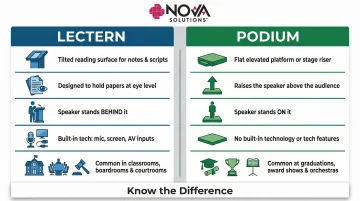
Lectern vs Podium: At-a-Glance Comparison
| Lectern | Podium | |
|---|---|---|
| Primary Function | Holds notes, manuscripts, or a laptop — the speaker stands behind it to reference materials while presenting | A raised platform the speaker stands on to be elevated above the audience — provides height, not a work surface |
| Physical Form | Slanted reading surface with optional shelf, microphone mount, or cable management; available as floor-standing or compact tabletop models | Solid, flat elevated platform — essentially a portable stage section. May support a lectern on top, but the podium itself is just the raised base |
Common Settings
Lectern: Classrooms, conference rooms, churches, courtrooms, government hearings, and corporate presentations where speakers need organized notes and technology access.
Podium: Award ceremonies, graduation stages, orchestra conducting, and large auditoriums where speaker elevation improves sightlines and authority.
Terminology in American English
Lectern: The technically correct term for the note-holding stand, though rarely used in everyday conversation outside academic or professional settings.
Podium: Widely used in the US to refer to both the platform and the speaker's stand, making it the dominant colloquial term—Merriam-Webster officially recognizes this overlap.
Technology Integration
Lectern: Typically built with integrated technology in mind — AV inputs, microphone mounts, monitor lifts, and wire management are standard features. ADA-compliant height-adjustable models are also available for accessible installations.
Podium: Rarely includes built-in technology. When tech is needed, a lectern is placed on top of the podium to provide the necessary connectivity and work surface.
What Is a Lectern?
A lectern is a stand—typically with a slanted or angled top surface—designed to hold a speaker's notes, books, or digital device at a comfortable reading height. The word traces back to the Latin lectrum, rooted in legere ("to read"), reflecting its historical use in churches and universities for reading scripture or delivering prepared speeches.
A lectern keeps speakers organized and hands-free, supports natural eye contact with the audience, and gives presentations a clear focal anchor. Its role shifts by setting:
- Classrooms: helps instructors manage lesson materials without juggling papers
- Boardrooms: projects authority and structure
- Government chambers: maintains formality and procedural order
Today's lecterns go well beyond a simple reading surface. Current models commonly include built-in sound systems, AV connectivity, monitor lifts that conceal screens when not in use, integrated wire management, and ADA-compliant height-adjustment mechanisms. NOVA Solutions' technology-integrated lecterns are built for educational institutions, government facilities, and corporate environments where these features directly affect presentation quality and accessibility compliance.
Types of Lecterns
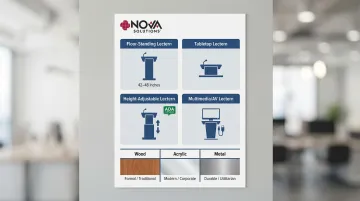
The main lectern types buyers encounter include:
Floor-standing lecterns: Full-height models (typically 42–48 inches) used in lecture halls and conference rooms, with a substantial base for stability.
Tabletop lecterns: Compact units placed on a desk or table, suited for smaller classrooms, breakout sessions, or meetings where portability matters.
Height-adjustable lecterns: Electric or pneumatic mechanisms let speakers of different heights—including wheelchair users—present comfortably. Most meet ADA compliance standards.
Multimedia/AV lecterns: Designed for slide, audio, and video presentations, with cable pass-throughs, equipment shelves, and optional monitor lifts or equipment racks.
Material choice signals both aesthetic and durability. Common options include:
| Material | Look & Feel | Typical Settings |
|---|---|---|
| Wood (oak, cherry, walnut) | Traditional, formal | Churches, universities, courtrooms |
| Acrylic or glass | Modern, open | Corporate offices, contemporary conference rooms |
| Metal | Durable, utilitarian | Training centers, multi-purpose venues |
What Is a Podium?
A podium is a raised platform (a small stage or elevated surface) that a speaker, conductor, or award recipient stands on. The word derives from the Latin podium, rooted in the Greek pódion ("small foot" or "base"). A helpful memory aid: a podiatrist treats feet, and you put your feet on a podium.
The practical distinction is simple: a podium does not hold notes or materials. It simply elevates the speaker. In large auditoriums or arenas, this improves sightlines for audiences seated far from the stage and helps the speaker project authority and visibility.
When both elevation and a note-holding surface are needed, a lectern is placed on top of the podium. They're complementary, not substitutes for each other.
According to the AP Stylebook, "A speaker stands behind a lectern, on a podium or rostrum." This distinction remains the standard in professional writing and procurement specifications, even though everyday speech treats them as synonyms.
What About a Pulpit?
A pulpit is a third related term: a raised and often enclosed platform used specifically in religious settings, particularly churches, from which sermons are delivered. The key difference is enclosure: a pulpit surrounds the speaker on multiple sides, while a lectern is an open stand.
Britannica defines a pulpit as "an elevated and enclosed platform from which the sermon is delivered during a service." The three terms are often used interchangeably in practice, but the traditional distinctions matter when specifying furniture:
- Podium: a raised platform the speaker stands on
- Lectern: an open stand the speaker stands behind, used to hold notes or materials
- Pulpit: an enclosed elevated platform, typically fixed in a worship space
Lectern vs Podium: Which One Do You Need?
Most buyers—event coordinators, school administrators, facility managers, or office procurement teams—are looking for a lectern, not a podium. If the goal is to give a speaker a stable surface for notes, a laptop, or a microphone, a lectern is the right product. A podium is only needed when the speaker must be physically elevated above the audience.
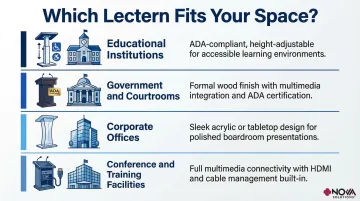
Situational Guidance by Environment
- Educational institutions: A floor-standing or height-adjustable ADA-compliant lectern suits most classroom and auditorium needs. NOVA Solutions' Sit/Stand AV Lectern with Downview™ — deployed at the University of Rochester — combines height adjustability, integrated visual display technology, and ADA compliance in one unit.
- Government agencies and courtrooms: A formal wood or multimedia lectern with integrated AV supports structured presentations. Under the 2010 ADA Standards for Accessible Design, lecterns used as work surfaces must have a top height between 28–34 inches with 30" × 48" clear floor space. Verify compliance before procurement.
- Corporate offices and conference rooms: A sleek tabletop or acrylic lectern works well where visual openness matters, providing structure without creating a barrier between speaker and audience.
- Conference and training facilities: A multimedia lectern with built-in cable management, power outlets, and HDMI inputs reduces setup time and eliminates cable clutter in high-volume, tech-driven environments.
The "Both Together" Scenario
In large-venue settings (graduation ceremonies, political addresses, major conferences), a speaker may stand on a podium with a lectern placed on top. These are two separate pieces of furniture serving complementary purposes — not interchangeable alternatives. The podium handles visibility; the lectern handles everything else.
For most institutional buyers, the right lectern comes down to three factors: ADA compliance, AV integration, and wire management. Explore NOVA Solutions' ADA-compliant lecterns built for education, government, and corporate environments — with customizable finishes and configurations to fit your facility.
Conclusion
The core distinction is straightforward: a lectern is what you stand behind (note-holding stand); a podium is what you stand on (raised platform). In everyday American usage, "podium" often substitutes for "lectern," and major dictionaries like Merriam-Webster now officially recognize this overlap. But knowing the correct terminology prevents costly miscommunication when ordering furniture, coordinating with AV teams, or specifying equipment for a venue.
That precision matters most at the point of purchase. Once you know what you actually need, matching it to the right product features—ADA compliance, technology integration, and material durability—ensures the speaker environment performs as intended, whether you're outfitting a lecture hall, a government chamber, or a corporate training room.
Frequently Asked Questions
What is the difference between a podium and a lectern?
A lectern is the stand a speaker stands behind to hold notes or a laptop, while a podium is the raised platform a speaker stands on for elevation. In American English, "podium" is commonly used to refer to both, though they're technically distinct objects.
What's the difference between a podium and a pulpit?
A pulpit is an enclosed raised structure used in religious settings for delivering sermons, while a podium is an open elevated platform used in secular settings. A pulpit surrounds the speaker on multiple sides; a podium is a flat raised surface with no enclosure.
Can a lectern be called a podium?
Yes, in common American usage, "podium" is frequently used to mean "lectern." Merriam-Webster officially recognizes podium as a synonym for lectern due to widespread usage since the mid-20th century.
What is a podium called in a church?
In a church, the enclosed raised speaking structure is called a pulpit, while the open reading stand for scripture or liturgical texts is called a lectern. The pulpit is used for sermons; the lectern is used for readings.
Should you stand directly behind a podium or lectern when speaking?
A speaker stands behind a lectern (using it as a surface for notes or materials) and stands on a podium (using it as an elevated stage). Standing too far from or incorrectly positioned at a lectern can reduce microphone effectiveness and weaken audience engagement.
What do Americans call a lectern?
Americans most commonly call a lectern a "podium," and this usage is so widespread that dictionaries now accept it. In formal or professional writing, "lectern" is the precise term — "podium" is fine in everyday speech.