Introduction
Over 70 million U.S. adults—28.7% of the population—live with some type of disability, yet 93% of disabled delegates continue to face barriers at events and facilities. That gap doesn't close with a checklist.
A truly ADA compliant meeting room ensures every attendee—regardless of mobility limitation, hearing or vision impairment, or other disability—can approach, enter, navigate, and fully participate.
This guide covers the essential requirements for accessible meeting spaces: dimensions and clearances, door and route standards, furniture specs, assistive listening systems, and practical planning steps for education, government, and corporate facilities.
What Does ADA Compliance Mean for Meeting Rooms
An ADA accessible room conforms to the 2010 ADA Standards for Accessible Design, the definitive legal benchmark published by the Department of Justice. These standards establish minimum scoping and technical requirements covering dimensions, routes, fixtures, and equipment that allow people with disabilities to approach, enter, and use the space independently.
Two Compliance Frameworks Apply to Meeting Spaces
Title II applies to state and local government facilities (codified at 28 CFR 35.151), while Title III covers public accommodations and commercial facilities (28 CFR 36.403). Both require accessible meeting spaces in new construction and alterations. For existing buildings, both frameworks mandate barrier removal when "readily achievable" — a standard that carries specific legal meaning covered below.
The "Readily Achievable" Standard for Existing Facilities
Under 42 U.S.C. § 12181(9), barrier removal must be "easily accomplishable and able to be carried out without much difficulty or expense." The DOJ evaluates this case-by-case based on:
- Nature and cost of the action required
- Overall financial resources of the facility
- Number of employees
- Impact on facility operations
One planning detail catches many facilities off guard: altering a meeting room triggers path-of-travel requirements under 28 CFR § 36.403. Corridors, restrooms, drinking fountains, and telephones serving that room must all be upgraded — up to 20% of the total alteration cost. Factor this into renovation budgets before finalizing scope.
Physical Space Requirements for ADA Compliant Meeting Rooms
Turning Space: 60-Inch Diameter Minimum
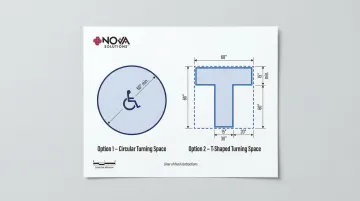
Wheelchair users require a circular turning space of 60 inches (1,525 mm) minimum diameter—or a T-shaped space within a 60-inch square—clear of fixed obstructions. This space allows individuals to reverse direction and navigate between tables, presentation areas, and exits. Without adequate turning space, wheelchair users become trapped or must awkwardly back out of the room.
Clear Floor Space at Elements: 30" x 48" Minimum
At each workstation, seating position, or operable element (light switches, thermostats, AV controls), provide a minimum clear floor space of 30 inches by 48 inches for wheelchair approach. These spaces may overlap accessible routes but not each other — you cannot count the same floor area twice.
Accessible Route Through the Room: 36-Inch Clear Width
Walking surfaces within the meeting room must maintain a minimum 36-inch clear width with no cross-slopes steeper than 1:48. Furniture placement commonly reduces effective aisle width below this threshold — a frequent violation during DOJ audits. Measure aisle widths with furniture in place, not on empty floor plans.
Flooring: Stable, Firm, and Slip-Resistant
Floor surfaces must meet three requirements under Section 302.1:
- Stable, firm, and slip-resistant across the entire walking surface
- Carpet pile height must not exceed ½ inch and must be securely attached with firm backing
- Loose mats and high-pile carpet create tripping hazards and increase roll resistance for wheelchair users and those using walkers or canes
Reach Ranges and Operable Parts: 15–48 Inches Above Floor
Light switches, electrical outlets, thermostats, and AV controls must be placed between 15 and 48 inches above the floor (forward reach). They must operate with no more than 5 lbs of force, without requiring tight grasping or wrist twisting.
This applies to any operable part on an accessible route or within an accessible space. Test controls with a closed fist to verify compliance.
Accessible Routes, Doors, and Entrances
Accessible Route to the Meeting Room
From accessible parking and building entrances, there must be a continuous, unobstructed path to each meeting room. Corridors serving meeting rooms must maintain 36-inch minimum clear width. Any changes in level greater than ½ inch must be ramped at a maximum 1:12 slope—meaning every inch of rise requires 12 inches of horizontal run.
Door Clear Width and Maneuvering Clearance
Each door serving a meeting room must provide 32 inches of clear width measured with the door open 90°. The approach side must also meet maneuvering clearance requirements. Key dimensions for a front pull approach:
- 60 inches perpendicular to the doorway
- 18 inches beyond the latch side — giving wheelchair users room to pull the door open without blocking their own path
Door Hardware and Force: Lever-Style, Maximum 5 Pounds
Door handles must be lever-style or similar hardware operable with a closed fist, located between 34 and 48 inches above the floor. The maximum force to open an interior hinged door is 5 pounds. This is one of the most commonly cited ADA violations in existing facilities—round knobs and heavy doors appear frequently in DOJ enforcement actions and consent decrees.
Thresholds and Level Changes at Doorways
Thresholds must not exceed ½ inch in height. Any level change between ¼ inch and ½ inch must be beveled at no steeper than 1:2. In retrofitted spaces, abrupt thresholds frequently fail inspection — they block wheelchair users and create fall risks for people with mobility impairments. Replacing non-compliant thresholds is typically a low-cost fix with immediate compliance impact.
Meeting Room Furniture and Work Surfaces
ADA Height Requirements: 28-34 Inches
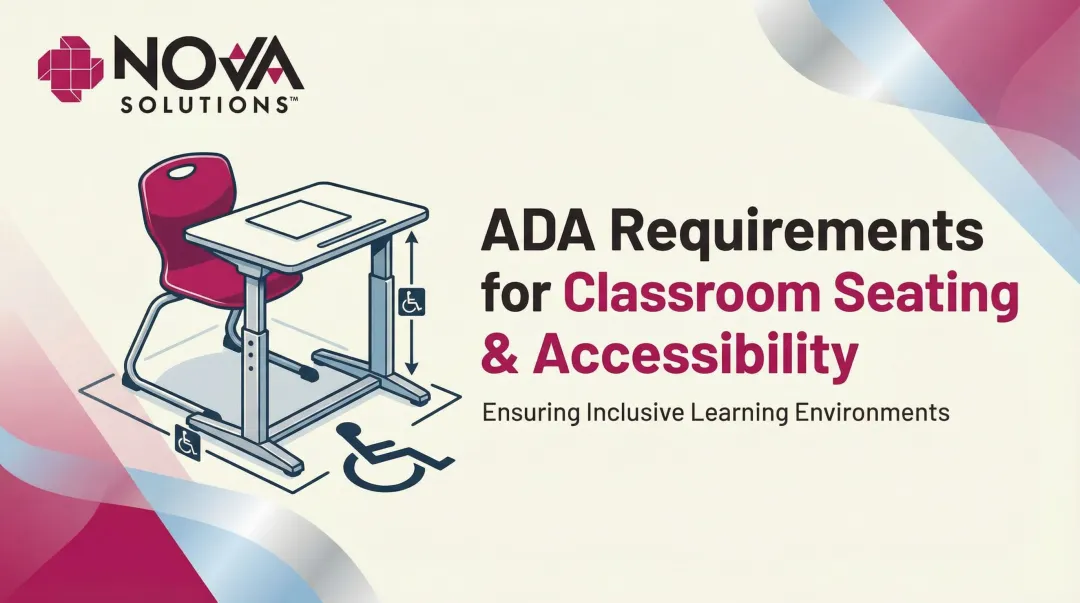
Dining and work surfaces accessible to non-employees must have a top height between 28 and 34 inches above the finished floor. This range accommodates both standing and seated users, including wheelchair users who need to roll under the table surface. Standard conference tables at 36 inches or higher exclude wheelchair users entirely.
Knee and Toe Clearance: 27" High, 25" Deep, 30" Wide
Accessible work surface positions must provide:
- Knee clearance: At least 27 inches high, 25 inches deep, and 30 inches wide
- Toe clearance: 9 inches high minimum and 17 inches deep minimum
Fixed base tables with center pedestals or aprons frequently fail this requirement. Evaluate table bases before purchase to confirm they don't obstruct the clearance envelope.
Minimum Number of Accessible Positions: 5% Rule
Per ADA Section 226.1, at least 5% of seating spaces and standing spaces at work surfaces provided for use by the public must comply with accessibility requirements. For example:
- 20-seat conference room: minimum 1 accessible position
- 40-seat training room: minimum 2 accessible positions
- 100-seat auditorium-style room: minimum 5 accessible positions
Dispersion of Accessible Positions Throughout the Space
Accessible seating positions must be distributed throughout the space—not clustered in one area or relegated to edges. ADA-compliant design means integrated, equivalent access, not separate or inferior placement. Avoid creating a "handicap section" at the back or side of the room.
Accessible Technology-Integrated Furniture
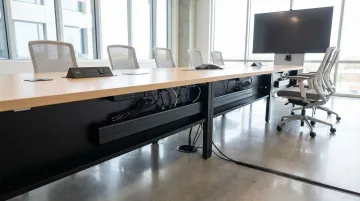
Meeting rooms that meet dispersion requirements also need furniture that keeps operable parts — power outlets, data ports, controls — within the 15–48 inch reach range. Tables with integrated cable management, adjustable-height surfaces, and built-in AV connectivity help satisfy this requirement while keeping floor clearances unobstructed.
NOVA Solutions manufactures conference and training room tables for educational, government, and corporate facilities. Their iMod™ wire management system routes cables through rear compartments, keeping ports within reach range without adding clutter at floor level. Tables ship fully assembled under GSA Contract GS-28F-005GA, which matters for government buyers who need to confirm accessibility dimensions haven't been altered during field assembly.
Communication Features and Assistive Technology
Assistive Listening Systems: Required When Audio Amplification is Used
In any meeting or assembly area where audible communication is integral to use of the space, an assistive listening system (ALS) must be provided if audio amplification is used. The number of required receivers depends on seating capacity:
| Room Capacity | Minimum Receivers Required | Hearing-Aid Compatible |
|---|---|---|
| 50 or fewer | 2 | 2 |
| 51–200 | 2, plus 1 per 25 seats over 50 | 2 minimum |
| 201–500 | 2, plus 1 per 25 seats over 50 | 1 per 4 receivers |
Example: A 100-person conference room requires 4 ALS receivers minimum, with at least 2 hearing-aid compatible.
Accessible Signage: Raised Characters and Braille
Room identification signs must include raised characters and Braille, installed between 48 and 60 inches above the finished floor on the latch side of the door. Directional and informational signs within the room must use high-contrast visual characters at appropriate heights and sizes for readability.
Fire Alarm and Emergency Systems: Audible and Visible
Signage addresses one layer of accessibility; emergency communication systems add another. Meeting rooms must meet these requirements:
- Provide both audible and visible fire alarm appliances
- Add visible alarms when upgrading or replacing existing fire alarm systems — a common retrofit trigger
- Equip two-way communication systems at restricted entrances with visual and tactile indicators for individuals who are deaf or hard of hearing
Planning Your ADA Compliant Meeting Room
Conduct a Systematic Audit Using the DOJ Priority Framework
The DOJ Title III Technical Assistance Manual outlines a four-priority approach for barrier removal:
- Priority 1 (Approach and Entrance): Enable physical entry to the facility — ramps, accessible parking, and widened entrances are the starting point
- Priority 2 (Access to Goods and Services): Provide clear routes to meeting rooms and primary service areas, including proper aisle widths and turning space
- Priority 3 (Restrooms): Ensure restroom facilities serving meeting spaces meet ADA dimensional and hardware requirements
- Priority 4 (Other Measures): Address remaining barriers such as inaccessible drinking fountains or fixed telephones
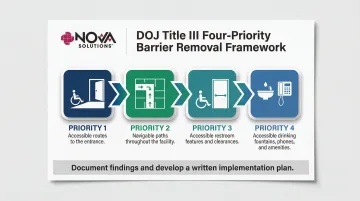
Document findings and develop a written implementation plan. The DOJ recognizes such plans as evidence of good faith compliance efforts — a meaningful protection during any enforcement review.
Source ADA-Compliant Furniture from Verified Manufacturers
Once your audit identifies gaps, sourcing from manufacturers that provide documented compliance certifications becomes the next concrete step. Look for detailed product specifications confirming clearance dimensions, surface heights, and hardware force ratings. NOVA Solutions, for example, manufactures ADA-certified conference tables, training room desks, and presentation furniture under GSA Contract GS-28F-005GA — and ships units fully assembled, so accessible dimensions aren't compromised by field assembly errors.
Establish Ongoing Maintenance and Re-Evaluation
Accessible features must be maintained in working order — doors must continue to open with 5 lbs of force or less, accessible routes must remain clear of obstructions, and assistive listening systems must function properly.
Best practices:
- Conduct annual accessibility reviews, especially after renovations or furniture changes
- Train staff on disability etiquette and accommodation request procedures
- Designate an accessibility coordinator responsible for monitoring compliance
- Establish a process for receiving and responding to accessibility concerns
Frequently Asked Questions
What are the requirements for an ADA room?
Per the 2010 ADA Standards for Accessible Design, an ADA room must meet these core requirements:
- Accessible routes with 36-inch minimum aisle widths and 60-inch wheelchair turning space
- Doors with 32-inch clear width and lever hardware operable with no more than 5 lbs force
- Work surfaces at 28–34 inches high with proper knee and toe clearance
- Accessible signage with raised characters and Braille
What is an ADA accessible room?
An ADA accessible room is any space that conforms to ADA Standards so people with disabilities can approach, enter, and use it independently—without relying on assistance. The specific requirements covering dimensions, hardware, and communication features are detailed in the question above.
Is ADA compliance a legal requirement?
Yes. The Americans with Disabilities Act of 1990 mandates compliance for state/local government facilities (Title II) and public accommodations or commercial facilities (Title III). The Department of Justice enforces these standards, and violations can result in settlements of $50,000 to $125,000 or more.
Does a private office need to be ADA compliant?
Employee work areas must be designed so individuals with disabilities can approach, enter, and exit per ADA Section 203.9, but full internal compliance is not required for spaces used only by employees for work. However, employers have separate obligations under Title I of the ADA to provide reasonable workplace accommodations, which may include modifying private offices for employees with disabilities.
What is the most common ADA violation?
Common ADA violations in meeting rooms include inaccessible door hardware requiring tight grasping or excessive force to open, insufficient aisle widths blocked by furniture, non-compliant thresholds exceeding ½ inch, and operable controls (light switches, thermostats, AV panels) placed outside the required 15-48 inch reach range or requiring more than 5 lbs of operating force.
How to make a conference more accessible?
Start with the space itself, then work through the details:
- Choose a venue with compliant routes, entrances, and restrooms
- Arrange seating to preserve 36-inch aisles and 60-inch turning spaces
- Use conference tables at 28–34 inches high with knee clearance
- Provide assistive listening systems when audio amplification is used
- Include an accommodation request process in all event communications