Introduction
Classrooms that don't meet ADA standards create real barriers for students and staff with disabilities—and expose institutions to legal risk. According to a 2020 Government Accountability Office (GAO) report, 66% of U.S. public school districts have schools with physical barriers that may limit access, with classrooms identified as a common problem area. Compliance means creating learning environments where every student can participate fully—not just checking a legal box.
The Americans with Disabilities Act (ADA) sets specific, measurable requirements for seating dimensions, table heights, aisle clearances, and accessible routes in educational settings. Requirements vary by classroom type—standard learning spaces, lecture halls, and computer labs each follow distinct rules. This guide is written for facility managers, procurement officers, and administrators making furniture and layout decisions.
This guide covers key dimensional standards, room-type-specific rules, accessible route requirements, and how to choose furniture that meets federal ADA mandates.
Key Takeaways
- ADA requires at least 5% of classroom tables to be wheelchair-accessible, with heights between 28–34 inches and minimum 24 inches of knee clearance
- Each wheelchair space requires a minimum 30" × 48" clear floor area — at least 19" must extend under fixed tables
- Lecture halls require wheelchair spaces distributed throughout seating areas, companion seats, and ramp access to any platform or stage
- Accessible routes within classrooms must maintain a minimum 36-inch aisle width for wheelchair passage
- Public institutions procuring through GSA contracts must specify ADA compliance requirements in their solicitations
Why ADA Compliance Matters in Educational Settings
Legal Obligations Under Title II
Title II of the ADA applies directly to all state and local government services, which includes public schools, community colleges, and state universities. It's a federal civil rights mandate covering students, parents, visitors, and employees across all programs—academics, extracurriculars, and athletics alike.
The Department of Justice (DOJ) enforces Title II. The Department of Education's Office for Civil Rights (OCR) enforces both Title II and Section 504 of the Rehabilitation Act for federally funded programs. Both agencies pursue corrective action through settlement agreements and compliance reviews when institutions fall short.
The Reality of Non-Compliance
Despite decades of ADA enforcement, physical barriers remain widespread in educational facilities:
- 66% of school districts have schools with physical barriers that limit access, according to the 2020 GAO report
- Only 31% of New York City public schools were expected to be fully accessible as of 2023, with 40% lacking access to a single classroom for individuals with physical disabilities
- A 2021 New York State Comptroller audit of District 75 special education schools found severe accessibility issues, including difficult-to-open doors and hallways lined with wheelchairs
Non-compliance creates legal exposure, limits educational access, and contradicts the core mission of inclusive education.
Consequences and Program Access Obligations
Schools that cannot make buildings physically accessible must still provide program access through relocated services, alternative delivery methods, or direct assistance.
That said, accommodation-after-the-fact puts the burden on students and staff rather than solving the underlying problem. Selecting ADA-compliant furniture from the outset addresses access at the source, eliminates the need for workarounds, and reduces the risk of costly retrofits or federal complaints down the line.
Core ADA Seating and Table Requirements for Classrooms
Wheelchair-Accessible Table Specifications
The 2010 ADA Standards for Accessible Design establish clear, enforceable requirements for classroom work surfaces:
Scoping Rule: At least 5% of classroom tables must be wheelchair-accessible. This is a proportional minimum, not a blanket requirement for every desk. These accessible tables must be dispersed throughout the space, not isolated to a single corner or area.
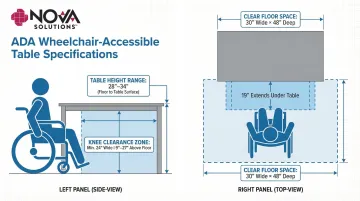
Table Height: Accessible tables must be between 28 and 34 inches high, measured from the floor to the top of the work surface. While adjustable-height tables aren't required, they're highly recommended because they serve both wheelchair users and seated or standing users more effectively.
Knee Clearance: A minimum of 24 inches of knee clearance beneath the table surface is required to allow wheelchair users to pull up to the table. This clearance must extend from 9 to 27 inches above the floor.
Clear Floor Space: Each wheelchair seating location requires a minimum clear floor space of 30 inches wide by 48 inches deep, with at least 19 inches of that depth extending under the table itself. This ensures wheelchair users can position themselves properly at the work surface.
Fixed Seating Considerations
When classrooms use tablet-arm chairs instead of traditional tables, different specifications apply. Specific requirements for tablet-arm chairs — such as the 10% left-hand accessible rule or a 130-square-inch tablet surface — are industry standards, not federal ADA mandates. Federal requirements focus on ensuring wheelchair-accessible work surfaces meet the dimensional standards outlined above.
ADA compliance is only one layer of classroom planning. Fire and life-safety codes also govern capacity: many jurisdictions limit single-entrance classrooms to 49 occupants, which directly shapes how seating is laid out and how accessible routes are maintained.
Key space-planning factors that intersect with ADA seating layout:
- Accessible tables dispersed throughout the room (not grouped in one area)
- Clear 36-inch minimum aisle width for wheelchair passage
- Emergency egress paths kept clear of furniture obstructions
- Accessible seating locations positioned near entrances when possible
ADA Requirements by Classroom Type
General Classrooms
Standard classrooms must incorporate the core table and seating requirements: at least 5% of tables must be wheelchair-accessible, positioned at heights between 28–34 inches, with 30" × 48" clear floor space at each accessible location.
These accessible tables must be distributed throughout the room — not grouped in one corner — so students with disabilities have seating choices comparable to their peers.
When planning general classroom layouts:
- Calculate 5% of total seating capacity to determine the minimum number of accessible tables required
- Position accessible tables near multiple areas of the room (front, middle, sides)
- Ensure accessible routes with 36-inch minimum width connect all seating areas
- Verify that at least 19 inches of the 48-inch clear floor space extends under each table
Lecture Halls and Auditorium-Style Spaces
Lecture halls with fixed seating present unique accessibility challenges that require careful planning:
Wheelchair Space Requirements:
- Wheelchair spaces must be dispersed horizontally across different seating sections, not grouped in one area
- Spaces must be dispersed vertically at varying distances from the stage or presentation area
- Each wheelchair space must provide lines of sight comparable to those available to other spectators
- Companion seats must be provided adjacent to wheelchair spaces and must be equivalent in size, quality, comfort, and amenities to surrounding seating
Platform and Stage Access:
Any raised platform or stage area requires ramp access per ADA requirements. The ramp must comply with the 1:12 slope rule (detailed below), ensuring instructors and presenters using wheelchairs can access elevated areas.
Seating Arrangement:
While not mandated, a semicircular arrangement of tiered seating is considered ideal for sightlines and accessibility. Movable structures cannot block wheelchair spaces, and fold-down tablet arms should be provided where possible to give wheelchair users a work surface option.
Computer Classrooms and Technology Labs
Computer labs require specialized planning to accommodate both technology infrastructure and accessibility needs:
Workspace Specifications:
Industry planning benchmarks suggest 30–35 square feet per person for computer classrooms, though this is not a federal ADA mandate. What the ADA does require is that accessible computer workstations provide:
- A clear floor space of 30" × 48" for wheelchair positioning
- Table height between 28–34 inches
- Minimum 24 inches of knee clearance beneath the work surface
- Adequate workspace to accommodate both computer equipment and note-taking materials
Practical Considerations:
Preferred workstation widths of 42–48 inches allow space for note-taking alongside the computer; the ADA doesn't mandate specific surface dimensions, but wider surfaces consistently improve usability. Adjustable-height desks handle the widest range of users and are the most defensible choice when outfitting a mixed-ability lab.
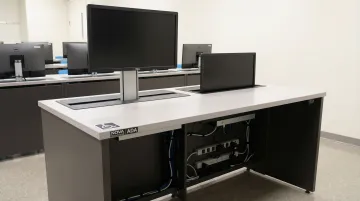
NOVA Solutions' computer training desks are built to meet these ADA dimensional standards while handling the realities of a wired classroom. The iMod™ Wire Management System routes cables without intruding on knee clearance, and the Trolley™ Monitor Lift retracts displays to free up the work surface — preserving the 30" × 48" clear floor space the ADA requires.
Accessible Routes, Aisles, and Clearances
Aisle and Pathway Requirements
Accessible routes within classrooms and between seating areas must maintain a minimum clear width of 36 inches to allow wheelchair passage.
Wheelchair space clearances vary based on positioning relative to fixed seats. These dimensions appear in Figure 45 of the ADA Standards for Accessible Design, which provides official dimensional diagrams.
| Wheelchair Space Position | Required Clear Floor Space |
|---|---|
| Beside fixed seats | 30" × 48" |
| Across the front of fixed seating | 42" × 48" |
When a wall or obstruction sits behind a wheelchair location at a fixed table, that same 36-inch clearance must be maintained between the table and the obstruction for maneuvering room.
Doors and Entry Points
Classroom doorways must meet specific accessibility standards:
- Clear opening width: At least 32 inches (for double doors, at least one leaf must meet this threshold)
- Door hardware: Must be operable with one hand, require no tight gripping or twisting, and be mounted between 34 and 48 inches from the floor
- Opening force: Interior doors should require no more than 5 pounds of force to open
- Thresholds: Cannot exceed ½ inch in height
Ramps and Platforms
The 1:12 ramp rule applies to all classroom platforms and entry thresholds: for every 1 inch of vertical rise, 12 inches of horizontal run are required. This means a platform that's 6 inches high would need a ramp at least 72 inches (6 feet) long.
Any raised area within a classroom — including instructor platforms in lecture halls — must provide ramp access meeting these slope requirements.
The 7 Principles of ADA-Compliant Classroom Design
The Seven Principles of Universal Design, developed in 1997 by the Center for Universal Design at NC State University, provide a broader framework for creating inclusive educational environments beyond the minimum ADA requirements:
- Equitable Use – Design is useful and marketable to people with diverse abilities
- Flexibility in Use – Design accommodates a wide range of preferences and abilities
- Simple and Intuitive Use – Easy to understand regardless of experience or knowledge
- Perceptible Information – Communicates necessary information effectively regardless of sensory abilities
- Tolerance for Error – Minimizes hazards and adverse consequences of accidents
- Low Physical Effort – Can be used efficiently with minimum fatigue
- Size and Space for Approach and Use – Appropriate size and space provided regardless of body size or mobility

Applying Universal Design to Furniture Decisions
Two principles are particularly actionable for classroom furniture selection:
Flexibility in Use: Adjustable-height tables are a prime example — they serve wheelchair users at the lower end of the adjustment range while also accommodating standing users or individuals of different heights. This flexibility eliminates the need to designate specific "accessible" furniture that might single out users.
Size and Space for Approach and Use: Sufficient room must be provided for maneuvering and reaching regardless of body size or mobility device. This means not just meeting the minimum 30" × 48" clear floor space, but considering how students will use the space — reaching for materials, shifting position during long classes, and moving between seated positions and other areas of the room.
Institutions that apply these principles from the start avoid expensive retrofits — and build classrooms that work better for every student, not just those with documented disabilities.
Choosing ADA-Compliant Classroom Furniture
Key Verification Factors
When purchasing classroom furniture for ADA compliance, verify these critical specifications:
- Table height adjustability: Ideally adjustable within or beyond the 28–34" range
- Knee clearance depth: Minimum 24 inches beneath the work surface
- Clear floor space compatibility: Ensure the furniture layout accommodates 30" × 48" clear floor space at accessible locations
- Dimensional specs in writing: Request detailed specifications from manufacturers documenting compliance with 2010 ADA Standards
Don't rely on generic "ADA-compliant" claims without supporting documentation. Ask manufacturers to specify exactly which ADA standards their products meet and request technical drawings showing dimensional compliance.
GSA Procurement Advantages
For institutions purchasing through government procurement channels, GSA-contracted suppliers offer pre-vetted, compliant products that simplify the acquisition process. NOVA Solutions holds a GSA contract and manufactures ADA-compliant technology furniture—including computer training desks built to meet classroom accessibility standards—which makes procurement faster to navigate for qualifying institutions.
Through the GSA Cooperative Purchasing program, eligible institutions can buy directly from GSA Multiple Award Schedule (MAS) contracts. Qualifying buyers include:
- Public school districts and charter schools
- Public or non-profit higher education institutions
- State and local government agencies
Relevant MAS categories cover furniture and furnishings, with Special Item Numbers (SINs) for classroom solutions and institutional furniture.
Important: While GSA schedules provide access to vetted vendors, the legal burden of ADA compliance remains with the purchasing entity. Public institutions must explicitly include 2010 ADA Standards requirements in their procurement solicitations and contracts.
Purchasing from a GSA schedule doesn't automatically guarantee that a specific desk configuration meets ADA requirements for your classroom layout—facility managers must verify dimensions prior to purchase.
Ongoing Compliance Management
Facility managers should conduct periodic accessibility audits using the 2010 ADA Standards for Accessible Design as a checklist. When planning major furniture refreshes or renovations, involve building accessibility coordinators or a qualified ADA consultant to ensure compliance throughout the planning and implementation process.
For institutions that need to move quickly, NOVA Solutions' computer training desks ship fully assembled—so accessibility features are preserved exactly as configured at the factory. Products incorporate integrated wire management (iMod™) and monitor lift systems (Trolley™) while maintaining required knee clearance and work surface dimensions.
Frequently Asked Questions
What are the ADA standards for furniture?
ADA furniture standards cover tables, seating areas, and circulation paths. At least 5% of tables in a classroom must be wheelchair-accessible, each providing a 30" × 48" clear floor space. Surfaces must fall within the 28–34" height range, with appropriate knee and toe clearance underneath.
What are the dimensions of ADA seating?
Wheelchair seating locations require a minimum 30" × 48" clear floor space. When positioned beside fixed seats, this space must be 30" × 48"; when positioned across the front of fixed seating, the minimum increases to 42" × 48".
How high does a table need to be for wheelchair access?
ADA-accessible tables must be between 28 and 34 inches high. A minimum of 24 inches of knee clearance beneath the surface is required to accommodate wheelchair users.
How much space is required between tables in ADA?
Accessible routes between tables must be at least 36 inches wide to allow wheelchair passage. Each wheelchair seating location requires a clear floor space of 30" × 48", with 19 inches extending under the table for proper positioning.
What is the minimum accessible aisle width?
The minimum accessible aisle width is 36 inches. Where a wall or obstruction sits directly behind a wheelchair seating location, that 36-inch clearance must be maintained between the table and the obstruction.
What is the 1:12 ramp rule?
The 1:12 ramp rule requires 12 inches of horizontal length for every 1 inch of vertical rise. This applies to classroom platform ramps, entry ramps, and any elevation changes throughout educational facilities.