
Introduction
Between 1930 and 1932, the British government convened three landmark conferences in London: the Round Table Conferences. Their purpose was to negotiate India's constitutional future. Over 70 delegates attended, representing British India, the Indian princely states, and multiple religious and social communities — all debating how much power Britain would actually transfer to India.
The conferences emerged from a crisis of legitimacy. The 1927 Simon Commission, tasked with reviewing the Government of India Act of 1919, included no Indian members, a decision that triggered massive boycotts and violent protests across India, including the death of Lala Lajpat Rai after a police lathi charge in Lahore. This failure forced the British to pivot toward negotiation rather than unilateral reform.
What followed was three sessions of fractious negotiation. Gandhi's decision to boycott the first conference, then attend the second, reshaped the political stakes. And the ideological clash between Gandhi and Dr. B.R. Ambedkar over the rights of the Depressed Classes (Dalits) became one of the most consequential conflicts of the entire reform process — one whose reverberations are still felt in Indian politics today.
Key Takeaways
- The British government held three Round Table Conferences (1930–1932) in London to redesign India's constitution after the Simon Commission's all-British composition triggered nationwide protests
- The Indian National Congress boycotted the first session; Gandhi attended the second as its sole representative but failed to reach agreement on minority representation
- Dr. B.R. Ambedkar clashed with Gandhi over separate electorates for the Depressed Classes, a dispute settled by the Poona Pact of 1932
- The Poona Pact replaced 71 separate electorate seats with 148 reserved seats within joint Hindu electorates
- None of the three sessions resolved the constitutional question, yet their deliberations directly shaped the Government of India Act 1935, expanding the franchise from roughly 7 million to approximately 35 million voters
Background: The Simon Commission and the Road to Reform
The Indian Statutory Commission — known as the Simon Commission after its chairman, Sir John Simon — was appointed on November 26, 1927, to review the Government of India Act of 1919. The 1919 Act had introduced a system of "diarchy" in provincial governments, dividing powers between elected Indian ministers and British-appointed officials, but it was widely considered inadequate and had promised a review after ten years.
The All-British Composition and Nationwide Revolt
The Commission consisted of seven British members — including future Labour Prime Minister Clement Attlee — and zero Indian representatives. This exclusion triggered protests in every major city across India. Both the Indian National Congress and the Muslim League launched coordinated "Simon Go Back" demonstrations during the Commission's visits in 1928 and 1929.
The most tragic consequence occurred on October 30, 1928, in Lahore. During a protest against the Commission, police used force to disperse crowds attempting to break barricades. Lala Lajpat Rai, a prominent Congress leader, received blows during the police lathi charge and subsequently died — an incident that sparked outrage and was debated extensively in the British House of Commons.
The Political Deadlock
The Simon Commission's failure created a constitutional impasse. Congress launched the Civil Disobedience Movement in 1930, including Gandhi's famous Salt March, while the Muslim League and other parties pressed unresolved demands around:
- Proportional representation in legislatures
- Separate electorates for religious and caste minorities
- Guaranteed safeguards for minority communities
With Indian leaders in jail and British credibility badly damaged, London moved to open direct negotiations. Labour Prime Minister Ramsay MacDonald convened the Round Table Conferences and chaired all three sessions personally. Holding them at the Royal Gallery of the House of Lords was no accident — it kept the British firmly in control of the agenda and made clear that any reform would proceed on British terms.
First Round Table Conference, 1930: Laying the Groundwork
The Opening and Delegate Composition
King George V inaugurated the First Round Table Conference on November 12, 1930, at the Royal Gallery of the House of Lords. The session ran until January 19, 1931, and included approximately 89 active delegates: 16 British representatives, 16 from Indian princely states, and 57 from British India representing diverse communities — Muslims, Sikhs, Parsis, Indian Christians, women's groups, and the Depressed Classes.
Conspicuously absent was the Indian National Congress, whose leaders were imprisoned for the Civil Disobedience Movement. Gandhi had been arrested on May 5, 1930, and Jawaharlal Nehru on April 14, 1930. This absence severely limited the conference's legitimacy and reach.
The Federal Principle: A Surprising Consensus
Despite Congress's absence, the conference achieved one significant breakthrough: unanimous acceptance of a federal structure for India. The princely states, which had historically resisted integration into British India's political framework, agreed in principle to join a federation.
All parties accepted representative government at the provincial level — a reversal of prior positions that established the constitutional blueprint eventually shaping the 1935 Government of India Act.
Nine Subcommittees and the Minorities Question
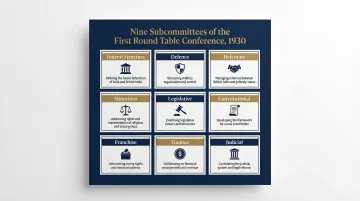
The conference established nine specialized subcommittees to address specific constitutional issues:
Key Subcommittees and Their Mandates:
- Federal Structure — Component elements of federation, legislature type, executive powers
- Provincial Constitution — Powers of provincial legislatures and executives
- Minorities — Provisions to secure cooperation of minorities and special interests
- Franchise — Principles for voting rights for men and women
- Defence — Political principles relating to military control
- North-West Frontier Province — Constitutional modifications for NWFP
- Sind — Constituting Sind as a separate province
- Burma — Conditions for separating Burma from British India
- Services — Relations between civil services and new political structures
The Minorities Subcommittee exposed the deepest fault lines. Muslims demanded maintained weightage and separate electorates to protect their political interests. Hindus argued for joint electorates. Dr. B.R. Ambedkar brought a third position that would prove the most divisive of all.
Ambedkar's Challenge: Separate Electorates for the Depressed Classes
As the representative of the Depressed Classes (Untouchables), Dr. B.R. Ambedkar submitted memoranda demanding special political representation through separate electorates. He argued that the Depressed Classes — numbering approximately 43 million people — were a distinct minority requiring political recognition separate from the Hindu majority.
Ambedkar stated clearly: "Our principal demand is for special representation through separate electorates." This was not a question of seats in legislatures; it was a fundamental challenge to the idea that upper-caste Hindus could represent Dalits in a democratic system. This demand would bring him into direct conflict with Gandhi at the second conference.
The Gandhi-Irwin Pact
The conference ended inconclusively on January 19, 1931. The absence of Congress meant no agreement carried the full weight of Indian political representation. Recognizing the gap left by Congress's absence, the British government pursued direct negotiations with Gandhi, resulting in the Gandhi-Irwin Pact signed on March 5, 1931.
Under the pact:
- Congress agreed to discontinue the Civil Disobedience Movement
- The British would release political prisoners convicted of non-violent offenses
- Restrictive ordinances would be withdrawn
- Congress would participate in the Second Round Table Conference
Congress's entry into the Second Round Table Conference would finally force Gandhi and Ambedkar into direct confrontation over the question of Dalit representation — the conflict that defined all that followed.
Second Round Table Conference, 1931: Gandhi, Congress, and the Communal Crisis
Gandhi as Sole Representative
The Second Round Table Conference ran from September 7 to December 1, 1931. Gandhi attended as the sole official representative of the Indian National Congress , an arrangement that placed enormous pressure on him to represent all of India's diverse interests.
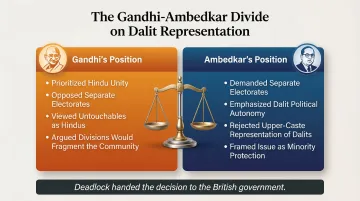
Gandhi arrived with an uncompromising position that immediately alienated other delegations. He insisted that Congress alone represented "all India, all interests" and was "no communal organisation." He opposed separate electorates for Muslims, Sikhs, and especially the Depressed Classes, arguing that such divisions would fragment Indian unity.
The Gandhi-Ambedkar Confrontation
The core conflict of the conference centered on political representation for Dalits. Ambedkar came demanding separate electorates for the Depressed Classes : a system where Dalit voters would elect their own representatives from Dalit-only candidate pools, independent of the Hindu majority electorate.
Ambedkar's Position
Ambedkar argued that the Depressed Classes were a distinct minority needing political protection separate from upper-caste Hindu domination. He stated: "We must be treated as a distinct minority, separate from the Hindu community." In his view, joint electorates would allow upper-caste voters to install token Dalit representatives beholden to upper-caste interests rather than Dalit communities.
Gandhi's Counter-Argument
Gandhi opposed separate electorates as permanently entrenching caste divisions within the Hindu community. He argued they would "vivisect and disrupt" Hinduism and insisted that Untouchables were Hindus, not a separate minority requiring independent political recognition.
The clash ran deeper than tactics. Gandhi prioritized Hindu unity above political differentiation; Ambedkar prioritized Dalit autonomy above Hindu solidarity. That underlying incompatibility carried the deadlock into Britain's hands.
Britain's Economic Crisis and the Deadlock
The conference's political tensions were compounded by Britain's domestic crisis. In August 1931, the Labour government fell, and Ramsay MacDonald formed a National Government dominated by Conservatives. Then, on September 21, 1931, Britain suspended the Gold Standard, triggering a severe economic crisis that distracted the Cabinet and fundamentally altered the political atmosphere of the negotiations.
No agreement was reached on communal representation or on making the executive accountable to the legislature. Faced with deadlock, Prime Minister MacDonald announced that His Majesty's Government would unilaterally issue a Communal Award to establish minority representation rather than let constitutional reform collapse entirely.
The Communal Award
On August 16, 1932, MacDonald announced the Communal Award. The Award granted separate electorates to the following groups:
- Muslims, Sikhs, Indian Christians, Anglo-Indians, and Europeans
- The Depressed Classes, who received 71 reserved seats in provincial legislatures through separate electorates
This was precisely what Ambedkar had demanded and Gandhi had opposed.
The Award directly triggered Gandhi's fast unto death and the negotiations that produced the Poona Pact.
Third Round Table Conference, 1932: A Diminished Conclusion
The Third Round Table Conference convened from November 17 to December 24, 1932, but it was a shadow of the previous sessions. Only 46 delegates attended — the Indian National Congress refused to participate, the British Labour Party sent no representatives, and M.A. Jinnah was absent. Without these voices, the session carried little political weight or legitimacy compared to earlier conferences.
Technical Blueprints Without Political Consensus
What the third conference lacked in political legitimacy, it partially offset with technical output. Delegates scrutinized committee reports on federal finance, franchise, legislative powers, and defense. Dr. Ambedkar participated actively, serving on the Committee on Commercial Safeguards. These reports provided the administrative and constitutional blueprints that would shape the Government of India Act 1935, but they reflected the work of administrators filling a vacuum that elected representatives had vacated.
The Poona Pact (1932): A Parallel Drama
While the third conference proceeded in London, a parallel constitutional crisis unfolded in India. On September 20, 1932, Gandhi — now imprisoned at Yerwada Central Jail in Poona — began a "fast unto death" to protest the Communal Award's grant of separate electorates to the Depressed Classes.
The Negotiation Under Duress
Gandhi's fast created immense political pressure on Ambedkar and other Dalit leaders. If Gandhi died, Dalits would be blamed for fragmenting Hindu society and potentially face violent backlash. With that threat looming, Ambedkar had little choice but to negotiate.
On September 24, 1932, 23 representatives signed the Poona Pact, including Ambedkar and upper-caste Hindu leader Madan Mohan Malaviya. Gandhi's son Devdas signed on his father's behalf. Gandhi broke his fast on September 26, 1932.
The Trade-Off:
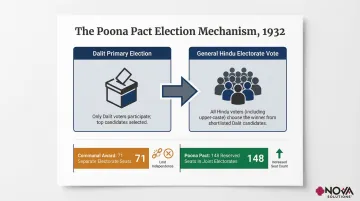
- Communal Award: 71 separate electorate seats for Depressed Classes
- Poona Pact: 148 reserved seats for Depressed Classes within the general Hindu electorate, using a two-tier primary election system
Under the Pact, Dalit candidates would first be selected through a primary election open only to Dalit voters, then the top candidates would compete in the general election where all Hindu voters (including upper-caste voters) would decide the winner.
Historical Assessments: Victory or Concession?
The Pact nearly doubled the number of reserved seats — from 71 to 148 — but it eliminated the political independence that separate electorates would have provided. Whether that trade-off constituted a victory or defeat remains contested among historians.
Scholars note that reserved seats in joint electorates allowed upper-caste parties to co-opt Dalit candidates, selecting those who would not challenge caste hierarchies. Ambedkar himself expressed ambivalence: the primary election mechanism offered a degree of independent representation, but he never stopped recognizing the compromise's limitations.
Legacy: The Government of India Act 1935 and What the Conferences Achieved
From Conference to Legislation
The British government compiled the recommendations from all three Round Table Conferences into a White Paper published in March 1933. After extensive parliamentary debate, this became the Government of India Act 1935, which received Royal Assent on August 2, 1935.
Provincial Autonomy and Franchise Expansion
The 1935 Act represented the most significant constitutional reform in British India's history:
Key Provisions:
- Provincial Autonomy — Ended diarchy at the provincial level; elected Indian representatives could form governments, though Governors retained special reserve powers
- Franchise Expansion — Expanded the provincial electorate from roughly 7 million to approximately 35 million voters (about 14% of the population), a fivefold increase in democratic participation
- Federal Structure — Created a framework for an All-India Federation bringing together British Indian provinces and princely states
What Was Never Implemented
Yet the Act's most ambitious provision never came into force. The All-India Federation — the centerpiece of the Round Table Conference negotiations — was never implemented. The required number of princely states refused to accede (formally join) the federation, fearing loss of sovereignty. India remained constitutionally fragmented until independence in 1947.
Indian Reactions
The Indian National Congress rejected the Act as a "slave constitution," arguing it fell far short of full self-rule or Dominion Status. Muslim leaders felt minority safeguards were insufficient. The Poona Pact had fundamentally altered Ambedkar's framework for Dalit political representation.
Despite this broad criticism, Congress participated in the 1937 provincial elections under the Act and formed governments in several provinces — a tacit acknowledgment that the Act, however flawed, was the political reality they had to work within.
Constitutional Legacy
The 1935 Act's influence extended far beyond the colonial period. When India drafted its Constitution after independence, the framers incorporated numerous provisions from the 1935 Act:
- Federal structure and distribution of powers
- The three legislative lists (Federal, Provincial, Concurrent) that became the Seventh Schedule
- Public Service Commissions (Article 312)
- Emergency powers of the executive
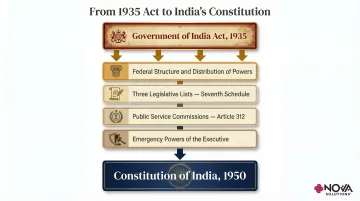
The deeper irony is that a constitution widely condemned as a tool of continued British control became the structural foundation that India's own framers chose to build upon — proof that the Round Table negotiations, for all their failures, produced something the new republic found worth keeping.
Historical Significance Beyond Legislation
The Round Table Conferences established precedents that transcended their immediate legislative outcomes. They demonstrated that constitutional negotiation between Britain and India was possible, even if agreement remained elusive. Beyond the legislation, they reshaped India's political landscape in three lasting ways:
- Elevated minority leaders: Ambedkar and Jinnah gained pan-Indian and international platforms, rising from regional figures to national voices.
- Crystallized political fault lines: Congress versus the Muslim League, Gandhi versus Ambedkar, and the princely states versus popular representatives — alignments that defined India's final push for independence in the 1940s.
- Proved the limits of colonial reform: Each failed session made it clearer that self-governance, not incremental concession, was the only viable path forward.
The conferences also exposed the deepest fault line in late colonial India. How do you balance majority rule with minority protection? How do you reconcile religious identity with secular nationalism? These tensions — debated in London between 1930 and 1932 — echo in South Asian politics to this day, from India's reservations policy to ongoing debates over communal representation.
Frequently Asked Questions
What are round tables at conferences?
A "round table" conference is a format where all participants sit as equals around a table with no designated head, symbolizing equal standing. In this political context, the term signaled that British and Indian representatives would negotiate as partners rather than in a hierarchical colonial setting.
What was the Round Table Conference?
The Round Table Conferences were a series of three constitutional negotiations held in London between 1930 and 1932, organized by the British government to determine India's future constitutional structure following widespread protests against the all-British Simon Commission.
What was the purpose of the Round Table Conference?
The purpose was to negotiate a new constitutional framework for India covering self-government, minority representation, princely states, and federal structure. It brought together British politicians alongside representatives of India's diverse religious and social communities.
Why did Gandhi boycott the First Round Table Conference?
Gandhi and the Indian National Congress boycotted the first conference because Congress leaders were imprisoned for the Civil Disobedience Movement. Congress also insisted that the Nehru Report's constitutional framework be accepted as a precondition for participation, which the British refused.
What was the Gandhi-Ambedkar conflict at the Round Table Conferences?
Gandhi opposed Ambedkar's demand for separate electorates for the Depressed Classes, arguing it would divide Hindus. Ambedkar countered that independent representation was the only safeguard against upper-caste-dominated electoral politics. The Poona Pact of 1932 resolved the standoff by replacing separate electorates with reserved seats within joint Hindu electorates.
What was the outcome of the Round Table Conferences?
None of the three conferences produced a final agreement, but their deliberations directly led to the Government of India Act 1935. That act granted provincial autonomy, expanded the franchise from 7 million to 35 million voters, and established a federal framework — though the All-India Federation was never implemented due to princely state opposition.