Most buyers approach this problem backwards: they pick a seating count, find a table that fits it, and order. What they overlook is clearance, room ratios, table shape, ADA requirements, and how chair width eats into capacity. All of those factors determine whether a room actually functions.
This guide covers everything: a seating capacity chart with room size requirements, a step-by-step sizing formula, shape comparisons, ADA standards, and the most common planning mistakes to avoid.
Key Takeaways
- Standard conference table height is 30 inches; widths range from 42–48 inches for rectangular tables
- Maintain a minimum of 48 inches of clearance between the table edge and any wall or obstruction
- Quick formula: subtract 8 feet from your room's length and width to find maximum table dimensions
- Per-person spacing ranges from 30 inches (minimum) to 48 inches (executive/boardroom)
- Table shape influences sightlines, meeting hierarchy, and hybrid video performance as much as it determines seat count
Conference Table Dimensions by Seating Capacity
Conference table lengths start around 6 feet for small teams and scale past 20 feet for large boardrooms. Widths on standard rectangular tables run 42–48 inches; boat-shaped and executive boardroom tables often reach 54–60 inches.
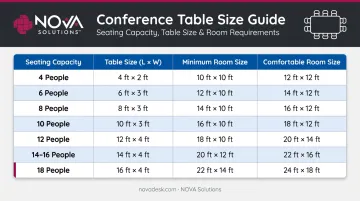
Use the chart below as a starting point, then adjust based on your chair dimensions, clearance needs, and room layout.
Reference Size Chart
| Seating Capacity | Table Size (L × W) | Minimum Room Size | Comfortable Room Size |
|---|---|---|---|
| 4–6 people | 6 ft × 36 in | 12 × 10 ft | 14 × 11 ft |
| 6–8 people | 8 ft × 42 in | 14 × 11 ft | 16 × 12 ft |
| 8–10 people | 10 ft × 48 in | 18 × 12 ft | 19 × 13 ft |
| 10–12 people | 12 ft × 48 in | 20 × 12 ft | 21 × 13 ft |
| 12–14 people | 14 ft × 48 in | 22 × 12 ft | 23 × 13 ft |
| 14–16 people | 16 ft × 48 in | 24 × 13 ft | 26 × 14 ft |
| 16–18 people | 18–20 ft × 48 in | 26 × 13 ft | 28 × 15 ft |
Round Tables
Round tables typically come in 48", 54", 60", and 72" diameters. A 48" round seats 4–5 people; 60" seats 6; a 72" diameter table seats 6–8 depending on chair width and base design.
Per-Person Spacing Standards
- 30 inches — absolute minimum; works only when no materials or devices are on the table
- 36 inches — comfortable standard for most business meetings
- 42 inches — preferred when participants are using laptops or spreading documents
- 48 inches — executive and boardroom standard; provides maximum personal space and elbow room
Practical caveat: Chair width matters as much as table length. Wide executive chairs at 30 inches each yield fewer seats than standard task chairs at 22 inches. Always verify your actual chair dimensions before finalizing a seating count from any chart.
Table Height
Standard conference table height is 30 inches, with a typical tabletop thickness of 1.25 inches. Bar-height stand-up tables exist for informal, quick-huddle zones but are generally unsuitable for meetings running longer than 20–30 minutes.
How to Calculate the Right Table Size for Your Room
Choosing a table size comes down to one constraint: preserving enough clearance for seated occupants and anyone moving behind them. Get that right, and the largest table that fits your room is the right table.
The 48-Inch Clearance Standard
48 inches is the industry best-practice clearance on all sides of the table. The math behind it:
- 24 inches for a person to sit and push their chair back
- 24 inches for someone to walk behind that seated person without disrupting them
36 inches is the legal ADA minimum for a circulation path, but it only permits passage — not comfortable movement around occupied chairs. Use 36 inches only when the room genuinely leaves no other option.
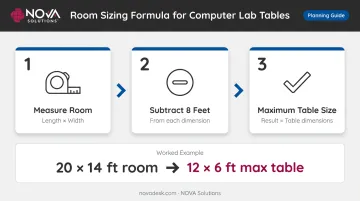
The Subtract-8-Feet Formula
- Measure your room length and width wall-to-wall
- Subtract 8 feet (96 inches) from each dimension
- The resulting numbers represent the maximum recommended table dimensions
Worked example: A 20 × 14 ft room yields a maximum table size of 12 × 6 feet (20 − 8 = 12; 14 − 8 = 6). That preserves 48 inches of clearance on both ends and both sides.
A slightly more conservative variation: subtract 10 feet from room length, which provides a 5-foot clearance zone at each end — useful for rooms with high foot traffic or where a presenter stands at the head of the table.
Before locking in a table size, account for what else is competing for that clearance zone.
Account for Obstructions
Several fixed and semi-fixed elements eat into usable floor space:
- Inward-swinging doors: measure the full arc of travel, not just the door width
- Credenzas and cabinets: measure from the front face of the furniture, not the wall behind it
- Whiteboards and AV screens: a presenter in front needs 24–30 inches of clear standing space
- Structural columns or pillars: treat these as fixed walls and calculate clearance from their face
Each obstruction reduces the effective room dimension you plug into the subtract-8-feet formula. Measure everything before committing to a table size.
Table Shapes and Their Impact on Seating and Layout
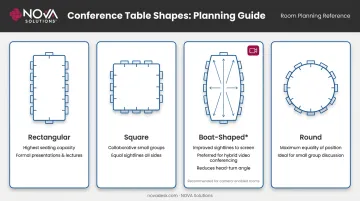
Shape governs meeting dynamics, sightline quality, and hybrid video performance. It should be chosen based on how the room is primarily used — not on how it looks in a catalog photo.
Rectangular and Square Tables
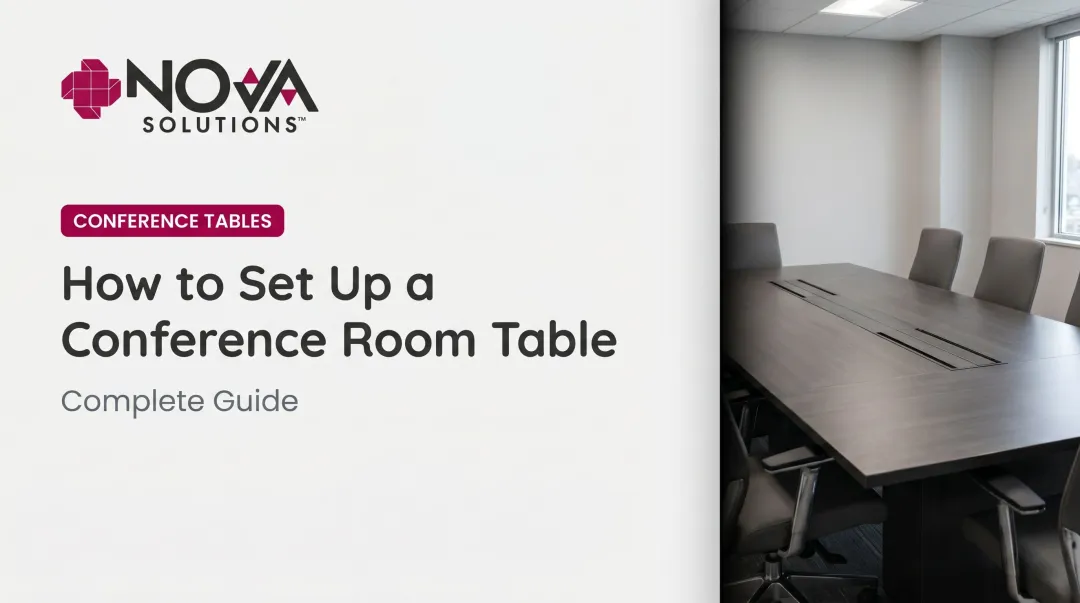
Rectangular tables deliver the highest seating capacity per square foot. They're well-suited for formal presentations and structured meetings with a clear head position. The tradeoff: a defined "head of table" can create hierarchy and reduce lateral dialogue in long configurations.
Square tables work best for small groups up to 8 people. Their symmetry creates an equal, collaborative dynamic similar to a round table, but they use corner space more efficiently. Good choice for working sessions where everyone needs equal access to shared materials.
Boat-Shaped and Oval Tables
Boat-shaped tables are wider at the center and taper toward the ends. That geometry does two things:
- Improves sightlines down the length of the table — people at the far ends aren't obscured by those in the middle
- Benefits hybrid video setups significantly: cameras can frame all participants more naturally, and audio localization systems perform better when no one is seated at a sharp corner
Industry guidance from furniture and AV integration specialists consistently points to tapered and boat shapes as the preferred choice for video-conferencing environments where camera framing and remote-participant visibility are priorities.
NOVA Solutions offers both rectangular and boat-shaped conference table configurations, designed for corporate boardrooms and institutional meeting environments where sightlines and professional aesthetics matter equally.
Modular and Training Table Configurations
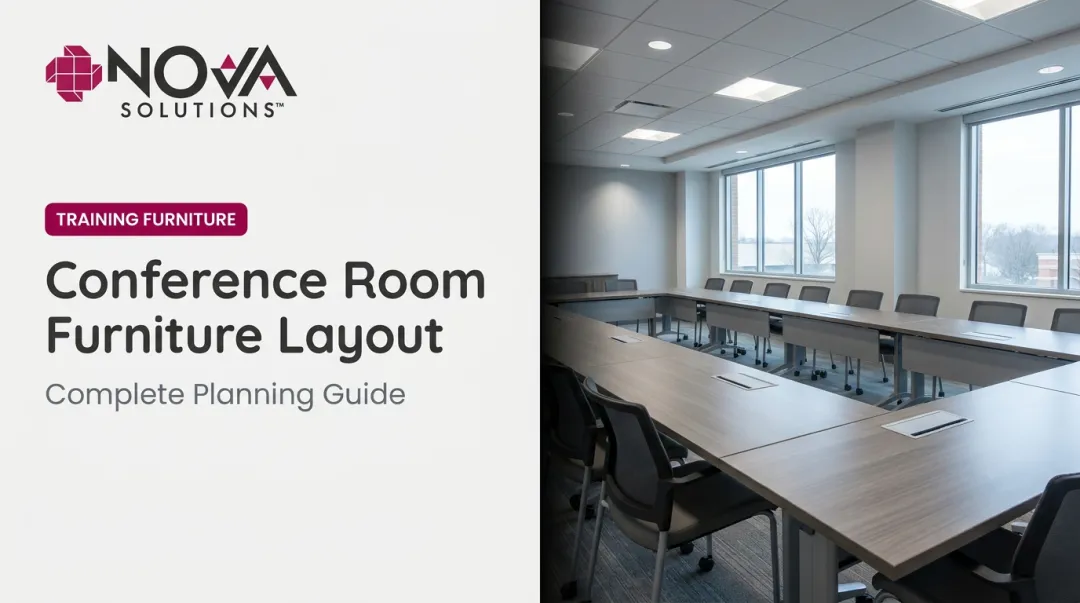
For multi-use rooms — spaces that run training sessions in the morning and full-group meetings in the afternoon — modular systems are the most practical solution. Individual rectangular or trapezoid tables gang together into whatever layout the session requires.
NOVA Solutions' training tables are built for this kind of reconfigurable use. Available configurations include:
- Single-user: widths from 36" to 60", depths from 18" to 36"
- Double-user: widths from 72" to 96"
Tables gang together using an optional mending kit. Each user position includes the iMod™ wire management system — a multi-plug power strip with a wire management channel that keeps cabling organized regardless of how the tables are arranged.
The integrated wire management matters for compliance, not just aesthetics. OSHA regulations (29 CFR 1910.22) prohibit running unprotected cords across floors as a permanent solution, and ganged training tables without built-in power management almost always create floor-cord problems. The iMod™ system addresses this at the product level.
ADA Compliance and Technology Integration
ADA Dimensional Requirements
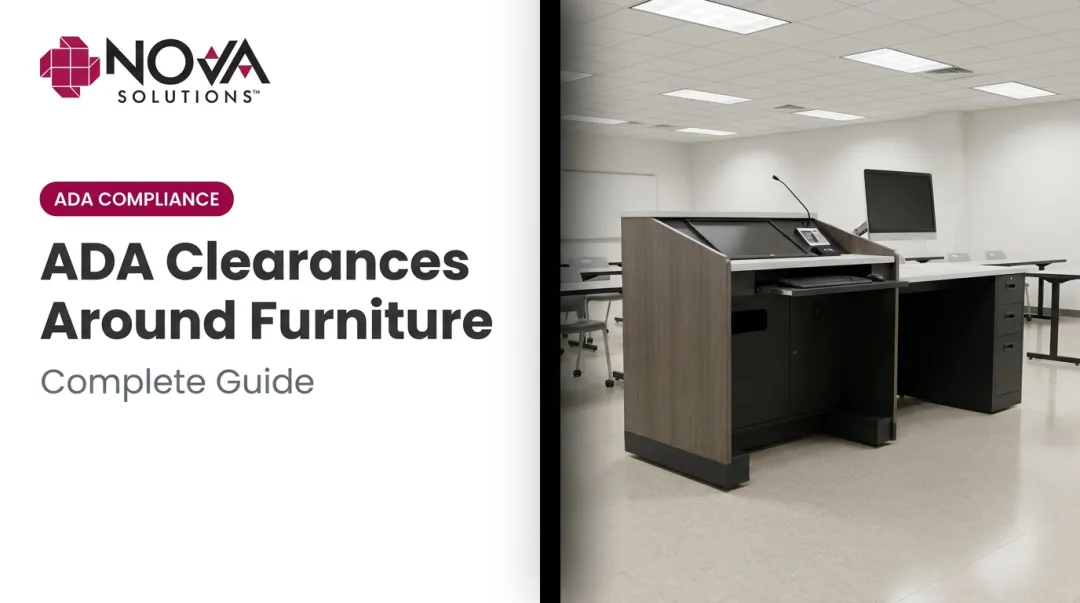
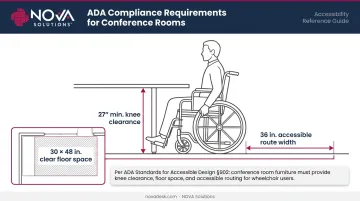
ADA compliance is a non-negotiable baseline for any shared conference space. The key dimensional requirements:
- 27 inches minimum vertical knee clearance beneath the table (ADA Standards Section 306.3)
- 30 × 48 inches clear floor space at each accessible seat position
- 36 inches minimum accessible route width throughout the room
- Knee clearance depth tapers: minimum 8 inches of depth at the 27-inch height mark
Many standard tables don't meet knee clearance requirements — compliance has to be specified, not assumed. NOVA Solutions' conference tables are certified ADA compliant and are available through the GSA contract (GS-28F-005GA) for federal procurement, which simplifies specification for government facilities already subject to ADA mandates.
Technology Integration
ADA compliance sets the physical access baseline — technology integration determines how well the room actually functions once people are seated. Modern conference rooms require at-the-table access to power and data. Cord runs across the floor create tripping hazards and violate OSHA's general-duty safety standards. What to specify:
- Standard AC outlets and USB-A/USB-C charging ports per seating position
- HDMI or wireless presentation connectivity
- Clean wire management that routes cables through or beneath the table surface
NOVA's iMod™ wire management system goes beyond basic cable routing. Removable panels give IT staff access to the wire management compartment without disrupting the room, with a built-in power strip and channel routing built in. It works equally well in fixed conference table setups and reconfigurable training environments.
Common Conference Room Sizing Mistakes to Avoid
Most conference room sizing problems aren't discovered during planning — they show up on day one, when chairs won't pull out or half the room can't see the screen. These three mistakes account for the majority of them.
Sizing for capacity while ignoring clearance. A 12-foot table in a 14-foot room technically "fits." It also leaves 12 inches of clearance per side — not enough for anyone to sit down or exit without scraping the wall. The 48-inch minimum isn't negotiable once people are actually using the space.
Choosing shape based on aesthetics. A long rectangular table looks authoritative. In a collaborative working session with 10 people, it also means opposite ends are essentially having different conversations. Match shape to primary use case, not to the mood board.
Measuring only the empty room. The finished room is rarely just four walls. Furniture that eats into your clearance includes:
- Credenzas and buffet storage
- AV carts and mobile display stands
- Whiteboards and flip chart easels
- Storage towers or filing cabinets
A room that measures 20 × 14 feet with a credenza along one long wall is functionally closer to 20 × 11 feet for table-sizing purposes. Measure everything before committing to table dimensions.
Frequently Asked Questions
How do you size a conference room table?
Measure your room length and width wall-to-wall, then subtract 8 feet from each dimension. The result is the maximum recommended table size. For example, a 20 × 14 ft room can accommodate a table up to 12 × 6 feet while maintaining 48 inches of clearance on all sides.
How much space is needed around a conference table?
The industry standard is 48 inches on all sides: 24 inches for chair pull-out and another 24 inches for circulation behind a seated person. Thirty-six inches is the ADA legal minimum for a pathway, but it's a tight fit in active rooms.
What is the standard height of a conference room table?
30 inches is the standard height, with a typical tabletop thickness of 1.25 inches. ADA-compliant tables must also provide at least 27 inches of knee clearance beneath the surface to accommodate wheelchair users.
What size table seats 6 people?
A 6-person rectangular table is typically 6 feet (72 inches) long by 36–42 inches wide. For a round configuration, a 54–60 inch diameter works comfortably for 6 people.
What size conference table seats 8 people?
An 8-person table is typically 8 feet (96 inches) long by 42–48 inches wide, requiring a minimum room size of approximately 14 × 16 feet to maintain adequate clearance on all sides.
How big is a 12-person conference table?
A 12-person table runs 12–14 feet (144–168 inches) long by 48 inches wide. Plan for a minimum room size of 20 × 12 feet, though 22 × 14 feet gives you full clearance plus room for a credenza along one wall.