Introduction
When a wheelchair user can't reach the computer lab, or a student with a visual impairment finds the classroom layout impassable, that's not just an inconvenience — it's a federal compliance failure. Under ADA Title II, public schools must provide equal access to all students, staff, and visitors across every hallway, restroom, parking lot, and classroom. Private institutions carry their own obligations under Title III and Section 504.
Yet accessibility gaps in physical facilities remain one of the most cited areas of federal enforcement. According to the U.S. Department of Education's FY 2024 OCR Annual Report, disability discrimination complaints represented 37% of all complaints filed — 8,457 out of 22,687 total — making it the single largest complaint category.
This guide is written for school administrators, facility directors, and procurement teams at K–12 and higher education institutions. It covers physical facility requirements, classroom accessibility standards, emergency preparedness, and how to build a long-term compliance plan, with specific dimensional standards included throughout.
Key Takeaways
- Public schools fall under Title II, private schools under Title III, and federal funding triggers Section 504 compliance
- The "path of travel" standard requires accessible parking, entrances, restrooms, and classrooms with specific dimensional specs
- Classrooms need at least one accessible work surface with specific knee clearance and surface height (28–34 inches)
- Emergency plans must cover Areas of Rescue Assistance, two-way communication, and visual/auditory alarms
- Schools with 50+ employees must complete a self-evaluation and written transition plan
What ADA Compliance Actually Requires from Schools
Which Laws Apply
The framework depends on your institution's type and funding:
- Public K–12 and public higher education — covered under ADA Title II (42 U.S.C. §12132), which prohibits excluding qualified individuals with disabilities from any public entity's services, programs, or activities
- Private schools — covered under ADA Title III (42 U.S.C. §12181(7)(J)), which explicitly lists private schools as public accommodations
- Any school receiving federal funding — independently subject to Section 504 of the Rehabilitation Act (29 U.S.C. §794(a)), which requires equal access and, for K–12, a Free Appropriate Public Education (FAPE) for each qualified student
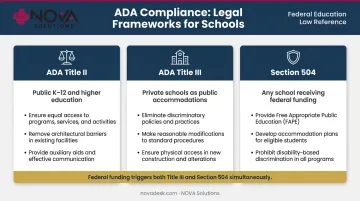
These laws overlap significantly but aren't identical. A private school receiving federal grants must satisfy both Title III and Section 504. The enforcement consequences for both are real — and they're covered in the next section.
Enforcement Reality
Consequences for non-compliance include:
- Office for Civil Rights (OCR) investigations and corrective action agreements
- Loss of federal funding
- Court-ordered remediation plans
- Private civil lawsuits
First-time complaints typically result in a corrective action agreement rather than immediate penalties — but the remediation requirements can be extensive and costly.
The Technical Rulebook
The 2010 ADA Standards for Accessible Design govern all physical facility requirements. For digital access, the DOJ's 2024 Title II final rule extended WCAG 2.1 Level AA requirements to public school websites and apps.
Compliance deadlines vary by entity size:
| Entity Size | Deadline |
|---|---|
| Serves 50,000+ people | April 24, 2026 |
| Smaller public entities | April 26, 2027 |
Physical Facility ADA Compliance Checklist
Compliance is evaluated along the "path of travel" — from parking lot to classroom — and every point along that route must meet dimensional standards. Schools built before 1992 must comply through a transition plan; newer construction must meet the full 2010 ADA Standards from the start.
Accessible Entrances, Exits, and Pathways
Key dimensional requirements under Chapter 4 of the ADA Accessibility Standards:
| Requirement | Standard |
|---|---|
| Accessible route width | 36 inches minimum |
| Ramp running slope | No steeper than 1:12 |
| Ramp landing clear length | 60 inches minimum |
| Door clear opening | 32 inches minimum (door open 90°) |
| Door maneuvering surface slope | No steeper than 1:48 |
| Floor/ground surfaces | Stable, firm, and slip-resistant |
Two additional rules apply beyond the dimensional specs:
- All primary entrances — not just one designated "accessible" entrance — must meet these standards. Where not all entrances are accessible, directional signage pointing to the nearest accessible entrance is required.
- Permanent rooms must have tactile/Braille signs per sections 216.2 and 703 of the ADA Standards.
Accessible Parking and Drop-Off Zones
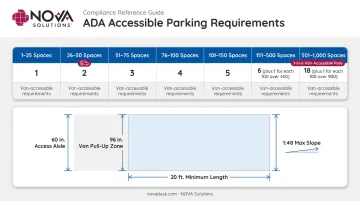
The ADA requires a minimum number of accessible spaces based on total lot size:
| Total Parking Spaces | Minimum Accessible Spaces |
|---|---|
| 1–25 | 1 |
| 26–50 | 2 |
| 51–75 | 3 |
| 76–100 | 4 |
| 101–150 | 5 |
| 151–500 | 6 |
| 501–1,000 | 2% of total |
Source: 2010 ADA Standards, Table 208.2.
Beyond the space count, parking areas must also meet these standards:
- At least 1 of every 6 accessible spaces must be van-accessible (Section 208.2.4)
- Access aisles must be 60 inches minimum wide and extend the full length of the parking space
- Parking surface slope cannot exceed 1:48
- Passenger drop-off zones need a pull-up space 96 inches wide and 20 feet long minimum, with a 60-inch access aisle
- At least one accessible route must connect parking and drop-off zones to accessible building entrances
Accessible Restrooms and Common Areas
Key restroom requirements:
- Turning space: 60-inch diameter circular space (not radius)
- Grab bars: 33–36 inches above finish floor; side-wall bar extends at least 54 inches from rear wall
- Lavatory height: 34 inches maximum above finish floor
- Knee clearance width: 30 inches minimum
- Faucet operation: One-hand operation, no tight grasping, 5 pounds maximum force
- Soap/paper towel dispensers: 15–48 inches above floor (reach range)
Shared spaces carry their own requirements. In cafeterias, at least 5% of dining surfaces must be accessible and dispersed throughout — not clustered in one corner. Auditoriums and lecture halls must provide wheelchair spaces and companion seats integrated throughout the seating plan, per sections 221 and 802 of the ADA Standards.
Accessible Playgrounds and Outdoor Areas
Playground requirements under sections 240 and 1008 of the ADA Standards:
- At least 50% of elevated play components must be on an accessible route, reachable via ramp or transfer system
- At least one of each type of ground-level play component must be on an accessible route; additional ground-level components follow Table 240.2.1.2
- All accessible routes, clear floor spaces, and turning spaces within play areas must have firm, stable, and slip-resistant surfaces
Classroom and Technology Workstation ADA Checklist
Classrooms are where students spend most of their time, but they're also where facility audits most often fall short — because accessibility here involves furniture and equipment, not just architecture. A hallway can pass inspection while the classroom itself remains inaccessible.
Accessible Desk and Seating Arrangements
Under section 226.1 of the 2010 ADA Standards, at least 5% of work surfaces provided for non-employee use must comply with section 902. That means:
- Surface height: 28–34 inches above finish floor (Section 902.3)
- Clear floor space: Positioned for a forward approach (Section 902.2)
- Knee clearance width: 30 inches minimum (Section 306.3.4)
- Knee and toe clearance: Must comply with Section 306
Fixed-seating auditoriums and lecture halls must provide accessible seating integrated throughout the space, not segregated to a single area.
Height-adjustable desks serve a wider range of users than fixed-height alternatives: students using power wheelchairs, students of varying statures, and those with ergonomic needs all benefit.
NOVA Solutions' Computer Training Desks and Computer Training Tables are available in ADA-compliant 32-inch height configurations and include the iMod™ wire management system, which routes cables within a rear compartment and keeps accessible knee space clear of obstructions. NOVA Solutions' Height Adjustable Sit/Stand Pedestal Desks adjust electrically from 30 to 42 inches, accommodating both seated wheelchair users and standing users within a single unit.
Technology Workstations and Computer Labs
Requirements for computer labs mirror classroom work surface standards, with additional reach range considerations:
| Requirement | Standard |
|---|---|
| Workstation surface height | 28–34 inches |
| Knee clearance width | 30 inches minimum |
| Forward reach (high) | 48 inches maximum |
| Side reach (high) | 48 inches maximum |
| Turning space | 60-inch diameter minimum |
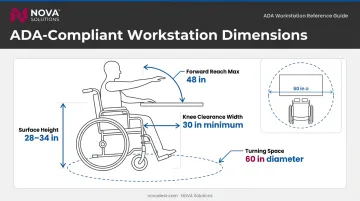
The legal minimum is at least 5% of workstations accessible — but a lab with only one compliant station creates real scheduling headaches. Most facility planners targeting 10–20% coverage avoid those bottlenecks entirely.
Workstations should also support assistive technology: screen readers, alternative input devices (trackballs, switch access), and voice recognition software. AV controls and presentation interfaces must be mounted within accessible reach ranges.
NOVA Solutions' Downview™ and Trolley™ Monitor Lift configurations are available in ADA-compliant setups across their computer lab product lines, with monitor positioning designed to keep displays within usable reach for seated users.
Classroom Lighting, Acoustics, and Sensory Considerations
Environmental factors are just as consequential as furniture specs — and they're frequently overlooked in formal audits:
- Lighting: Adjustable or uniform lighting supports students with low vision or sensory sensitivities
- Sound systems: Hearing loop installations or sound-field systems serve students with hearing impairments
- Sightlines: Accessible seating positions must have clear visual access to whiteboards, screens, and instruction areas
Emergency Preparedness and Staff Training Checklist
Evacuation Planning for Individuals with Disabilities
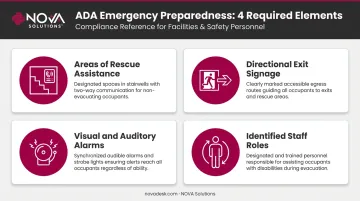
ADA compliance requires documented evacuation procedures that address non-ambulatory and other disability-related needs. Required elements include:
- Areas of Rescue Assistance (ARA) on each floor above and below ground level, with two-way communication systems providing both audible and visual indicators (Section 708)
- Directional signage at exits identifying accessible means of egress where not all exits are accessible (Section 216.4.3)
- Visual and auditory fire alarms throughout the building in all public and common-use areas (Sections 215 and 702)
- Identified staff roles for assisting individuals with disabilities during evacuation
Note: NFPA 101 Life Safety Code (Section 7.2.12) provides complementary standards for Area of Refuge requirements and is frequently referenced alongside ADA Standards in state building codes.
Staff Training and Communication Requirements
ADA-compliant staff training must cover:
- Awareness of physical accessibility features and assistive devices in the building
- Proper use of assistive technologies available in classrooms
- Sensitivity and etiquette when interacting with students with disabilities
- The school's emergency procedures for individuals with disabilities
Training should be documented and repeated annually. Beyond the curriculum itself, schools must meet several additional administrative requirements:
- Designate an ADA/Section 504 Coordinator responsible for compliance oversight
- Publish a grievance procedure accessible to students, parents, and staff
- Provide all school communications in accessible formats (large print, Braille, digital) upon request
- Post the nondiscrimination policy prominently and in accessible formats
How to Build a Long-Term ADA Compliance Plan
Self-Evaluation and Transition Plan Requirements
Under 28 CFR §35.105 and §35.150, public entities with 50 or more employees must:
- Conduct a self-evaluation of current services, policies, and practices — including input from individuals with disabilities or organizations representing them
- Develop a written transition plan if structural changes are needed — identifying physical obstacles, methods to address them, a completion schedule, yearly milestones (when the period exceeds one year), and the responsible official
- Keep self-evaluation records on file and available for public inspection for at least three years
- Make the transition plan available for public inspection
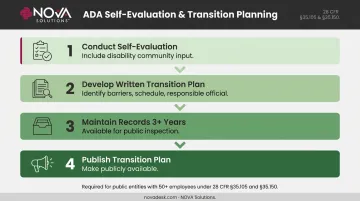
Treat the transition plan as a living document. As barriers are addressed and new ones identified through renovation or complaint, update it to reflect current status — then use that foundation to build consistent, ongoing habits.
Ongoing Compliance Best Practices
- Schedule annual audits — both architectural walkthroughs and classroom/equipment reviews
- Collect feedback from students, parents, and staff with disabilities; they'll identify issues auditors miss
- Assign a cross-departmental team so compliance isn't siloed in facilities management alone
- Prioritize compliant vendors when replacing furniture or equipment — manufacturers with documented ADA credentials and government procurement contracts (such as GSA Contract holders like NOVA Solutions) make both sourcing and audit documentation straightforward
- Stay current with regulatory updates — including the 2024 DOJ Title II digital accessibility rule, state building code amendments that may exceed federal minimums, and OCR guidance letters clarifying obligations in educational settings
Frequently Asked Questions
Do private schools have to comply with the ADA?
Yes. Private schools are listed as public accommodations under ADA Title III (42 U.S.C. §12181(7)(J)), regardless of federal funding status. Private schools that also receive federal funding must additionally comply with Section 504 of the Rehabilitation Act — both laws require accessible programs and facilities.
What is the minimum aisle width required in ADA-compliant classrooms?
Accessible routes within classrooms must be at least 36 inches wide per Section 403.5.1 of the 2010 ADA Standards. Where wheelchair users must navigate turns or reach accessible workstations, wider clearances apply; consult Section 304 for turning space requirements (60-inch diameter minimum).
How many accessible parking spaces does a school need under the ADA?
The required number scales with total lot size per Table 208.2 of the 2010 ADA Standards — for example, lots with 51–75 spaces require 3 accessible spaces. At least 1 of every 6 accessible spaces must be van-accessible, per Section 208.2.4.
What is the difference between ADA compliance and Section 504 compliance for schools?
ADA Title II covers physical and programmatic access for all public entities broadly. Section 504 specifically protects students with disabilities at schools receiving federal funding and imposes individualized accommodation obligations — including FAPE for K–12 students under 34 CFR Part 104. The two laws overlap significantly, but Section 504 adds enforceable individualized support requirements that the ADA alone does not mandate.
What happens if a school is found non-compliant with the ADA?
Non-compliance can trigger:
- OCR investigations and corrective action agreements
- Loss of federal funding
- Court-ordered remediation or civil lawsuits
First-time complaints typically result in a negotiated corrective action plan rather than immediate penalties, though remediation requirements can be extensive.
How often should schools conduct ADA compliance audits?
Annual facility walkthroughs are recommended, with additional reviews triggered by renovations, new construction, or disability-related complaints. Update the self-evaluation and transition plan whenever barriers are resolved, new construction begins, or a complaint is filed.