The gap between those two images is where student engagement gets lost.
Facilities and procurement teams know the pressure. Updating classroom furniture means navigating tight budgets, ADA requirements, technology needs that didn't exist a decade ago, and rooms that must serve a lecture of 80 one hour and a seminar of 20 the next. This guide breaks down exactly how to approach a classroom furniture update — from flexible layouts to tech integration to accessibility compliance — with practical steps for planning the project without the chaos.
Key Takeaways
- Flexible furniture in active learning classrooms is linked to 40–60% lower failure rates in college STEM courses — results that depend on pairing new layouts with intentional teaching strategies
- 76% of U.S. colleges already offer active learning classrooms — modular, reconfigurable furniture is now a baseline expectation, not a pilot program
- ADA compliance requires at least 5% of student work surfaces to meet Section 902 specifications, dispersed throughout each room
- Built-in power and wire management prevent the safety hazards and ongoing maintenance costs that come with retrofitted power strips
- Budget further by phasing rollouts across buildings or departments and purchasing through GSA or cooperative contracts
Why Updating College Classroom Furniture Actually Matters
The physical setup of a classroom shapes how instruction happens — sometimes in ways faculty don't notice until they try to change it.
A 2019 peer-reviewed review in Heliyon found that SCALE-UP active learning classrooms were associated with 40% to 60% lower failure rates in introductory physics settings. That's a significant finding, but it comes with an important caveat: the mechanism isn't furniture alone. It's furniture combined with pedagogy, faculty training, and intentional course design.

Still, the research makes one thing clear: the arrangement of the room sends a message. Fixed-row seating creates friction by forcing instructors to choose between holding the front and moving through the room. It makes group work awkward. It signals to students, through the physical setup itself, that passive listening is the default expectation.
The Cost of Doing Nothing
Aging furniture creates three compounding problems:
- Accessibility gaps: Fixed rows with integrated tablet-arm chairs frequently lack compliant seating positions for students using wheelchairs or other mobility aids
- Institutional perception: Nearly two-thirds of students say campus facilities influence their college choice, and visibly worn classrooms register quickly during campus visits
- Deferred maintenance costs: Small repairs accumulate. A planned replacement cycle is almost always cheaper than years of patching
For administrators weighing the decision, furniture that can't support active learning, hybrid instruction, or accessible seating isn't a neutral choice. It carries a cost — in student experience, in compliance risk, and in deferred spending that compounds over time.
Flexible & Modular Classroom Layouts
What Active Learning Classrooms Actually Require
EDUCAUSE reported that 76% of U.S. colleges provided active learning classrooms by 2019, ranking them as the second most important strategic technology investment that year. The defining feature of these spaces isn't a particular chair model — it's the ability to shift room configuration without interrupting a class session.
That requires furniture with specific physical properties:
- Lightweight frames that one person can move without strain
- Casters or glides that allow repositioning on standard flooring
- Nesting or stacking capability so reconfigured pieces don't create storage problems
- No fixed orientation — rooms where any wall can function as the "front"
Layout Configurations Worth Adopting
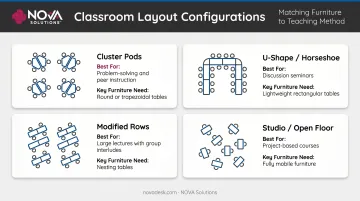
Different course formats benefit from different arrangements:
| Layout | Best For | Key Furniture Need |
|---|---|---|
| Cluster pods (4–6 seats) | Problem-solving, peer instruction | Round or trapezoidal tables, mobile chairs |
| U-shape / horseshoe | Discussion seminars, Socratic courses | Lightweight rectangular tables, consistent sightlines |
| Modified rows with aisles | Larger lectures with group interludes | Nesting tables, quick-stack chairs |
| Studio / open floor | Project-based studios, design courses | Fully mobile everything, wall-mounted storage |
NOVA Solutions' Multi Purpose Tables come in nesting, rectangular, round, and quarter-round configurations. Optional smooth-rolling casters let students reposition tables between activities, and the nesting design keeps unused pieces stacked compactly against the wall.
The Instructor's Workspace
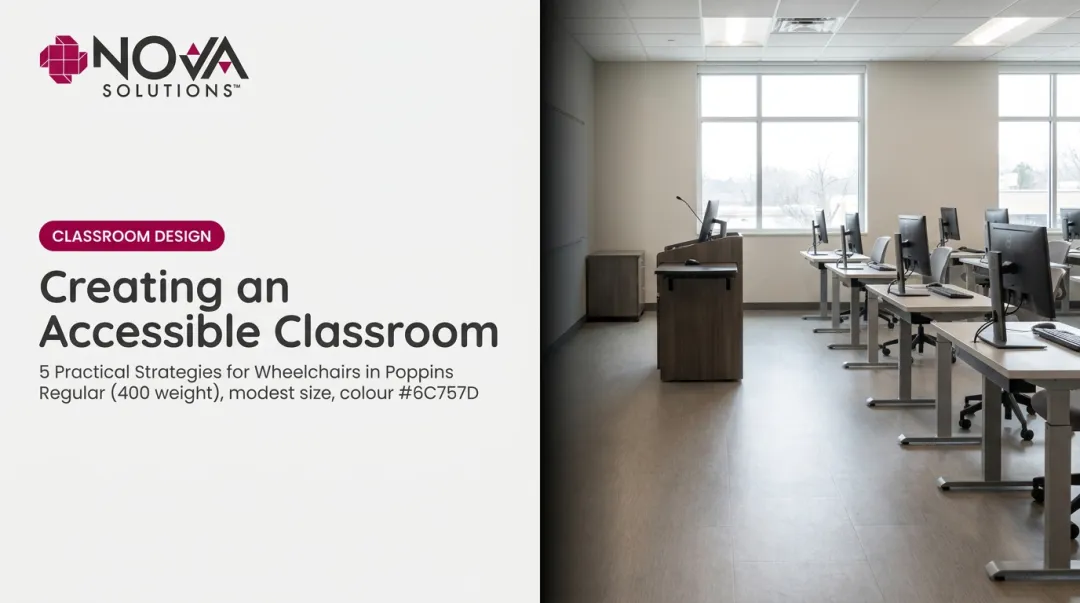
A fixed teacher desk occupying 12 square feet at the front of a 600-square-foot classroom is a poor trade. A mobile lectern or height-adjustable instructor station solves two problems at once: it returns usable floor space to the room and lets the instructor move toward students rather than staying anchored at the front wall.
NOVA's sit/stand AV lecterns adjust electronically from 30" to 42" and include integrated AV rack storage, so faculty get both mobility and full equipment access.
A Practical Note on Storage
All of this flexibility depends on one unglamorous detail: storage. Stackable chairs need a dedicated wall or closet space. Rolling carts for table storage need a clear path to it. Without that, reconfiguring a room takes most of the class period, and faculty stop doing it.
Technology-Integrated Furniture for Modern College Classrooms
Why Power and Cable Management Belong in the Furniture
According to EDUCAUSE's 2025 Students and Technology Report, hybrid course enrollment grew 7 percentage points since 2023. In documented HyFlex implementations, participation split roughly 44% fully online, 17% fully in-person, and 39% mixed. That distribution means every student seat in a classroom is potentially a hybrid workstation — and every seat needs power.
Power strips zip-tied to table legs create trip hazards, fail under institutional use, and make IT maintenance a recurring headache. Purpose-built technology furniture eliminates those problems before they start.
Key Technology Features to Prioritize
When evaluating classroom furniture for technology integration, look for:
- Integrated power outlets at each student station — not shared strips at room perimeter
- USB-A and USB-C charging ports to accommodate current device ecosystems
- Cable management channels that route cords off the floor and out of sight
- Worksurface sizing that accommodates a laptop plus a notebook side-by-side
NOVA Solutions' iMod™ wire management system addresses the cable problem at the furniture level. Each unit includes a multi-plug power strip and wire management channel per user, with wiring concealed in a backside compartment behind a removable laminate or perforated-metal modesty panel.
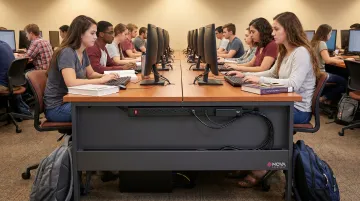
IT staff can access equipment quickly without disassembling anything. Installations at East Los Angeles College and the College of Staten Island show how the system keeps high-use computer labs organized at scale.
Computer Labs and Training Rooms
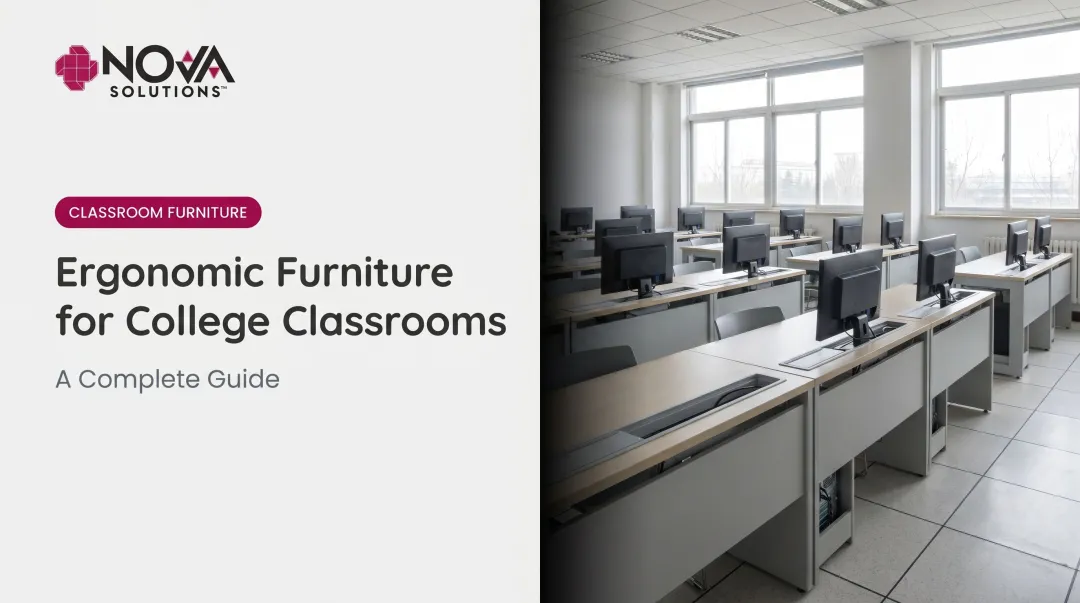
High-rotation labs have different demands than general classrooms. NOVA's Downview™ training desks address this by recessing the monitor below the worksurface under tinted tempered glass — a natural downward viewing angle that keeps the full tabletop clear. Available in single and double-user configurations with ADA-compliant 32" height options, these desks eliminate monitor clutter and protect equipment in environments where dozens of students rotate through daily.
Hybrid and HyFlex Classroom Considerations
Furniture placement directly affects hybrid classroom audio and video quality. Common problems include:
- Tables too close to walls that cut off camera sightlines
- Poor cable routing that creates interference near microphones
- Instructor stations that force faculty to turn away from the camera
Height-adjustable lecterns with integrated monitor lifts — where the display rises to eye level and retracts after use — let instructors face the room and the camera simultaneously, without craning around to check slides.
ADA Compliance & Accessible Design in College Classrooms
The Legal and Equity Case
NCES data shows that approximately 21% of undergraduates and 11% of postbaccalaureate students reported a disability in 2019–20. Accessible seating isn't a niche accommodation — it affects roughly one in five students in a typical classroom.
The legal framework is clear: ADA Title II applies to public higher education institutions, and Section 504 applies to all federally funded programs. An OCR resolution involving Northern Michigan University established that universities can face enforcement action when classrooms rely on integrated chair-desks with no accessible alternatives. The exposure is real, not hypothetical.
ADA Specifications for Classroom Furniture
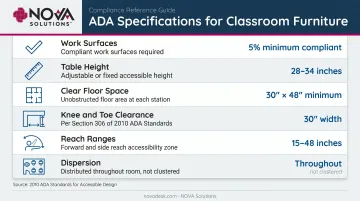
Per the 2010 ADA Standards for Accessible Design:
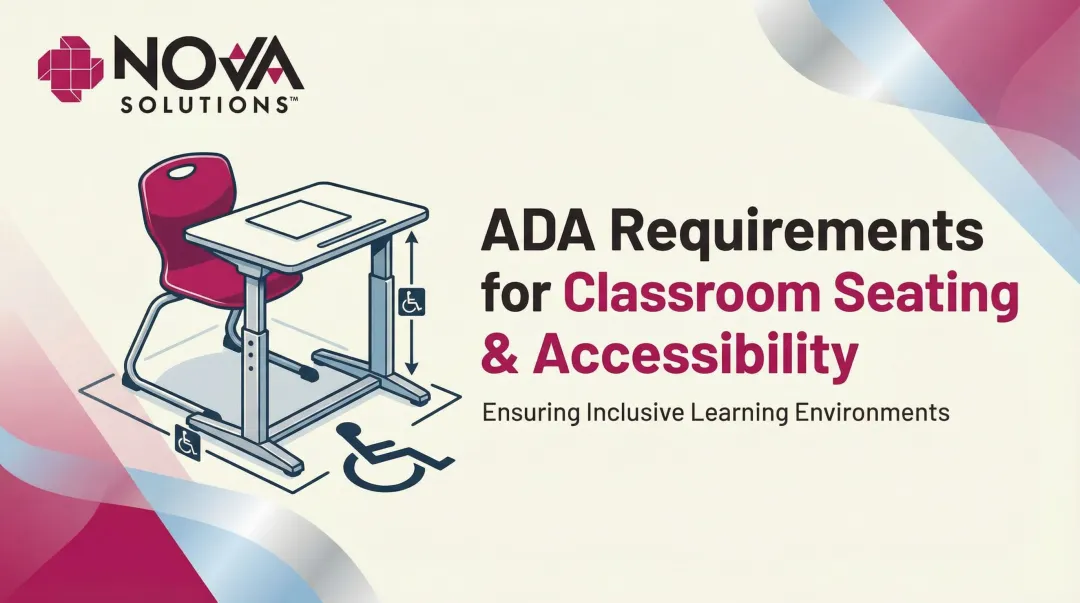
- At least 5% of non-employee work surfaces must comply with Section 902
- Table height: 28–34 inches above finished floor
- Clear floor space: 30" × 48" minimum at each accessible position
- Knee and toe clearance per Section 306 (minimum 30" knee clearance width)
- Reach ranges: 15–48 inches for controls and technology access points
- Dispersion: Accessible positions must be distributed throughout the room — not clustered at the back or sides
Dispersion matters in practice. An institution that places all ADA-compliant tables in the back row has technically provided accessible seating — but not equal access to the learning environment.
ADA Compliance Without Sacrificing Function
NOVA Solutions' ADA-compliant furniture line includes computer training desks and tables at the compliant 32" height, height-adjustable sit/stand lecterns (30"–42"), and study carrels — all with integrated iMod™ wire management and technology options.
ADA compliance and technology integration aren't competing requirements in purpose-built furniture. When both are designed in from the start, the result is a fundamentally different product than retrofitting existing pieces to meet standards they were never built for.
Practical Steps to Plan Your College Classroom Furniture Update
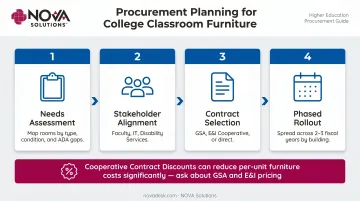
Start With a Room-by-Room Needs Assessment
Not all classrooms have the same problem. A 120-seat lecture hall, a 24-seat seminar room, and a 30-station computer lab each need different furniture — and buying the wrong solution for a room is as costly as buying nothing.
Categorize rooms by type and map:
- What's broken, worn, or functionally obsolete in each room
- Physical constraints like column locations, fixed infrastructure, and door clearances
- Which rooms lack in-seat power, ADA-compliant positions, or adequate cable management
- Which rooms carry the heaviest load of ADA accommodation requests or hybrid-format classes
Involve the Right Stakeholders Early
Facilities teams alone will miss requirements that only surface when other stakeholders are in the room. A brief cross-functional session before issuing any purchase request saves more time than sorting out mismatches after delivery.
Each group brings something the others can't:
- Faculty know which AV integrations they actually use versus which ones sit idle
- IT knows which cable management setups work with existing campus infrastructure
- Disability services knows which rooms generate the most accommodation requests and where accessible seating matters most
Procurement Considerations for Higher Education
With the right stakeholders aligned on requirements, the next step is identifying how to purchase efficiently within higher education's procurement landscape.
- GSA contracts: NOVA Solutions holds GSA Contract GS-28F-005GA (through February 2027), covering computer training desks, AV lecterns, collaboration tables, and more at a 61.71% discount off list price. Public universities should verify their eligibility for specific GSA contract programs before relying on them — eligibility is program- and authority-specific
- Education cooperatives: Programs like E&I Cooperative Services offer higher education-specific furniture contracts that may be more directly accessible for some institutions
- Phased rollouts: Spreading a campus-wide update across 2–3 fiscal years by building or department is more budget-realistic than a single large purchase, and it allows early rooms to inform later decisions
- Fully assembled delivery: NOVA ships all products fully assembled, which reduces room downtime significantly — a meaningful advantage when classrooms are in use most of the week
Frequently Asked Questions
Frequently Asked Questions
How often should college classrooms be refurnished?
Plan on 10–15 years for quality commercial-grade pieces, though frames typically outlast foam, casters, and surface materials. High-traffic lecture halls often need attention sooner. Annual condition assessments beat waiting for visible deterioration to trigger a request.
What furniture layout works best for collaborative learning in college classrooms?
Cluster pod arrangements with modular or nesting tables are the most effective for collaboration. They allow quick transitions between group and full-class formats, particularly when paired with lightweight chairs on casters that students can reposition without instructor intervention.
What makes furniture ADA-compliant for college classrooms?
Key specifications include table heights between 28–34 inches, 30" × 48" clear floor space at each accessible position, and knee clearance per ADA Section 306. Compliant positions must be distributed throughout the room — not isolated in a corner — and verified against the 2010 ADA Standards for Accessible Design.
How can technology be integrated into college classroom furniture?
Built-in power outlets, USB charging ports, cable management channels, and monitor lift systems are the primary integration features. Purpose-built solutions like NOVA's iMod™ wire management differ from retrofitted power strips — safer, easier to maintain, and designed for institutional volume.
What should a college budget for a classroom furniture update?
Per-seat costs range roughly from a few hundred dollars for basic seating to $1,000+ for technology-integrated workstations, depending on room type and scope. A phased approach by building or department spreads costs across fiscal years. GSA contracts and education cooperative purchasing vehicles can reduce per-unit costs significantly compared to open-market procurement.
What is the most durable classroom furniture for high-traffic college environments?
Look for 16-gauge steel frames, high-pressure laminate surfaces, and 2mm PVC edge banding — the construction standards NOVA Solutions builds into its institutional product lines. Request warranty documentation and maintenance requirements from any manufacturer before committing to a large order.