
Introduction
For most of its history, furniture procurement was straightforward: choose a style, verify dimensions, confirm the price. The physical object was the product.
The furniture being specified for corporate training rooms, university computer labs, and government facilities today is a different proposition. Technologies now determine how precisely components are cut, how well a piece accommodates diverse users, and whether it actively supports the technology-intensive work happening on and around it.
According to BIFMA, the North American business and institutional furniture market reached $21.73 billion in 2023 — a market large enough that even incremental improvements in manufacturing precision or functional integration carry significant consequences for buyers and end users alike.
This article covers four technologies reshaping how institutional furniture is designed and built: CNC machining, integrated smart systems, 3D printing, and AI-assisted design. Each one changes what to ask when evaluating a furniture specification.
Key Takeaways
- CNC machining delivers dimensional consistency across large production runs — every unit in a 50-desk order performs identically.
- Smart technology integration means power, motorized height adjustment, and wire management are engineered into the furniture structure from the start.
- 3D printing accelerates prototyping and enables custom components that traditional manufacturing can't produce economically in small quantities.
- AI-assisted design tools are shortening product development cycles and informing ergonomic specifications with real usage data.
Technology #1: CNC Machining and Digital Fabrication
What CNC Actually Does
CNC (Computer Numerical Control) machining uses computer-programmed software to control cutting tools that shape wood, metal, and composite materials with precise, repeatable accuracy. The practical difference from traditional manual or semi-manual manufacturing: the machine executes the same cut identically every time, regardless of operator variation.
For furniture production, this matters most at the component level. Panel sizing, joint cuts, edge profiles, and cable routing cutouts are all produced to exact tolerances — not close, but exact.
According to Woodworking Network, high-end nested CNC routers can process 70-plus sheets per day and complete what previously required multiple machines in a single step. That's a fundamental production capacity shift — one that changes what a shop can realistically quote and deliver.
Why Institutional Buyers Should Care
When a school district or government agency orders 40 training desks, dimensional consistency isn't optional — it determines whether the furniture functions as specified across every unit. CNC-produced components are measurable and repeatable, which directly supports compliance with dimensional standards.
The 2010 ADA Standards for Accessible Design require work surfaces between 28 and 34 inches above finish floor, with knee clearance of 27 inches high minimum and 30 inches wide minimum. CNC manufacturing makes it practical to hit those numbers consistently across a large production run — not approximately, but verifiably.
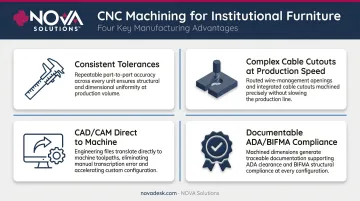
Key benefits of CNC in institutional furniture procurement:
- Every panel and joint is cut to the same tolerance, so unit 50 performs the same as unit 1
- Complex cutouts for integrated cable routing are produced at production speeds without custom tooling
- Design files move from CAD/CAM directly to the machine, reducing iteration time and human error
- Dimensional compliance with ADA and BIFMA standards becomes documentable, not just assumed
ANSI/AWI 0641-2019 specifies Premium grade joint gaps of no more than 0.3mm — a tolerance that manual production can approach but CNC can consistently achieve. For facilities that submit compliance documentation during procurement, consistent CNC tolerances give procurement officers something measurable to reference — not a manufacturer's claim, but a specifiable standard.
From Screen to Machine
Where CNC becomes particularly valuable for institutional buyers is in handling non-standard configurations. When a facility requests a custom worksurface depth or a specific cutout position for an AV setup, that change flows directly from the designer's file into the machine — no manual translation, no interpretation error between spec and output.
This matters for institutions that frequently configure furniture around non-standard room layouts or specific technology setups. Custom isn't a slower, more error-prone process anymore — it runs through the same workflow as a standard unit.
Technology #2: Integrated Smart Technology in Furniture
Beyond the Power Strip Zip-Tied to the Desk
"Smart integration" in furniture doesn't mean a USB port screwed onto a desk edge. It means technology components engineered into the furniture's structural design from the start — where the wiring routes, where the motor sits, where the power delivers, and how all of it interacts with the user.
The distinction matters because aftermarket add-ons create problems: exposed wiring, structural compromise, inconsistent aesthetics, and maintenance complexity. Furniture with integrated technology built into its architecture avoids all of that.
Commercial settings accounted for approximately 79% of standing desk sales in 2023, reflecting how standard motorized height adjustment has become in professional environments. And a peer-reviewed study found that sit-stand desk use was associated with meaningfully lower odds of discomfort compared to fixed-height seating (OR=0.37, p=0.007) — though the same research notes that leg discomfort can increase, and long-term outcomes require further study.
Categories of Smart Integration in Professional Furniture
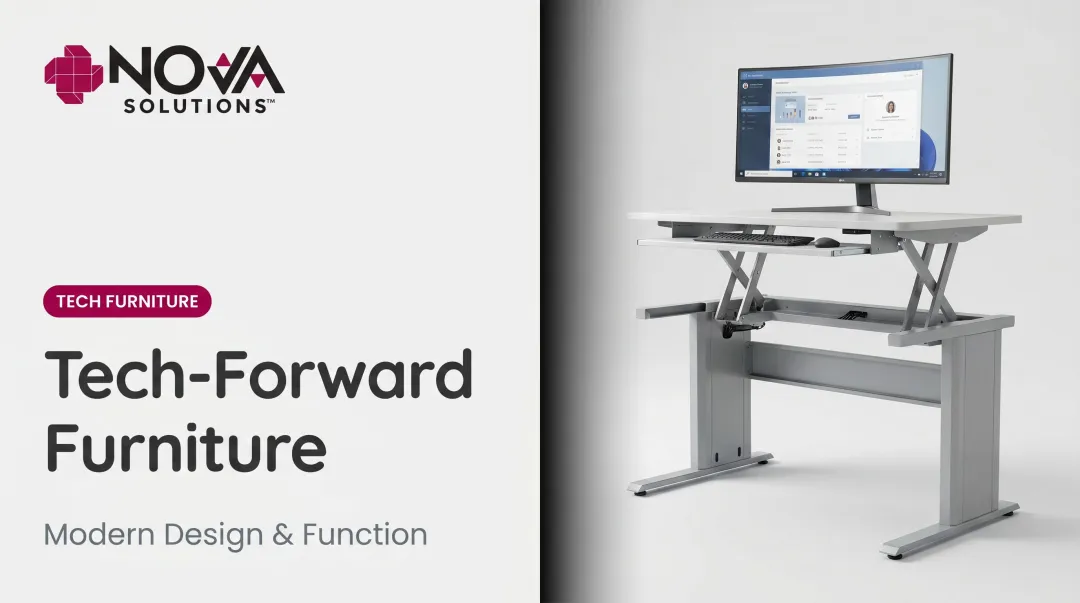
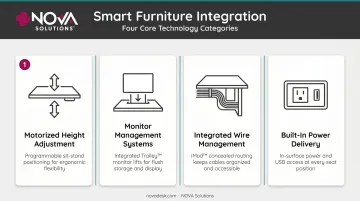
1. Motorized height adjustment Electrically adjustable surfaces that accommodate seated and standing use — and critically, wheelchair users. ADA compliance requires surfaces adjustable to 28 inches minimum; products that don't hit that floor are inaccessible by design.
2. Monitor management systems Recessed monitor lifts that retract screens below the worksurface when not in use. Beyond aesthetics, this directly affects instructor-student sightlines in training rooms and eliminates the visual clutter fixed monitors create in multi-use spaces.
3. Integrated wire management Cables routed through dedicated compartments in the furniture structure. A training room that looks functional versus one that looks chaotic often comes down to this single feature.
4. Built-in power delivery USB-A, USB-C, and AC outlets positioned at the point of use, within arm's reach rather than at a wall panel across the room. In technology-intensive environments, power access is a workflow requirement.
The Trolley™ Monitor Lift goes further. A low-voltage motor raises and lowers monitors through a patented access door that opens and closes automatically with push-button activation. When retracted, the monitor is fully concealed below the desktop, clearing the sightline between instructor and students. The system's Intelligent Motion Technology™ continuously monitors operation and stops movement if obstructed, protecting both equipment and users.
The optional NOVALinked™ system lets instructors raise or lower all monitors simultaneously from a single control point.
For ADA compliance, NOVA's height-adjustable sit/stand lecterns and pedestal desks adjust from 30 inches to 42 inches, covering the ADA-required range and then some. These ship fully assembled with no tools required, ready to deploy within the 50-day standard delivery window.
The Department of Veterans Affairs and multiple National Guard installations have used NOVA's training furniture with Trolley™ Monitor Lifts and iMod™ wire management — environments where accessibility compliance and clean functionality aren't optional.
Technology #3: 3D Printing and Rapid Prototyping
Where Additive Manufacturing Fits in Furniture
3D printing's role in furniture manufacturing today is primarily about speed of development, not finished products. Designers can physically test a component — a custom bracket, a hardware fitting, an ADA-specific fixture, a unique joint — within hours. Previously, producing a physical prototype required tooling and lead times measured in weeks.
The additive manufacturing industry grew 9.1% to $21.9 billion in 2024, reflecting broad adoption across manufacturing sectors. In furniture specifically, companies like Model No. have used 3D printing with materials including 93% biodegradable wood-filled resin to produce finished furniture components at scale — demonstrating that additive manufacturing is moving from prototype tool to production method.
What This Means for Custom Specifications
For institutional buyers, the practical implication is responsiveness. Manufacturers using 3D printing to prototype can:
- Validate custom specifications before committing to full production runs
- Produce small quantities of specialized components — custom ADA fixtures, non-standard mounting hardware — that traditional manufacturing can't make economically
- Iterate designs based on buyer feedback without the cost of retooling
A training facility that needs a custom cable routing configuration or a non-standard monitor mount position benefits from a manufacturer that can physically test that solution in days rather than weeks. That speed directly reduces the risk of committing to a specification that doesn't work in practice.
3D printing also enables component-level design experimentation that would be cost-prohibitive otherwise. For institutional buyers, the result is a shorter path from custom requirement to confirmed, production-ready solution.
Technology #4: AI-Powered Design and Ergonomic Optimization
How AI Enters the Design Process
Machine learning tools in product design analyze large sets of ergonomic data, structural performance variables, and material behavior to generate and refine designs — without requiring designers to manually run hundreds of parametric variations. The result is faster iteration and designs that account for user variables that manual design processes tend to flatten into a single "average."
McKinsey estimates that generative AI tools can reduce physical product development cycle times by over 70% and cites $60 billion in productivity potential in product research and design — figures drawn from cross-industry analysis, not furniture-specific data. The cross-industry numbers won't map precisely to furniture, but the scale of impact points in a clear direction.
The Ergonomics Angle for Institutional Settings
The relevance for schools, government training centers, and corporate facilities is specific. These environments serve wide user populations with varied body dimensions, mobility needs, and reach zones. Furniture designed to a single "standard" user profile fails a predictable percentage of those populations.
AI-informed ergonomic design addresses this by:
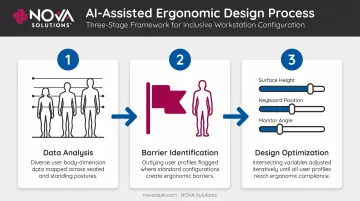
- Analyzing distributions of seat height, reach, and posture data across diverse user groups
- Flagging where standard dimensions create barriers for outlying user profiles
- Modeling how design variables interact — surface height, keyboard position, monitor angle — to optimize for the full user range, not just the median
The same tools extend into manufacturing decisions:
- Identify material waste opportunities before cutting begins
- Suggest construction alternatives that reduce cost without compromising structural load performance
- Model how a design performs under extended use conditions — before a prototype exists
That documented design process has a downstream value beyond the product itself. For facilities that have to justify procurement decisions to oversight bodies, furniture specified with documented ergonomic analysis is easier to defend than furniture selected on aesthetics and price alone.
What These Technologies Mean When Buying Furniture for Your Organization
The Right Questions to Ask
Technology adoption in furniture manufacturing isn't uniform. The four technologies covered here represent a meaningful quality signal — but only if you can verify that a manufacturer actually uses them. The right procurement questions go beyond aesthetics and price:
- CNC production: Ask for tolerance documentation, not just a general precision claim.
- Engineered vs. external integration: A power module bolted to a desk edge is not the same as an iMod™-style compartment built into the furniture structure.
- ADA dimensional verification: Request documentation of work surface heights, knee clearance, and reach ranges — not just a compliance label.
- Structural performance standards: ANSI/BIFMA X5.5 covers desk and table safety and performance; confirm whether products are tested to it.
Procurement Channels and Lead Times
Once you've identified a manufacturer that meets those criteria, the next step is procurement. For government buyers, the GSA Furniture and Furnishings program provides a streamlined path with typical delivery in 90 days or less.
NOVA Solutions holds GSA Contract GS-28F-005GA (valid through February 23, 2027), covering office furniture under SIN 33721. NOVA's GSA pricing runs 61.71% off list, with Net 30 terms and a 50-day ARO delivery window. The Right Solutions™ Catalog — Government Edition is publicly available on the NOVA website for procurement planning.
For facilities evaluating technology-integrated furniture — training desks, sit/stand lecterns, conference tables with built-in power and wire management — NOVA's institutional product line is worth reviewing. Every unit ships fully assembled from Effingham, Illinois, with integration built in at the manufacturing stage rather than added after the fact.
Frequently Asked Questions
What are the new technologies in furniture manufacturing?
CNC machining, 3D printing, AI-assisted design, and integrated smart components are the four technologies reshaping how institutional furniture is designed and built. Each targets a different stage of production, but together they define what modern commercial furniture looks like.
What are the latest trends in furniture?
The dominant trends in professional and institutional furniture are smart integration, data-informed ergonomics, and technology-ready designs for hybrid work and learning environments. Smart integration covers built-in power delivery, motorized height adjustment, and engineered wire management — features now expected rather than optional.
What is the biggest furniture trend in 2026?
The convergence of smart technology integration and ADA/accessibility compliance is the defining direction. Furniture that is simultaneously connected, adjustable, and inclusively designed — rather than treating accessibility as a separate specification — reflects where institutional procurement standards are heading.
What is smart furniture and how does it work in professional settings?
Smart furniture integrates technology components — height-adjustment motors, power delivery, monitor management — directly into the structure rather than adding them externally. In professional settings, this means users can focus on their work instead of managing cords, fixed surfaces, or obstructed sightlines.
How does CNC machining improve furniture consistency and quality?
CNC machining uses computer-controlled cutting tools to produce components to exact dimensional tolerances every time. For institutional buyers ordering 20, 50, or 100 units, this means every desk in the order meets the same specifications — relevant for both structural performance and documented ADA dimensional compliance.
How do these technologies support accessibility in furniture design?
AI ergonomic modeling produces designs that accommodate a wider range of users, while CNC manufacturing ensures ADA dimensional requirements — work surfaces between 28 and 34 inches, knee clearances, reach ranges — are met consistently across every production run. Motorized height adjustment extends that access to wheelchair users without requiring separate product lines or special orders.