Introduction
Selecting the wrong dimensions for a modular classroom is an expensive mistake to fix after delivery. Unlike stick-built construction, where walls can move and layouts can evolve, a modular unit arrives with its dimensions locked in. Get the floor area wrong by 15%, and you're either overcrowding students or paying for space you can't use.
This article covers the specifications that matter most during planning: standard module widths, common floor area configurations by classroom type, occupancy code minimums, and ADA clearance requirements. It also walks through the planning mistakes that turn a correctly sized module into a functionally inadequate classroom.
Key Takeaways
- Standard modular classrooms run 24' × 36' to 24' × 40' (single) and 24' × 60' to 24' × 64' (double)
- Interior usable area is 10–15% smaller than the exterior footprint
- IBC Table 1004.5 requires 20 net sq. ft. per occupant for standard K-12 classrooms; specialized rooms (labs, vocational) require 50 net sq. ft.
- ADA mandates 36" accessible routes, 32" minimum door clear width, and 60" wheelchair turning circles
- Ceiling heights vary by manufacturer; at least one major product line specifies 8 ft interior height — confirm before specifying projectors or HVAC
- Furniture footprint, wire management, and ADA clearances must be factored into the dimensional spec before procurement
What Modular Classroom Dimensions Actually Define
"Dimensions" in a modular classroom spec covers more than floor area. The number on the quote sheet represents exterior footprint — but ceiling height, wall thickness, and transport width all shape what the finished space can actually hold and how it gets there.
Exterior vs. Interior Net Area
Every modular unit ships with an exterior footprint — typically expressed as width × length, such as 24' × 40'. That number is not your usable teaching area. Wall assemblies, mechanical chases, built-in cabinetry, and HVAC equipment reduce interior net area by 10–15% compared to the exterior measurement. Occupancy calculations must use interior net area. Using exterior dimensions is one of the most common and costly planning errors in modular procurement.
Why Transport Constrains Module Width
Module width is a logistics constraint before it's a design choice. The FHWA sets the standard commercial vehicle width at 102 inches on the National Network. Modular classroom units routinely exceed that limit, moving as oversize loads that require state permits, route surveys, and sometimes escort vehicles.
Per the Modular Building Institute, modules commonly measure around 15 feet wide for transport. That's why finished 24-foot-wide classrooms are assembled from two narrower modules joined on site — bolted together, sealed, and connected to utilities after delivery. That assembly process has real downstream implications. Structural connections between modules, any interior column placement, and corridor layout all trace back to that original width limit.
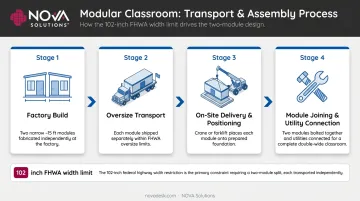
Key site planning factors affected by module width include:
- Structural seam location and connection specifications
- Interior column placement (if any)
- Corridor and egress layout relative to module joints
- Permit and route survey requirements before delivery
Ceiling Height
Ceiling height is a dimensional specification, not an aesthetic preference. It affects HVAC duct routing, lighting layout, and where you can physically mount a projector or display. Manufacturer specs vary — at least one major double-wide classroom product line lists 8 ft interior height, and some manufacturers note that ceilings above 8–9 ft can reduce cost-effectiveness.
Confirm ceiling height against your HVAC and AV specs before finalizing a floor plan. Catching a mismatch after the unit ships is expensive.
Standard Modular Classroom Size Ranges and Configurations
Modular classrooms fall into three main tiers — single-module, double-module, and multi-unit complexes — each with distinct footprints, occupancy limits, and use cases.
Single-Module Classrooms
Single-module classrooms typically run 24' × 36' to 24' × 40', yielding approximately 850–960 sq. ft. of exterior area.
At 20 net sq. ft. per occupant (IBC standard for K-12), and accounting for 10–15% reduction to net usable area, a 24' × 40' unit supports roughly 30–35 students in a standard classroom configuration. These units suit standard K-12 instruction, small training groups, and single-teacher deployments.
Double-Module Classrooms
Double-module configurations commonly measure 24' × 60' to 24' × 64', yielding 1,440–1,536 sq. ft. of exterior area. Mobile Modular's 24' × 64' product, for example, consists of two 24' × 32' classrooms separated by an interior partition.
Typical features include:
- Independent thermostats per classroom
- Optional restroom access
- Shared or separate entry points
These units work well for paired classrooms, dedicated teacher prep space, or configurations where two adjacent groups need independent temperature control.
Multi-Unit Complexes
At larger scales, modular classrooms are assembled into complexes ranging from 4 to 30 or more modules. A WillScot project at Colorado Academy combined eight 24' × 60' classrooms with a 56' × 128' classroom/admin complex — totaling approximately 18,700 sq. ft.
Dimensional planning at this scale requires attention to:
- Building orientation and module alignment
- Connecting corridor widths and egress path clearances
- Support space placement (restrooms, admin, storage)
- Multi-story configurations, which add stairwell, elevator, and fire-egress dimensional requirements
Specialized Classroom Footprints
Specialized rooms follow a stricter IBC standard: 50 net sq. ft. per occupant applies to shops and vocational areas, including science labs, maker spaces, and vocational shops.
Consider a 24' × 40' module (~960 sq. ft. exterior, ~840 sq. ft. net usable):
| Room Type | IBC Standard | Approximate Occupancy |
|---|---|---|
| Standard K-12 classroom | 20 net sq. ft./person | ~30–35 students* |
| Lab / vocational room | 50 net sq. ft./person | ~17 occupants |
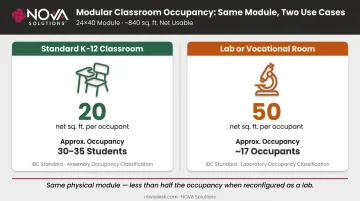
*Applies 10–15% net usable area reduction per IBC methodology.
The same physical module holds less than half the occupancy when reconfigured as a lab — which means a program switching from general instruction to science or tech courses may need to upsize by one full module tier to maintain equivalent headcount.
How Occupancy Requirements Govern Dimension Selection
The IBC is the baseline regulatory framework for modular classroom sizing in the U.S. Modular buildings don't operate under a separate code — they're regulated through state and local building codes and inspection programs, with the IBC (or an adopted state equivalent) as the governing standard.
The Core Formula
IBC Table 1004.5 provides the occupant load factors:
- K-12 standard classroom areas: 20 net sq. ft. per occupant
- Shops and vocational room areas: 50 net sq. ft. per occupant
A practical example: a class of 25 students requires a minimum of 500 net sq. ft. of usable interior area for a standard classroom. Add the 10–15% deduction for walls and mechanicals, and you need a module with roughly 560–590 sq. ft. of exterior floor area at minimum — before ADA clearances.
State Rules Can Exceed IBC Minimums
IBC Table 1004.5 is an egress occupant-load tool. It sets the minimum for safe evacuation, not educational adequacy. State rules frequently require more:
- Texas (post-Nov. 2021): Elementary classrooms require 36–42 sq. ft. per pupil; middle/high school requires 32–36 sq. ft.
- Florida SREF: K-3 classrooms require 36 net sq. ft. per student station; grades 4–8 require 30 net sq. ft.
Start your sizing from state education rules, then verify the result against IBC egress requirements and ADA clearances. State requirements routinely set the real standard — the IBC minimum is just the starting point.
ADA Clearances Reduce Net Usable Area Further
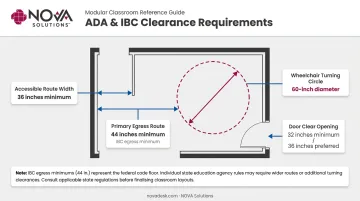
ADA compliance imposes hard dimensional constraints that reduce your usable floor area directly:
- Accessible route clear width: 36 inches minimum
- Primary egress routes: 44 inches (IBC, subject to component and occupant load conditions)
- Wheelchair turning space: 60-inch diameter minimum circle
- Door clear opening: 32 inches minimum, 36 inches preferred
These aren't optional for any federally funded or government-serving facility. Each clearance zone — aisles, turning radii, door swings — comes off the total before you place a single desk. Factor these in early, or your module size calculation will fall short.
Key Dimensional Specifications Beyond Floor Area
Floor area gets most of the planning attention. The specs below get far less — yet they're what determines whether a correctly sized module actually functions well in practice.
Door Placement and Egress Geometry
Door swing arcs create dead zones that reduce effective usable area. A standard 36-inch door swings a roughly 9-square-foot arc into the room. Multiply that by two egress points, add the required clearance paths to those doors, and you've consumed real floor area that can't hold furniture.
Egress path widths also affect interior layout: rows of desks can't block the path to exits, which means furniture arrangement must account for door placement from the start.
Furniture as a Dimensional Variable
Furniture footprint isn't an afterthought — it's a dimensional input that belongs in the planning spec alongside floor area and ceiling height.
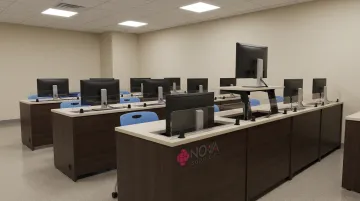
Training desks with integrated wire management, like NOVA Solutions' ADA-compliant computer training desks with the iMod™ wire management system, consolidate cable routing into the desk structure itself. This eliminates the floor-level cable clearance that standard installations require around and behind each unit (clearance that would otherwise consume circulation space in an already constrained modular floor plan).
NOVA's single-user desks are available in depths from 24" to 36" and widths from 30-1/8" to 48-1/8", with ADA-compliant 32" height configurations.
In a smaller single-module footprint (850–960 sq. ft.), selecting a 24" depth desk versus a 36" depth desk recovers meaningful row space: enough to fit an additional row or maintain compliant aisle clearances throughout.
Key dimensions to specify before ordering furniture for a modular classroom:
- Desk depth and width (determines row footprint)
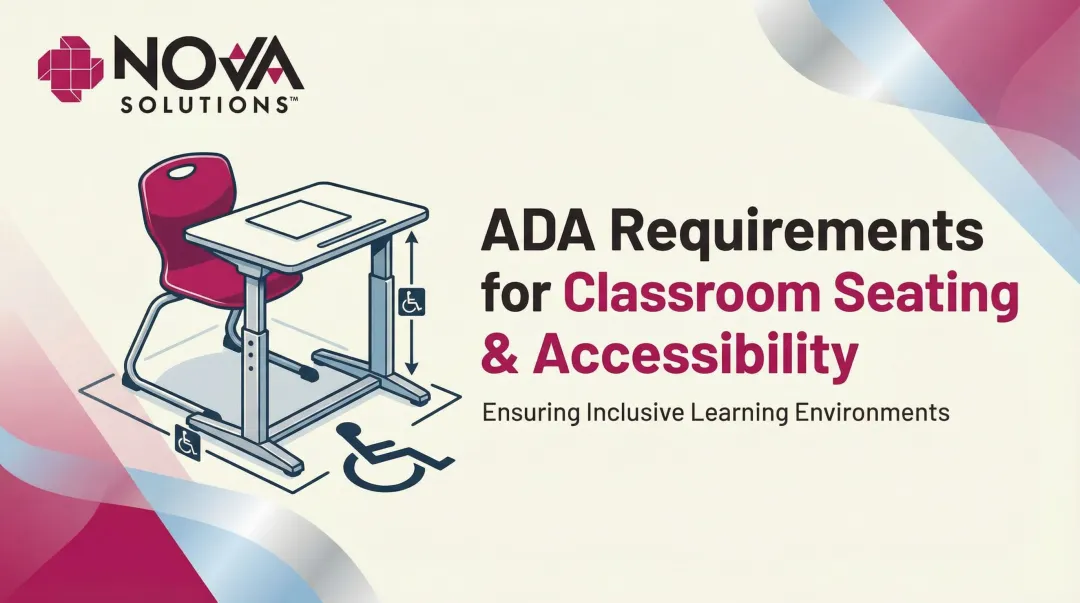
- ADA knee clearance: minimum 30" width, 25" max depth at 9" above floor
- Aisle widths between rows: 36" minimum for accessible routes
- Turning radius clearance zones: 60" diameter minimum
Vertical Dimensions for Technology-Heavy Rooms
Projector placement depends on throw ratio, image width, and mounting height — all of which interact with ceiling height. For technology-integrated classrooms, confirm:
- Projector throw ratio against available ceiling height and room depth
- Display mounting height relative to seated sightlines (typically 42–48" to bottom of screen)
- HVAC clearance for any ceiling-mounted equipment
NOVA's Trolley™ Monitor Lift system sidesteps ceiling clearance concerns: the monitor retracts below the desk surface when not in use, eliminating any overhead clearance requirement at the workstation level. In classrooms with 8-foot ceilings, that removes a real constraint that wall-mounted and ceiling-mounted display options can't avoid.
Common Sizing Mistakes When Planning a Modular Classroom
Using Exterior Dimensions for Occupancy Math
The most common mistake: taking the exterior module footprint (for example, 24' × 40' = 960 sq. ft.) and dividing by 20 to get an occupancy of 48. The correct figure uses interior net area — which, after deducting walls, mechanicals, and built-ins, is closer to 840 sq. ft.
That's an occupancy of 42 before ADA clearances. After those clearances, functional capacity drops further still.
The classroom isn't code-deficient on paper. It's just functionally overcrowded once the furniture is in.
Applying the Wrong Occupancy Standard
Using 20 sq. ft. per person for a room that will operate as a computer lab or science lab means the module is sized for a standard classroom but occupied at lab density. The correct IBC standard for shops and vocational room areas is 50 sq. ft. per person. A planner who sizes a computer training room using the classroom factor ends up with a space that's technically legal for egress but physically inadequate for the work.
Ignoring Furniture, ADA, and Technology in the Initial Spec
Treating the dimensional spec as complete once floor area is confirmed is a reliable path to post-occupancy regret. Rooms that deliver the right square footage on paper regularly require costly reconfiguration because:
- ADA turning radius clearances weren't mapped against the furniture layout
- Desk depths consumed more row space than anticipated
- Cable management requirements created floor-level obstructions
- Projector placement didn't account for actual ceiling height
Each of these variables is easier — and cheaper — to resolve on a floor plan than after the furniture arrives.
Frequently Asked Questions
What are the average dimensions of a modular classroom?
Single-module classrooms typically run 24' × 36' to 24' × 40'; double-module configurations run 24' × 60' to 24' × 64'. Interior usable area is 10–15% smaller than the exterior footprint due to wall thickness, mechanical space, and built-in features.
What is the difference between a modular classroom and a portable classroom?
The terms are often used interchangeably. "Portable" typically implies a temporary, relocatable single-unit building; "modular" can describe both temporary and permanent multi-module structures. Both must comply with applicable building codes — there's no separate, lower standard for modular construction.
What is the minimum square footage required per student in a modular classroom?
IBC Table 1004.5 requires 20 net sq. ft. per occupant for standard K-12 classroom areas and 50 net sq. ft. for shops and vocational room areas such as science labs and computer centers. State education rules often require more than the IBC baseline.
Can modular classrooms be connected or expanded over time?
Yes — modular units are designed to be expanded by adding adjacent modules. Any structural addition constitutes a new project, however, requiring permits, engineering review, and building code inspections.
What ceiling height do modular classrooms typically have?
Ceiling heights vary by manufacturer and product line. Most standard double-wide units specify 8 ft interior height for double-wide classroom units. Confirm ceiling height against your specific product spec before finalizing HVAC, lighting, and AV equipment selections.
Do science labs and computer classrooms require different modular classroom dimensions?
Yes. The IBC requires 50 net sq. ft. per occupant for vocational and shop areas versus 20 net sq. ft. for standard classrooms. Lab configurations also require additional clearances for utility connections, lab benches, and equipment access — factors that affect both furniture layout and overall room planning beyond raw square footage.