The shift isn't cosmetic. According to Cisco's 2025 Global Hybrid Work Study, 40% of in-office interactions now include at least one remote participant — which means a room designed only for in-person use is already underequipped for nearly half its meetings.
For corporate offices, government agencies, and educational institutions making investment decisions in 2026, understanding which technologies are genuinely moving the needle — and which are still pilot-stage — is the difference between a smart upgrade and an expensive one.
Key Takeaways
- AI-powered audio, video, and meeting assistance tools are moving from enterprise-only features to mid-market standard
- Interactive displays and wireless connectivity have replaced projectors and HDMI cables as the baseline collaboration setup
- ADA-accessible, technology-integrated furniture is now a baseline infrastructure requirement for compliant, future-ready spaces
- Hybrid work is the primary force behind nearly every conference room technology decision in 2026
- Organizations that align physical infrastructure with digital tools today will sidestep costly retrofits down the road
Top Conference Room Technology Trends in 2026
Trend 1: AI-Powered Audio, Video & Automated Meeting Assistance
AI hasn't just improved conference room technology — it's changed what a meeting room is expected to do.
Modern AI-powered AV systems handle tasks that used to require a dedicated technician or manual setup. The practical capabilities now available in commercial conference room systems include:
- Multi-camera speaker tracking that automatically frames the active speaker
- AI voice isolation and noise cancellation that separates speech from background noise (keyboard clicks, HVAC hum, hallway conversations)
- Automatic room activation that detects occupancy and powers up displays, cameras, and audio without any manual input
- Dynamic framing that adjusts the camera composition as participants move around the room
Beyond AV, AI meeting assistants are becoming a standard layer of the conference room stack. Metrigy reports that nearly 40% of organizations had integrated AI meeting assistants by early 2026, with 42% of surveyed companies planning deployment within the following year. These tools auto-generate meeting summaries, extract action items, and provide real-time transcription — including language translation for global teams.
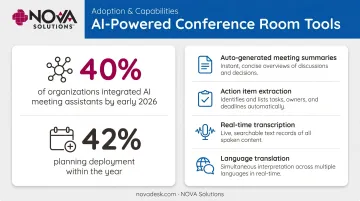
One important note: Metrigy also found that 41% of organizations require human oversight of AI-generated meeting content before treating it as an accurate record. That's a reasonable governance position for any organization rolling out transcription tools.
Cisco's 2025 study found that 90% of employers are strategically investing in AI and collaboration technologies, with 23% specifically planning smart meeting-room assistants. Both are active procurement categories today.
For corporate boardrooms and government training facilities, the most immediate AI value is in zero-touch room setup and post-meeting documentation. A room that self-configures when someone walks in, records and summarizes accurately, and resets automatically has moved from premium feature to baseline requirement for facilities serving hybrid teams.
Trend 2: Interactive Displays, Digital Whiteboards & Wireless Connectivity
The passive presentation screen is effectively obsolete in modern conference rooms. Its replacement — the interactive touch display — supports real-time annotation, cloud syncing, and simultaneous multi-user input.
Anyone in the room (or joining remotely) can mark up content, move elements, and contribute in real time — no waiting for a turn at the keyboard.
The market reflects this shift. Futuresource reports the corporate professional display market reached $7.0 billion in CY2024. The global interactive whiteboard market, estimated at $3.7 billion in 2024, is projected to reach $6.1 billion by 2030.
Wireless connectivity is the other half of this transformation. Screen mirroring and wireless casting systems have largely replaced the wire management headaches of the previous decade: searching for the right dongle, fighting HDMI conflicts, waiting while someone installs a driver. This matters most in hybrid meetings, where a mix of laptops, tablets, and mobile devices need to share content simultaneously without a cable hierarchy.
Practical capabilities of modern wireless collaboration systems:
- Multiple devices can present simultaneously without switching inputs
- Remote participants share content directly into the room display
- No adapters, no cables, no compatibility troubleshooting
- Content persists in cloud storage after the meeting ends
For larger rooms — training centers, town halls, client presentation spaces — large-format displays and LED video walls are gaining ground. These aren't just bigger screens; at the right scale, they make content genuinely readable from the back of a 50-seat room without straining. Accessibility features built into modern displays, including real-time closed captioning and screen magnification, align with Section 508 federal guidance that requires captions for meetings where audio content is shared.
Trend 3: Flexible, ADA-Accessible Room Design & Technology-Integrated Furniture
Technology upgrades on top of a poorly designed physical environment rarely deliver their full potential. This is the insight driving the third major trend: treating room design and furniture as active components of the meeting technology stack, not neutral containers for equipment.
From Static Layouts to Reconfigurable Spaces
JLL's 2026 occupancy data shows global office utilization at 56%, with demand shifting toward smaller, more flexible spaces — phone booths up 41%, focus rooms up 30%, small meeting rooms up 29%. Fixed boardroom layouts designed for one use case and one seating configuration no longer match how teams actually work.
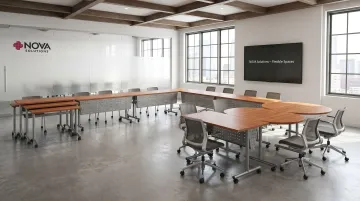
The alternative is modular, reconfigurable furniture that allows the same room to function as a training room in the morning and a collaboration hub in the afternoon. NOVA Solutions' Nesting Multi-Purpose Tables, for example, roll on casters, nest for compact storage, and reconfigure in minutes — no facilities crew required. Collaboration Tables in Keystone, D-Top, and Round configurations offer the same flexibility with modular designs that adapt to changing group sizes.
ADA Compliance as a Design Standard, Not an Afterthought
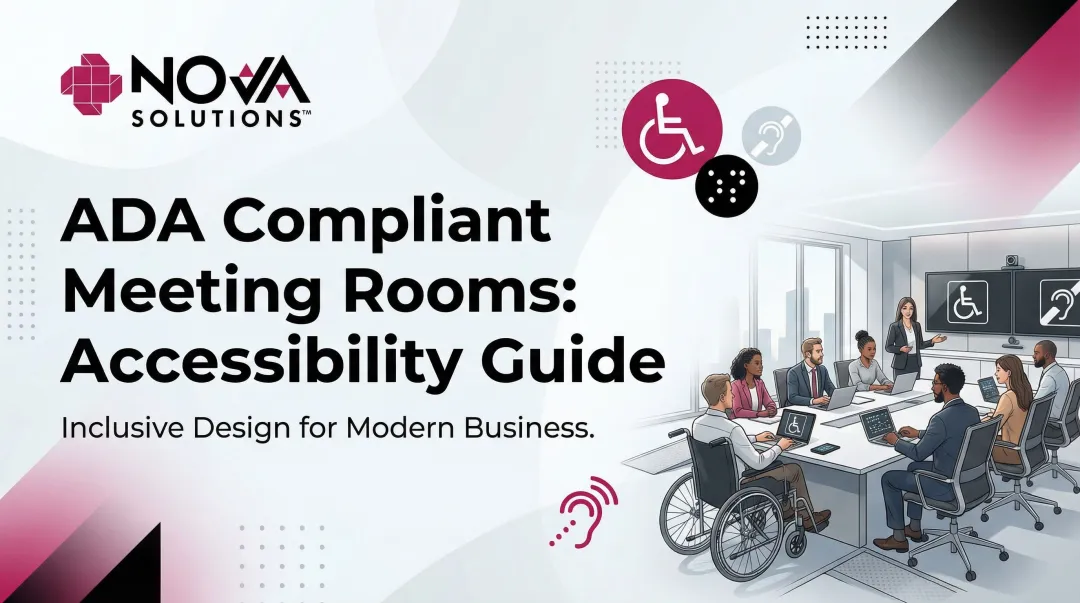
The DOJ's 2010 ADA Standards establish minimum requirements for accessible facilities, including 36-inch-wide aisles and sufficient turning space (a 60-inch diameter turning circle as a reference). For government agencies and educational institutions, compliance scrutiny is ongoing — and retrofitting a non-compliant room after installation is far more expensive than building accessibility in from the start.
ADA-compliant conference room design in practice means:
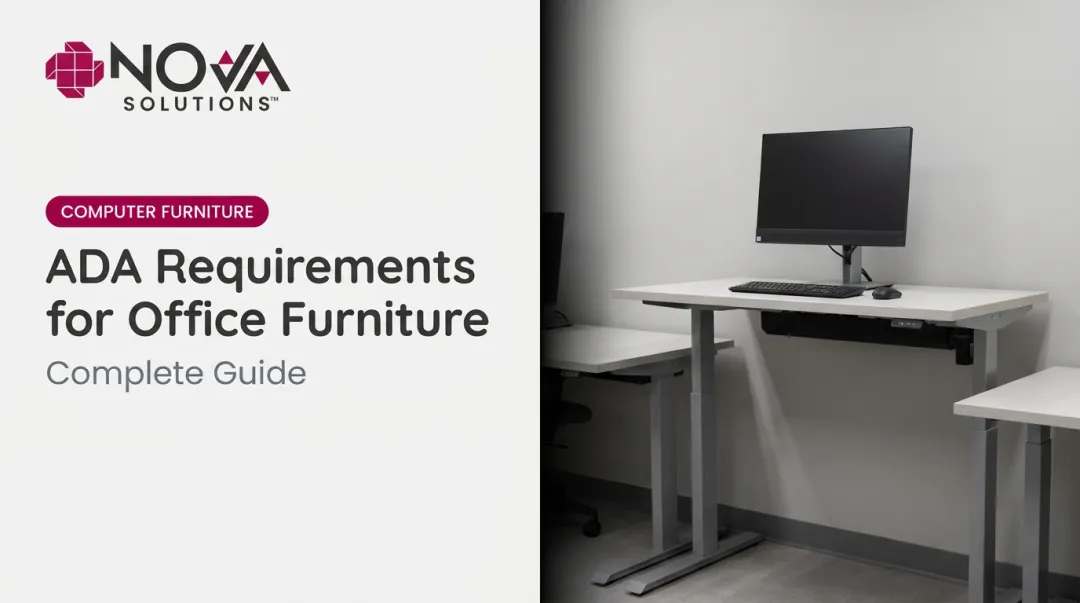
- Adjustable-height surfaces that accommodate both seated and standing users
- Clear knee clearance dimensions that allow wheelchair access at the work surface
- Accessible pathways to all seating positions
- Technology controls positioned within reachable range for all users
NOVA Solutions' conference and collaboration tables are designed to meet ADA requirements, including configurations at the 32-inch accessible seated height and sit/stand lecterns with electronic height adjustment from 30 to 42 inches.
Technology-Integrated Furniture as Infrastructure
The physical backbone of a functional smart conference room is furniture designed around technology from the start. Wire clutter, inaccessible cable runs, and monitors positioned wrong for the room create friction that no software update can fix.
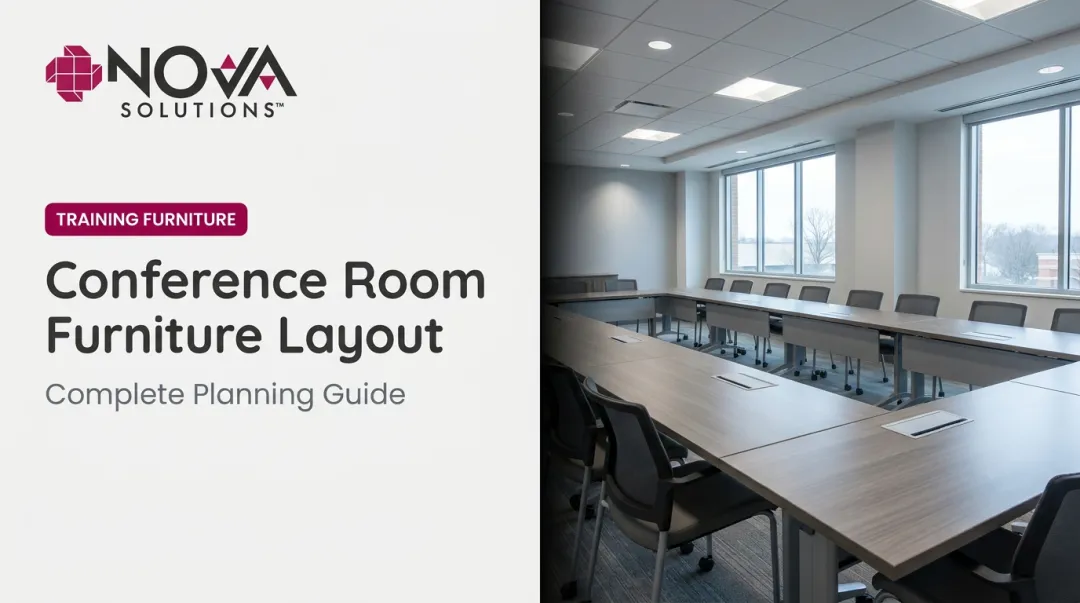
NOVA's iMod™ Wire Management System addresses this directly. Integrated into training tables, conference tables, and AV lecterns, it routes cables through a dedicated backside compartment with a multi-plug power strip and wire management channel per user. Removable laminate or perforated metal modesty panels provide cable protection and IT access without exposing the infrastructure.
For rooms requiring monitor concealment, the Trolley™ Monitor Lift raises and lowers monitors through the desktop via push-button activation. Its Intelligent Motion Technology™ stops the lift automatically if it detects an obstruction — protecting both equipment and users.
NBC Universal Orlando applied this solution directly: a custom 11-seat conference table with Trolley™ Monitor Lifts, delivering a clean executive environment where technology stays out of sight until it's needed.
What's Driving These Conference Room Technology Trends in 2026
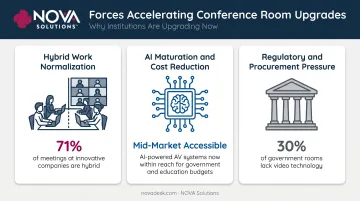
Three forces are accelerating conference room upgrades simultaneously.
Hybrid work normalization is the primary driver. When 71% of meetings at the most innovative companies are hybrid, a room designed only for in-person participants is functionally inadequate for most of its meetings. This raises the minimum viable spec for audio, video, display, and furniture simultaneously — because a bad camera or poor acoustics disadvantages remote participants in every single call. Gallup's hybrid work data shows six in ten employees with remote-capable jobs prefer hybrid arrangements. That's a structural workforce preference, not a trend that's reversing.
AI maturation and cost reduction are making sophisticated automation accessible beyond large enterprises. A mid-market organization can now deploy AI speaker tracking, auto-transcription, and occupancy-based room activation without enterprise IT budgets. Employees accustomed to consumer-grade technology at home arrive at the office expecting the same ease of use, and notice quickly when it isn't there.
Regulatory and procurement pressure is particularly acute for government agencies and educational institutions. ADA compliance requirements apply to newly constructed and altered facilities, and government technology brief data shows 30% of government conference rooms still lack any video technology. GSA contract frameworks, including TAA/MAS compliance requirements, shape purchasing decisions across these sectors.
For government buyers, that procurement path can be significantly shorter. NOVA Solutions' active GSA Contract (GS-28F-005GA, valid through February 2027) provides access to ADA-compliant, Made-in-USA conference furniture without a separate competitive bidding process, at a negotiated 61.71% discount off list price.
How These Trends Are Reshaping Collaboration Across Industries
The operational impact of under-equipped conference rooms is well-documented. A Logitech 2025 study found 63% of hybrid workers face technology issues on office days, with subpar tech causing 37% to work late and 28% to miss meetings entirely. These aren't minor inconveniences — they're measurable productivity losses that compound across an organization.
Different sectors experience these pressures differently:
| Sector | Primary Conference Room Priority | Key Constraint |
|---|---|---|
| Corporate | AI, hybrid AV, wireless connectivity | Speed of setup, employee experience |
| Government | ADA compliance, video capability, procurement compliance | GSA/TAA requirements, budget cycles |
| Education | Interactive displays, ADA accessibility, durability | Procurement contracts, instructional versatility |
For corporate environments, the ROI argument for AI and hybrid tools centers on time savings, talent retention, and meeting quality. Employees who feel technically supported report higher engagement — and in organizations where hybrid flexibility is a recruiting differentiator, facilities decisions have become effectively HR decisions.
Where corporate buyers lead with experience, government and educational facilities lead with compliance. An inaccessible room or a non-compliant furniture specification creates legal exposure and procurement problems long before it affects meeting quality — making ADA compliance and GSA/TAA alignment the baseline, not an afterthought.
Future Signals for Conference Room Technology
Three emerging developments are worth tracking over the next one to three years.
Extended reality (XR) tools are moving toward mainstream commercial use. IDC reports the XR market expanded 44.4% in 2025, with global device shipments forecast to grow 33.5% in 2026. For conference rooms, this means immersive presentation capabilities are no longer speculative — they're a practical pilot option for organizations planning infrastructure with a two-to-three-year horizon.
Occupancy-based energy management now ships as a standard feature in most sustainable office builds. These systems detect room occupancy and automatically adjust lighting, HVAC, and AV power states — cutting operating costs while supporting ESG goals without manual oversight.
Unified workplace intelligence may be the most consequential near-term shift. Room booking platforms, furniture occupancy sensors, AV system data, and HR analytics are converging into real-time dashboards that tell facilities managers exactly how spaces are being used — and by whom.
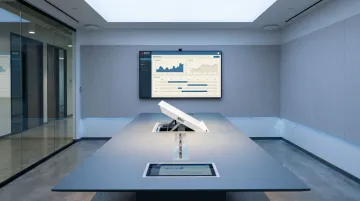
Organizations that invest in interoperable, scalable furniture and technology infrastructure now will absorb these capabilities as they mature — without replacing what's already installed.
Treating a conference room as a complete system — furniture, wire management, displays, audio, AI tools, and accessibility — isn't just good design practice. It's what separates a room that stays functional in 2028 from one that needs a costly overhaul to get there.
Conclusion
The top conference room technology trends for 2026 — AI-powered meeting tools, interactive displays, wireless connectivity, and ADA-accessible technology-integrated furniture — aren't independent developments. Together, they reflect a single shift in how organizations define a functional room: one that works equally well for every participant, across every meeting format, without requiring workarounds.
Early adopters who align their physical infrastructure with their digital investments will see the most durable results. A room with high-end AV undermined by tangled cables, inaccessible furniture, and a rigid layout will still underperform. The competitive advantage belongs to organizations that treat the room as a complete system from the start — where furniture, infrastructure, and technology are specified together rather than patched together over time.
Frequently Asked Questions
What is conference room technology?
Conference room technology encompasses the hardware and software tools that enable effective in-person, remote, and hybrid meetings — including AV systems, interactive displays, room scheduling platforms, wireless connectivity, and technology-integrated furniture.
What are the biggest conference room technology trends for 2026?
The leading trends are AI-powered audio and video (speaker tracking, noise cancellation, automated transcription), interactive touch displays, wireless screen sharing, and ADA-accessible technology-integrated furniture. All are accelerating as hybrid work becomes the standard rather than the exception.
How do you make a conference room ADA-compliant?
ADA compliance requires adjustable-height surfaces, 36-inch minimum aisle widths, sufficient turning space for wheelchair users, and technology controls within accessible reach ranges. Starting with certified ADA-compliant furniture — rather than retrofitting later — is significantly less costly and avoids compliance gaps.
What furniture is needed for a modern conference room?
Core furniture essentials include conference tables with built-in wire management, height-adjustable surfaces, AV lecterns with monitor lift options, and modular collaboration tables that support reconfigurable layouts. NOVA Solutions' iMod™ wire management and Trolley™ Monitor Lift integrate these capabilities directly into the furniture, keeping cable runs clean and AV setups straightforward.
How does AI improve conference room technology?
AI enables automatic speaker framing, background noise cancellation, zero-touch room activation upon occupancy detection, and real-time meeting transcription with summary and action item extraction.
What should organizations prioritize when upgrading their conference room in 2026?
Align physical infrastructure — accessible, technology-integrated furniture — with digital tools from the start. Prioritize ADA compliance, scalable wireless and AV systems, and interoperable components that won't require full replacement as AI and XR capabilities mature over the next few years.