
The stakes are real. Choose the wrong manufacturer and you risk furniture that off-gasses volatile organic compounds in enclosed classrooms, arrives with an outsized transportation footprint, fails within a few years, and ends up in a landfill. Choose wisely and you get durable, accessible, healthy learning environments that serve students for decades.
This guide walks through exactly what sustainable classroom furniture procurement requires — from material certifications to total cost of ownership — so you can separate genuine commitments from marketing language.
Key Takeaways
- Sustainability covers environmental responsibility, ADA compliance, and long-term durability — not just recycled materials
- The three certifications that matter most: GREENGUARD Gold, FSC, and BIFMA level®
- Third-party certifications are the only reliable way to verify sustainability claims
- Calculate total cost of ownership over 10–15 years, not sticker price
- Domestic manufacturers with GSA contracts offer traceable supply chains and faster procurement
What Does "Sustainable" Really Mean for Classroom Furniture?
Most buyers hear "sustainable" and think recycled materials. The real definition covers three distinct dimensions — and understanding all three makes for sharper procurement decisions.
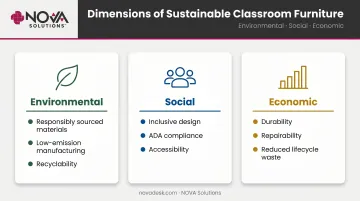
True sustainability for classroom furniture covers three dimensions:
- Environmental — responsibly sourced materials, low-emission manufacturing, recyclability at end of life
- Social — inclusive design that serves all users, including students and staff with disabilities
- Economic — durability and repairability that reduce replacement frequency and lifecycle waste
Product-Level vs. Manufacturer-Level Sustainability
The difference between these two levels determines how much risk you carry when selecting a long-term vendor.
Product-level sustainability focuses on materials: wood certifications, recycled content, adhesive formulations, and VOC emissions. A single product can meet environmental standards even if the manufacturer's broader practices don't.
Manufacturer-level sustainability reflects how the company operates — sourcing decisions, production waste management, labor practices, and post-sale support like warranties and end-of-life guidance.
Both dimensions belong in your RFP. A manufacturer who highlights one recycled component but can't document the rest of their supply chain is making a marketing claim, not a sustainability commitment.
Key Factors to Evaluate Sustainable Classroom Furniture Manufacturers
Sustainability criteria don't exist in isolation. A manufacturer who excels on eco-materials but produces fragile furniture or lacks ADA-compliant options will ultimately cost schools more, through replacements, compliance gaps, and lost instructional time.
Material Sourcing and Manufacturing Practices
Ask manufacturers to document their full material supply chain. Specifically:
- Are wood components FSC-certified? (See the Certifications section for what FSC labels actually mean)
- Do plastic components contain post-consumer recycled content?
- Are laminates and adhesives low-VOC or formaldehyde-free?
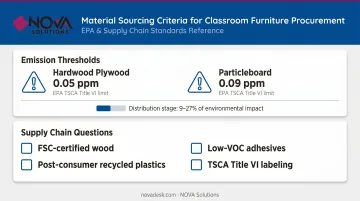
- Do composite wood products comply with EPA TSCA Title VI emission thresholds?
EPA regulations set maximum formaldehyde emissions for hardwood plywood at 0.05 ppm and particleboard at 0.09 ppm — any product containing these materials and sold in the U.S. after March 2019 must carry TSCA Title VI compliance labeling.
Transportation carbon is also worth considering. A 2025 peer-reviewed life cycle assessment of 25 furniture pieces found the distribution stage averaged 9% of total environmental impact, with some products reaching 27%. Domestically manufactured furniture generally has a shorter supply chain, which can meaningfully reduce that share.
Ergonomic Design and ADA Compliance
Ergonomics and accessibility aren't optional add-ons: they're core sustainability values.
Furniture that causes physical discomfort leads to disengagement. A study of nearly 900 schoolchildren found desk height mismatch affected 94.1% of intermediate students and 82.3% of secondary students.
Back pain affected over 10% of students who sat for extended periods. Poor-fitting furniture isn't just uncomfortable; it affects attendance and learning outcomes.
ADA compliance addresses the social sustainability dimension: furniture that excludes users with disabilities fails the people it's supposed to serve. When evaluating manufacturers:
- Confirm ADA-compliant designs are standard product line items, not special-order additions
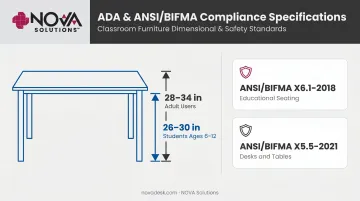
- Verify compliance with ANSI/BIFMA X6.1-2018 (educational seating) and ANSI/BIFMA X5.5-2021 (desks and tables)
- Check that work surfaces meet U.S. Access Board requirements: 28–34 inches for adult users, 26–30 inches for students ages 6–12
Manufacturers who build accessibility into standard configurations, rather than treating it as an afterthought, demonstrate a broader commitment to inclusive design.
Technology Integration and Future-Proofing
Every time classroom technology evolves, schools face a choice: replace the furniture or adapt it. Furniture with integrated wire management, modular charging solutions, and upgradeable technology components makes the second option viable.
Ask manufacturers directly:
- Can monitor arms, cable management systems, or charging centers be added post-purchase?
- Are modesty panels or technology compartments removable and accessible for IT staff?
- Does the furniture accommodate common VESA mounting standards for monitor compatibility?
NOVA Solutions' iMod™ wire management system is a concrete example of this approach. Cables are organized within a compartment on the back of each unit, with a multi-plug power strip per user and removable modesty panels available in laminate or perforated metal.
Those panels allow IT staff to update or reconfigure equipment without disturbing the furniture itself. Institutions can upgrade monitors, computers, and peripherals while retaining the core furniture investment.
Flexibility, Modularity, and Reconfigurability
Teaching formats change. A classroom configured for lecture-style instruction today may need group collaboration layouts next semester. Furniture that can't adapt to those changes drives unnecessary purchasing.
When evaluating modularity:
- Can individual components be swapped or upgraded rather than requiring full-unit replacement?
- Do tables link or nest for flexible room configurations?
- Are retrofit kits available to add technology features to existing units?
NOVA's retrofit kit system, for example, lets institutions add Trolley™ Monitor Lifts, Downview™ visual displays, keyboard drawers, and pop-up power centers to existing desks, all ADA-compliant and compatible with the iMod™ system. SUNY Broome Community College used exactly this approach to modernize an existing computer lab without full replacement.
Manufacturer Credentials, Transparency, and Track Record
A manufacturer's institutional history is among the strongest signals of long-term quality accountability. Those who have served educational and government clients for decades carry accountability structures that low-cost importers typically don't.
Key signals to look for:
- GSA contract holders must meet rigorous quality, pricing, and compliance standards — their products represent a pre-vetted starting point for public-sector procurement
- Domestic production generally means more traceable supply chains and easier verification of labor and material standards
- Institutional client history in educational and government sectors indicates sustained performance
Warranty, After-Sales Support, and End-of-Life Programs
A comprehensive warranty reduces both financial risk and material waste: furniture that can be repaired rather than discarded is more sustainable by definition.
Before purchasing, confirm:
- What structural defects are covered, and for how long?
- Is replacement parts availability guaranteed for a defined period?
- Does the manufacturer offer take-back programs, recycling partnerships, or end-of-life guidance?
End-of-life programs are rarely included in standard RFPs, which means most buyers don't know to ask. That gap is worth closing: the EPA reported 9.68 million tons of furniture and furnishings were landfilled in the U.S. in 2018, and manufacturers who provide disposal guidance are directly addressing that problem.
Certifications and Standards That Signal Genuine Sustainability
When evaluating manufacturers, third-party certifications are the most reliable way to verify sustainability claims — far more reliable than anything self-reported in a brochure.
GREENGUARD Gold
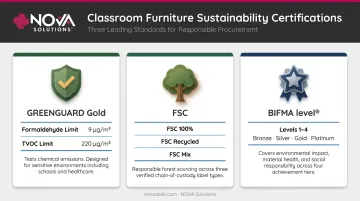
GREENGUARD Gold tests for chemical emissions from products over time using dynamic environmental chamber testing. Maximum allowable concentrations for furniture include formaldehyde at 9 µg/m³ and TVOC at 220 µg/m³ — thresholds designed specifically for sensitive environments like classrooms, where children spend six or more hours daily.
As the EPA has documented, poor indoor air quality in schools can trigger asthma and allergies that increase absenteeism and reduce academic performance. GREENGUARD Gold is the most direct certification connecting furniture choice to student health outcomes.
FSC (Forest Stewardship Council)
FSC certification verifies that wood components come from responsibly managed forests. The label categories are distinct — ask manufacturers to specify which applies:
- FSC 100% — all materials from certified forests
- FSC Recycled — made from 100% recycled materials
- FSC Mix — combination of certified, recycled, and/or controlled wood sources
"FSC certified" without specifying the label type is ambiguous. Push for the specific category.
BIFMA level®
BIFMA level® is the furniture industry's most comprehensive multi-attribute sustainability standard. Certified under ANSI/BIFMA e3, it evaluates products and manufacturers across environmental impacts, material health, and social responsibility. That scope makes it a signal of manufacturer-wide commitment rather than product-level compliance alone. Certifications run from Level 1 (Bronze) through Level 4 (Platinum).
Made in USA
Not a formal certification, but meaningful. The FTC requires that an unqualified "Made in USA" claim means the product is all or virtually all made domestically — final assembly in the U.S. and all significant processing of U.S. origin. To verify a claim:
- Ask the manufacturer for the FTC basis for their designation
- Check whether the claim is qualified (e.g., "Assembled in USA from foreign components") or unqualified
- Unqualified claims carry the stricter standard and offer stronger sourcing assurance
Total Cost of Ownership: Why Cheap Furniture Costs More
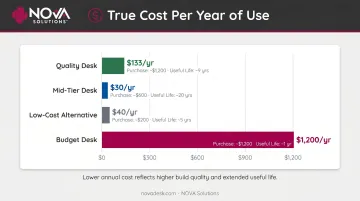
Purchase price is the wrong metric for sustainable furniture procurement. The correct metric is cost per year of use over the furniture's full lifespan.
A lifecycle cost analysis illustrates the math clearly:
| Scenario | Purchase Price | Useful Life | Maintenance/yr | Annual Cost |
|---|---|---|---|---|
| Quality desk | $2,000 | 15 years | — | ~$133/year |
| Budget desk | $600 | 6 months | — | ~$1,200/year |
| Mid-tier | $300 | 15 years | $10 | ~$30/year |
| Low-cost alternative | $200 | 10 years | $20 | ~$40/year |
The pattern is consistent: furniture bought on sticker price alone typically costs more in replacements and ends up in the landfill within a few years. The higher the upfront quality, the lower the annual cost — often by a factor of 10 or more.
For institutions using government procurement channels, GSA contracts provide pre-negotiated pricing on quality-verified products — removing the pressure to trade quality for budget compliance.
How NOVA Solutions Can Help
NOVA Solutions is a Made-in-USA classroom and training furniture manufacturer based in Effingham, Illinois, with over 35 years of experience serving educational institutions, government agencies, and corporate training environments. The company's product philosophy directly addresses the sustainability criteria in this guide.
Key differentiators relevant to sustainable procurement:
- ADA compliance is built into standard product lines across computer training desks, AV lecterns, study carrels, collaboration tables, and sit/stand podiums — not available as a special order only
- iMod™ wire management, Trolley™ Monitor Lifts, and Downview™ computer training desks extend product lifespan by enabling technology upgrades without full furniture replacement
- Retrofit Kits & Accessories let institutions add monitor arms, charging centers, and cable management post-purchase, avoiding unnecessary replacement cycles
- GSA Contract GS-28F-005GA (through February 2027) covers the full product line under SIN 33721 at a 61.71% discount off list price, simplifying government and institutional procurement
- Fully assembled shipping means products arrive ready for immediate deployment, eliminating on-site assembly waste and installation complexity
- All products are manufactured in Effingham, Illinois, providing supply chain transparency, a reduced transportation footprint, and consistent U.S. quality and ADA compliance standards
NOVA has served clients including Texas State University, Kennesaw State University, Rutgers University, Cannon Air Force Base, the U.S. Department of Veterans Affairs, and dozens of community colleges.
To discuss your classroom or training facility needs, contact the NOVA Solutions team at 800-730-6682 or orders@novasolutionsinc.com.
Frequently Asked Questions
What certifications should I prioritize when evaluating a sustainable classroom furniture manufacturer?
Request documentation for GREENGUARD Gold (indoor air quality and VOC emissions), FSC (responsible wood sourcing), and BIFMA level® (holistic multi-attribute sustainability). Together, they address chemical safety, material sourcing, and manufacturer-wide environmental and social responsibility — the dimensions that matter most for schools and institutions.
Is domestically manufactured classroom furniture more sustainable than imported alternatives?
Domestic production typically reduces transportation-related carbon emissions, improves supply chain visibility, and makes labor and material standard verification more straightforward. That said, buyers should still request third-party certifications regardless of where furniture is manufactured — origin alone doesn't confirm sustainability.
How does furniture durability connect to sustainability?
Longer-lasting furniture means fewer replacement cycles, less material sent to landfill, and lower total cost of ownership. Durability is one of the most direct and measurable sustainability outcomes a buyer can evaluate — verify it through warranty length and references from institutional clients who've owned the product for several years.
Does sustainable classroom furniture have to cost more upfront?
Often yes, but the relevant comparison is cost per year of use — not purchase price. Sustainable furniture typically delivers significantly lower annual cost over a 10–15 year horizon. A $400 desk lasting 15 years costs far less annually than a $250 desk replaced every 5.
What does ADA compliance have to do with sustainable furniture selection?
ADA compliance represents the social dimension of sustainability — ensuring all students and staff, including those with disabilities, can use the space equitably. Manufacturers who build accessibility into standard product lines, rather than offering it as a special-order option, demonstrate a broader inclusive design commitment.
How can I verify that a manufacturer's sustainability claims are legitimate?
Request current, product-specific documentation for every stated certification and confirm it was issued by a recognized third party. Ask for material disclosure sheets — Health Product Declarations (HPDs) or Declare labels — rather than accepting company-wide marketing claims as evidence.