
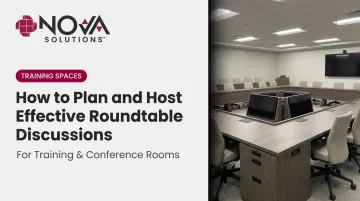
This guide covers the exact steps to plan and run an effective roundtable: format selection, moderator prep, agenda design, physical setup, and the follow-up that converts a good conversation into lasting value.
Key Takeaways
- Define your goal first — it determines every other decision, from participant selection to room layout
- The moderator is the single most important variable; choose and brief them well in advance
- Circular or U-shaped seating shapes participation equity, not just aesthetics
- Pre-briefing participants one week out eliminates unprepared silence and raises discussion quality
- Follow up within 48 hours or the conversation's value evaporates
How to Plan and Host a Roundtable Discussion
Step 1: Define Your Goals and Choose a Format
Before anything else, decide what the roundtable needs to accomplish. Knowledge sharing, stakeholder alignment, problem-solving, and professional development each require different structures. Getting this wrong early creates problems that are hard to fix later.
Three format decisions to make early:
- In-person vs. virtual — In-person produces higher engagement and nonverbal cues. Virtual extends reach but requires breakout room capability and more deliberate facilitation to prevent passive attendance
- Expert-led vs. participant-led — Expert-led sessions work when subject-matter depth matters; participant-led sessions work when the goal is peer exchange or co-creating solutions
- Single table vs. multi-table — Larger conferences often run multiple simultaneous tables by topic, with participants rotating between them
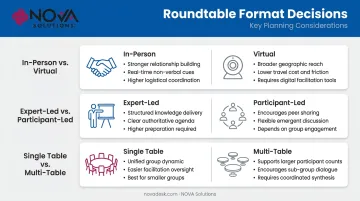
Lock in format before touching the agenda. The format determines participant count, room requirements, and moderator briefing needs.
Step 2: Select and Brief Your Moderator
The moderator does more to determine roundtable quality than any other single factor. A strong moderator keeps discussion balanced, prevents any one voice from dominating, draws out quieter participants, and redirects when conversation drifts.
Without that, the session becomes an informal lecture by whoever speaks first and loudest.
What to look for in a moderator:
- Subject matter familiarity (enough to follow the conversation, not enough to dominate it)
- Active listening skills and genuine comfort with silence
- Ability to summarize without editorializing
- Time awareness — keeping segments on track without feeling rushed
The International Association of Facilitators' Core Competencies describe six domains for effective facilitators, including creating participatory environments and guiding groups to useful outcomes. These competencies define what separates functional facilitation from productive facilitation.
That level of preparation requires a thorough briefing — at minimum one week out. The moderator should know the topic, desired outcomes, participant backgrounds, and agenda well enough to run the session without referring to notes.
Step 3: Choose Your Participants and Speakers
Homogeneous groups produce shallow conversations. The most productive roundtables build in what facilitation practitioners call "productive tension" — participants who bring genuinely different perspectives or areas of expertise are more likely to surface assumptions and challenge conventional thinking.
Research from HBR confirms that diverse groups may feel less comfortable but tend to process information more carefully — which is exactly what a roundtable is designed to do.
Practical sizing guidance:
- For discussion-heavy roundtables, plan roughly 6 to 12 participants per moderator, with 10 as a common conference benchmark (per ACTFL's roundtable guidelines)
- For contentious, highly technical, or mixed-status groups, reduce the number or add a co-facilitator
- For expert-led roundtables, aim for a minimum of three speakers representing different viewpoints
Inform participants of the topic and any expected preparation — a brief case study, a data point, or a position statement — at least one week before the session.
Step 4: Build Your Agenda and Discussion Questions
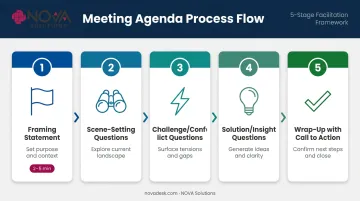
A well-sequenced agenda moves participants from orientation to insight without losing momentum. The "what, why, how" arc is a reliable structure:
- Framing statement (2–5 minutes) — Orient participants to the topic and objectives
- Scene-setting questions — Establish shared context before asking for opinions
- Challenge/conflict questions — Surface disagreement and differing perspectives
- Solution/insight questions — Move toward synthesis and actionable takeaways
- Wrap-up with call to action — Name what was decided or learned, and what happens next
Question design is where the agenda either earns its keep or quietly collapses. Nielsen Norman Group's research on open-ended questions confirms that open-ended questions allow free-form answers and reveal unanticipated insights — closed questions constrain depth. Test each question in advance: if it can be answered in one sentence, it's not ready.
Questions worth using:
- "What's one assumption your organization holds about this topic that may be wrong?"
- "Where have you seen this approach fail, and why?"
Questions to cut:
- "What do you think about [broad topic]?"
- "Can you introduce yourself and share your experience with X?"
Step 5: Set Up the Physical Space
Seating arrangement isn't cosmetic. Research published in the Journal of Experimental Education found that traditional rows generally allow less participation than circular or U-shaped layouts. When participants can see each other, conversation flows more equitably.
Room setup requirements:
- Circular or U-shaped layout so all participants have sightlines to each other
- Adequate aisle width and clear floor space for mobility aids — the U.S. Access Board's ADA standards specify 36 inches minimum clear width for accessible routes and 60-inch diameter for wheelchair turning space
- Reliable AV support if presenting visuals; for virtual sessions, confirm breakout room capability
For training rooms, government spaces, and educational conference settings, NOVA Solutions' circular Conference Tables and Round Collaboration Tables are built for this kind of setup. Both product lines promote equal sightlines across the table and include integrated iMod™ wire management, which keeps cable clutter off the surface — a real consideration when 10 people are working in close proximity.
Both lines are available under GSA Contract GS-28F-005GA, which simplifies procurement for government agencies and educational institutions.
Accessible seating isn't optional for government, education, or publicly accessible facilities — it's a legal requirement. Plan for it from the start rather than retrofitting.
Step 6: Facilitate and Follow Up
Day-of facilitation essentials:
- Open with brief participant introductions — it gets voices in the room early and reduces first-contribution anxiety
- Use a visible timer to maintain equal floor time across segments
- Actively redirect to quieter participants: "We haven't heard from [name] on this yet — what's your read?"
- Close each segment with a brief summary of what was surfaced before moving on
For a 30-minute roundtable, the American Public Health Association recommends a baseline split of 15 minutes for presentation and 15 minutes for group discussion. Longer sessions should allocate more time proportionally to discussion — that's the format's purpose.
Follow-up is where value is captured or lost:
- Send a written summary of key takeaways within 48 hours
- Record sessions when possible (with participant consent)
- Deploy a short post-event survey to capture feedback before attention drifts
What You Need Before Hosting a Roundtable
Preparation quality is the most reliable predictor of roundtable success. A 2023 study in Measuring Business Excellence found that pre-meeting interactions were positively associated with perceived meeting effectiveness, with coordination fully mediating the relationship. That means what happens before participants sit down shapes what happens once they do.
Participant and Speaker Readiness
Send a briefing document at least one week before the session. It should include:
- The discussion topic and context
- The agenda and discussion questions
- Names and brief bios of other participants
- Any expected preparation (a case study, data point, or short position statement)
This eliminates the first 10–15 minutes of cold-start orientation that plagues under-briefed roundtables.
Moderator Preparation
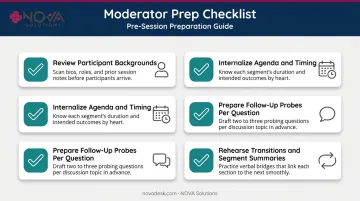
A well-prepared moderator should be able to run the session without referring to notes. That requires:
- Reviewing all participant backgrounds
- Internalizing the agenda and timing
- Preparing follow-up probes for each question ("Tell me more about that" / "Can you give a specific example?")
- Running through transitions and segment summaries in advance
With people-side prep complete, shift focus to the room itself — and every operational detail that makes the session run smoothly.
Materials and Logistics
Confirm these before the day of the event:
- Name placards for in-person sessions (reduces awkward name-asking mid-discussion)
- Handouts or digital materials distributed in advance, not on arrival
- Recording setup confirmed and consent obtained
- Post-event survey ready to deploy immediately after the session closes
Key Factors That Determine Roundtable Quality
Even well-planned roundtables can underperform when a few key variables aren't controlled.
Topic Specificity
Broad topics ("the future of healthcare") let participants stay in safe, surface-level territory. Specific, somewhat provocative questions force real perspective-sharing. Compare "What challenges does your organization face in X?" against "What's one assumption your organization holds about X that may be wrong?" The second question generates the kind of exchange people actually remember.
Participant-to-Moderator Ratio
Beyond 12 participants per moderator, equal participation breaks down. Dominant voices take over; quieter participants disengage. For contentious or high-stakes sessions, 8 is a safer ceiling than 12.
Time Structure
How time is allocated determines the session's character. One practical framework:
- 40% for framing and context-setting
- 20% for open exploration
- 40% for synthesis and action planning
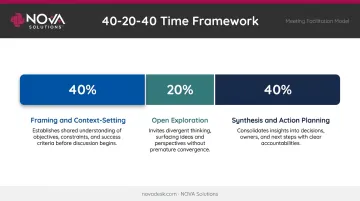
The exact split matters less than having one at all. Unstructured time in group settings defaults to the most confident voice.
Room Comfort and Acoustics
A 2023 indoor environmental quality study in Building and Environment found that noise level and temperature were the primary drivers of perceived comfort. Cognitive performance indicators tracked closely with environmental quality ratings. Poor acoustics and uncomfortable temperatures don't just annoy people — they reduce the quality of thinking. Address both before the session starts, not after it's underway.
When a Roundtable Is the Right Format
Roundtables work best when the goal is collaborative exchange, not information delivery. Choose this format when:
- Participants have comparable levels of expertise (peer groups work; mixed novice/expert groups require more structure)
- The objective is stakeholder alignment, shared sensemaking, or problem exploration
- You're running breakout sessions within a larger conference and need small-group depth
- Training programs require reflective practice, not just content consumption
When a roundtable is the wrong choice:
- There's a clear right answer that needs to be communicated efficiently
- The audience substantially outnumbers available discussion leaders
- Participants lack shared baseline knowledge — productive tension requires a common foundation
This distinction is reinforced by how professional organizations define the format. The MLA specifies that roundtables should center broad questions and avoid formal presentations — a principle EuroSEAS echoes by positioning roundtables as spaces for current issues and emerging developments, not prepared papers. The common thread: roundtables demand active contributors, not passive attendees.
Common Mistakes When Planning and Hosting Roundtables
Skipping Pre-Event Participant Briefing
Walking into a roundtable cold — without knowing the topic in depth or who else is in the room — produces shallow contributions. The first 10–15 minutes get consumed by orientation instead of substance. The briefing document isn't a formality; it's the mechanism that converts attendance into participation.
Neglecting the Moderator's Role
Roundtables without strong moderation become lectures by whoever speaks first and loudest, which defeats the format's purpose entirely. The CDC's focus group guidance flags "domination or sidetracking by a few individuals" as one of the primary failure modes of poorly managed group discussions. Moderators need to be selected, briefed, and prepared — not volunteered for the role five minutes before the session starts.
Ignoring Room Setup and Accessibility
Theater-style rows structurally inhibit roundtable conversation before a single question is asked. Inaccessible seating excludes participants and, in government and educational facilities, creates legal exposure. Both are entirely avoidable with the right furniture and layout planning.
Each of these mistakes shares a common thread: they're all planning failures, not execution failures. Getting the briefing, the moderator, and the room right before participants arrive determines whether a roundtable produces real dialogue or just fills a calendar slot.
Frequently Asked Questions
What is a roundtable format at a conference?
A conference roundtable is a facilitated small-group discussion where participants are assigned to tables by topic or interest, engage directly with subject-matter experts or peers, and rotate between tables in some formats. It contrasts with keynotes and panels, which are one-to-many formats where most attendees observe rather than contribute.
How does a roundtable discussion work at a conference?
A moderator opens with brief framing, participants introduce themselves, and structured questions drive the conversation in timed segments. At the close, each table shares two or three key insights with the room — a synthesis moment that connects the parallel conversations.
What should I expect at a roundtable meeting?
Active participation is required — not passive observation. Discussion is structured but conversational, and you'll leave with peer perspectives and practical insights rather than a formal presentation. Come prepared to contribute a specific perspective or example, not just general opinions.
What makes a good roundtable discussion topic?
The best topics are specific, contested, or practice-oriented — shared challenges, emerging issues without consensus, or lessons learned from real implementations. Broad or purely informational subjects produce surface-level conversation; a slightly provocative, focused question draws out the candid exchange that passive formats rarely achieve.
What is the difference between a roundtable and a panel?
A panel centers on a small set of formal presenters responding to a moderator's questions in front of a largely passive audience. A roundtable is an open, equal-contribution discussion where all voices — including participants — carry the same weight. MLA allows up to eight participants in a roundtable format and explicitly discourages formal presentations.
What is the 40-20-40 rule for meetings?
The 40-20-40 framework allocates 40% of meeting time to framing and context-setting, 20% to open discussion, and 40% to synthesis and action planning. Applied to roundtables, this structure keeps sessions from drifting into extended lectures or ending without clear takeaways.