Introduction
Picture this: a government training facility just completed a $200,000 renovation. New flooring, fresh paint, brand-new computer training tables. Then an ADA compliance review flags two violations — a training table placed 36 inches from the pull-side door, blocking the required maneuvering clearance, and fixed desks without adequate knee clearance underneath.
Neither the door nor the building structure failed. The furniture placement did.
This scenario plays out regularly in training rooms, classrooms, and computer labs across the country. The financial stakes are real: under 28 CFR 36.504, a first Title III ADA violation carries civil penalties up to $75,000, with subsequent violations reaching $150,000. And behind every penalty is a person who couldn't use the space.
This guide walks facility managers, space planners, and procurement officers through the specifics: door clearance dimensions from the 2010 ADA Standards, furniture height and knee clearance requirements, how the two interact in real room layouts, and which buildings must comply.
TLDR: ADA Door Clearance and Furniture Requirements at a Glance
- Minimum clear door width: 32 inches (36 inches if doorway depth exceeds 24 inches)
- Pull-side maneuvering clearance, front approach: 60 inches deep × 18 inches beyond the latch side
- ADA work surface height: 28–34 inches, with knee clearance 27 inches high × 30 inches wide × 8 inches deep
- Accessible workstations require a 30 × 48-inch clear floor space minimum for forward approach
- Furniture must never encroach on door maneuvering clearance zones
What Is ADA Door Clearance and Why Does It Matter?
ADA door clearance refers to the dimensional requirements under the Americans with Disabilities Act — specifically 2010 ADA Standards for Accessible Design, Section 404 — that ensure doors, doorways, and gates on accessible routes can be navigated by wheelchair users, walker users, and people with other mobility aids. These are federal law requirements enforced by the Department of Justice, not voluntary guidelines.
"Door clearance" covers more than just the opening width. It includes:
- Maneuvering clearances: floor space required to approach and operate the door
- Thresholds: height limits at the base of the opening (½ inch maximum for most doors)
- Hardware: operable with one hand, no tight grasping or twisting required
- Opening force: the maximum pounds of force a person must exert to open the door
- Closing speed: how quickly the door swings shut after release
Each requirement affects the others. A door can meet the width standard exactly and still fail ADA compliance because a closer is set too strong or a threshold is a quarter-inch too tall.
Who must comply: Compliance obligations depend on building type and project scope:
- New construction: All commercial and publicly accessible buildings with a permit date on or after March 15, 2012 must meet the 2010 ADA Standards
- Existing buildings: Must remove architectural barriers when "readily achievable" — meaning doable without significant difficulty or expense
- Alterations: When work affects a primary function area, the path of travel to that area must also be brought into compliance, up to 20% of the alteration cost
ADA Door Clearance Requirements: Key Specifications
Clear Width and Vertical Clearance
Door openings must provide a minimum of 32 inches of clear width, measured from the face of the door to the opposite stop when open at 90 degrees. If the doorway depth exceeds 24 inches, the minimum increases to 36 inches.
Vertical clearance requirements:
- 80 inches minimum overall
- 78 inches minimum at door closers and door stops
- No projections below 34 inches into the clear opening
- Between 34 and 80 inches, projections up to 4 inches on each side are permitted
Maneuvering Clearances
This is where most furniture-related violations originate. The required floor space on each side of a door depends on approach direction and door hardware:
| Approach | Side | Perpendicular Depth | Latch-Side Clearance |
|---|---|---|---|
| Front approach | Pull side | 60 inches | 18 inches |
| Front approach | Push side (no closer/latch) | 48 inches | None required |
| Front approach | Push side (closer + latch) | 48 inches | 12 inches |
| Latch-side approach | Pull side | 48 inches | 24 inches |
| Latch-side approach | Pull side with closer | 54 inches | 24 inches |
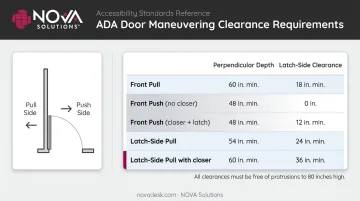
Maneuvering clearances must be completely free of protrusions up to 80 inches high and must have no changes in level (except compliant thresholds).
Thresholds and Hardware
Thresholds:
- New construction: ½ inch maximum height
- Existing/altered thresholds: up to ¾ inch if beveled on both sides at no steeper than 1:2 slope
- A ¼-inch unbeveled lip is enough to catch wheelchair casters and constitutes a violation
Hardware:
- All handles, pulls, latches, and locks must be operable with one hand — no tight grasping, pinching, or wrist twisting
- Lever handles and U-shaped pulls meet this standard; round knobs do not
- Hardware height: 34–48 inches above the floor
- Interior hinged doors and sliding/folding doors: 5 lbf maximum opening force
- Door closers: must take 5 seconds minimum to move from 90 degrees to 12 degrees from latch
Doors in Series and Automatic Doors
Hardware and threshold compliance becomes especially critical in multi-door configurations. Where two doors appear in series (such as a vestibule), at least 48 inches of separation plus the width of any door swinging into that space is required — enough room for a wheelchair user to clear the first door before engaging the second.
Automatic doors must maintain 32 inches minimum clear width in both power-on and power-off modes. Full-powered automatic doors must comply with ANSI/BHMA A156.10-2024; low-energy and power-assisted doors must comply with ANSI/BHMA A156.19-2019. Control activation areas must be positioned outside the door swing arc.
ADA Furniture Requirements: Work Surfaces, Desks, and Clearances
Work Surface Heights and Knee Clearance
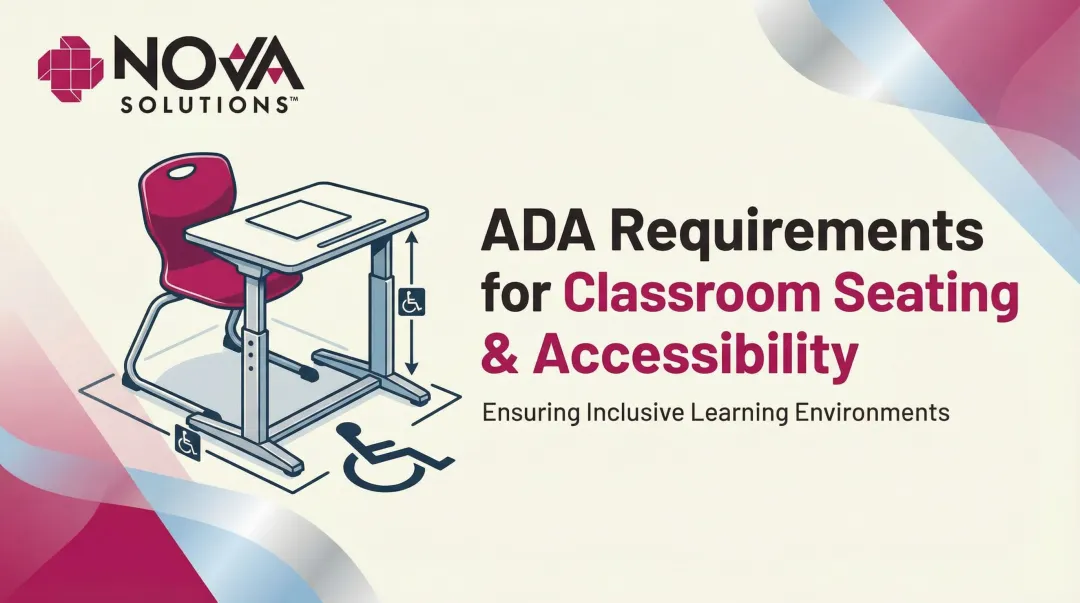
ADA Standards Section 902 requires that accessible dining and work surfaces in public-use areas be 28–34 inches high, measured to the top surface. This range serves both wheelchair users and ambulatory users without requiring separate "accessible" stations.
Under the work surface, Section 306 specifies these minimum knee clearance dimensions:
- Height: 27 inches minimum
- Width: 30 inches minimum
- Depth at 27-inch height: 8 inches minimum
- Depth at 9-inch height: 11 inches minimum
Toe clearance occupies the zone from the floor to 9 inches, extending 17–25 inches under the element.
Common knee clearance obstructions to watch for:
- Center support legs positioned in the user's knee zone
- Fixed drawers or pedestal cabinets under the surface
- Cable raceways or power modules mounted too low
- Modesty panels that extend to the floor
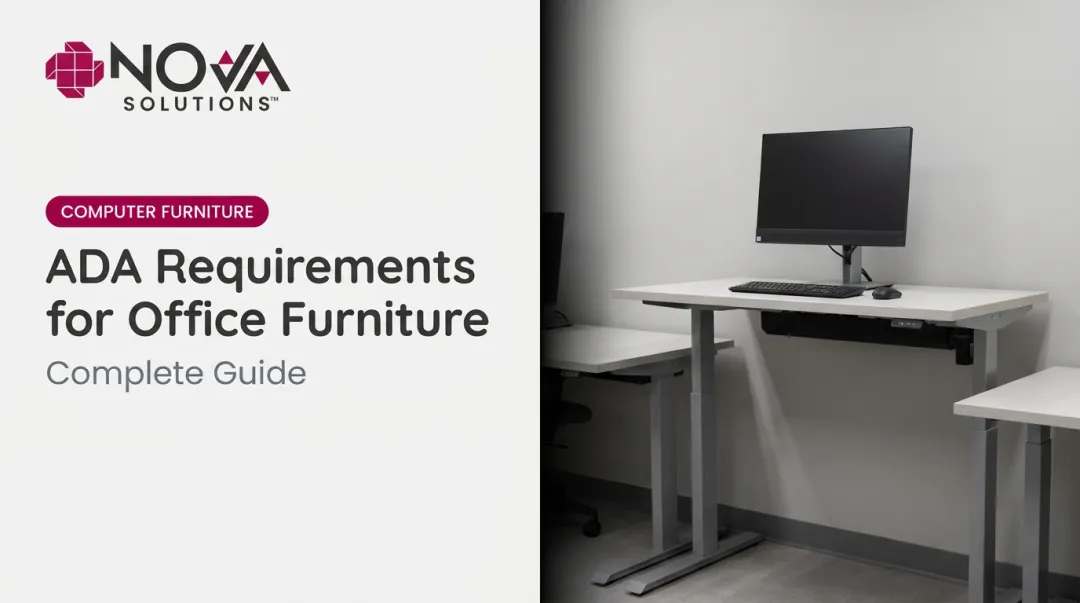
NOVA Solutions' computer training tables use T-Leg and Arched Leg configurations to keep the knee clearance zone fully open. The 32-inch height option meets ADA standards, and height-adjustable sit/stand models extend that range from 30 to 42 inches — useful when a single room serves diverse users across shifts or sessions.
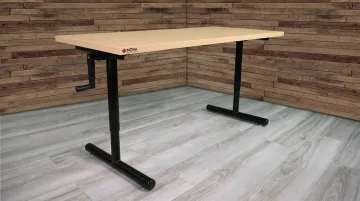
Knee clearance is only one piece of the puzzle. Clear floor space, turning radius, and reach ranges all factor into whether a workstation is truly accessible — not just code-minimum.
Clear Floor Space, Turning Space, and Reach Ranges
Clear floor space (Section 305): Every accessible work surface requires a 30 × 48 inch clear floor area positioned for forward approach, centered on the work surface. This space must connect directly to an accessible route.
Scoping for multi-station rooms (Section 226.1): At least 5% of total work surfaces for non-employees must comply with full ADA specifications. In a 40-station computer training lab, that means at least 2 stations must meet height, knee clearance, clear floor space, and accessible route requirements.
Note the exception under Section 206.2.8: reduced circulation path requirements apply within employee work areas under 1,000 square feet defined by permanently installed partitions. This does not eliminate the 5% scoping requirement for shared workstations.
Reach ranges (Section 308): Any operable component built into furniture — power ports, cable access panels, monitor controls — must fall within:
- Forward reach: 15 inches minimum (low) to 48 inches maximum (high)
- Side reach: same range applies
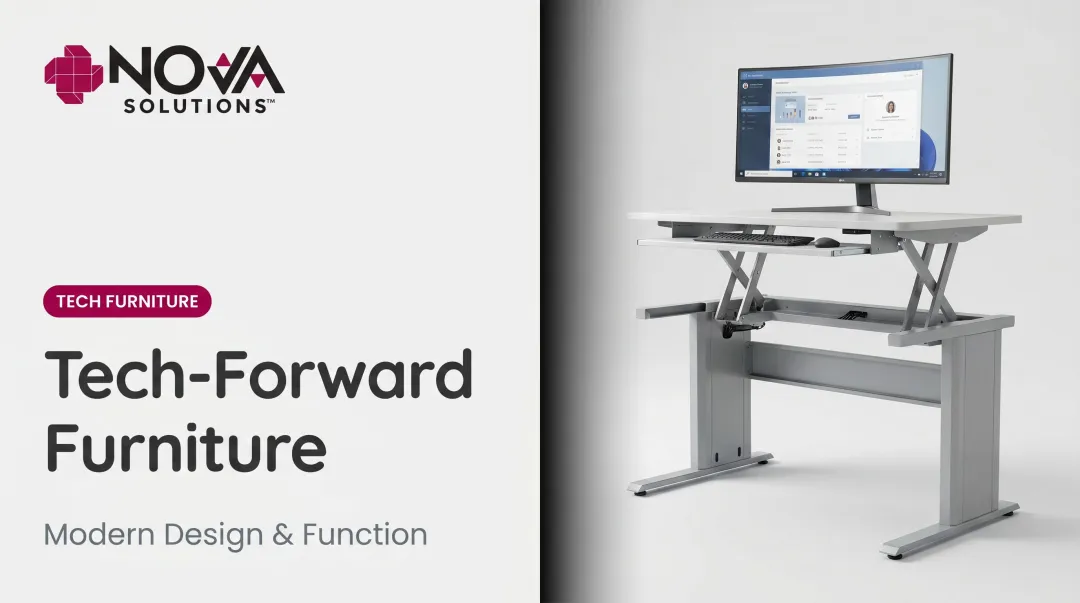
This matters most for technology-integrated furniture. A power strip mounted at the back of a 36-inch-deep training table may be completely out of forward reach range for a wheelchair user. NOVA Solutions' iMod™ wire management system keeps power and cable connections organized within the desk structure itself — within reach range rather than routed to the back of a deep surface where wheelchair users can't reach them.
How Furniture Placement Affects Door Clearance Compliance
A door can pass every dimensional test and still create an ADA violation the moment furniture blocks the maneuvering clearance zone in front of it.
This is one of the most common and preventable compliance issues in training rooms and offices. The door itself hasn't changed. A chair pushed back, a table shifted three feet toward the entry, or a storage cart parked near the pull side can each eliminate the 18-inch latch-side clearance or the 60-inch depth zone required for front-approach pull doors.
Specific rules for door swing and furniture clearance:
- Doors cannot swing into the clear floor space required at accessible work surfaces or fixtures (Section 603.2.3)
- Doors are permitted to swing into required turning spaces (Section 304.4)
- Automatic door controls must have clear floor space located outside the door swing arc (Section 404.3.5)
For room layout planning, map door maneuvering clearance zones on the floor plan first — before placing any furniture. Accessible workstations should not land within those zones.
Under 28 CFR Part 36 Subpart C, rearranging furniture (tables, chairs, display racks) to improve accessibility counts as a "readily achievable" barrier removal action. This means the cost threshold for requiring furniture repositioning is low — organizations cannot claim it's too expensive to move a table away from a door.
That same logic applies when new furniture is being procured. During renovation or fit-out, furniture specifications and door clearances must be evaluated together — procurement is the point where getting it right costs nothing extra; correcting it after installation is far more disruptive.
NOVA Solutions ships furniture fully assembled, which means units arrive with their footprint and clearance dimensions fixed. Facility managers should verify product dimensions against their floor plan's clearance zone map before delivery, not after.
Which Buildings and Spaces Must Comply
Scope of ADA coverage:
| Facility Type | Coverage |
|---|---|
| New commercial construction (permit ≥ March 15, 2012) | Full 2010 ADA Standards apply |
| Existing public accommodations | Barrier removal required when "readily achievable" |
| Alterations to primary function areas | Path of travel must be made accessible up to 20% of alteration cost |
| Federal/GSA facilities | ABA Accessibility Standards (ABAAS) mandatory for all public, common, and employee areas |
| Private clubs and religious organizations | Exempt from Title III |
| Strictly residential facilities | Not covered by Title III (public accommodations within residential buildings are covered) |
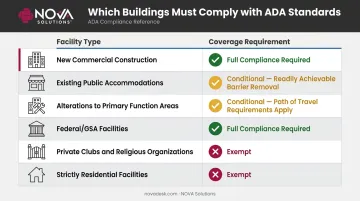
Where door clearance and furniture requirements intersect most often:
- Computer training labs and classrooms
- Conference rooms and boardrooms
- Government service counters and agency offices
- Medical offices and therapy spaces
- University libraries and study areas
- Corporate open-plan offices
These spaces are also where ADA compliance shows up as a hard procurement requirement — not just a best practice. Federal purchasers can source ADA-compliant furniture through NOVA Solutions' GSA contract (GS-28F-005GA) under Special Item Number 33721.
Common ADA Violations and How to Avoid Them
Most frequent door and furniture-related violations:
- Insufficient latch-side clearance on pull doors — a wall, cabinet, or table positioned within 18 inches of the latch side eliminates the required maneuvering space
- Round door knobs — hardware requiring grasping or twisting fails ADA Section 404.2.7; replace with lever handles
- Thresholds over ½ inch without beveled edges — common in older facilities with worn seals or replacement thresholds
- Work surfaces outside the 28–34 inch range — fixed-height desks set at 29 or 36 inches are common in older installations
- Knee clearance obstructions — center pedestal legs, keyboard trays, and cable management hardware mounted in the user zone
Practical avoidance strategies:
- Map clearance zones before finalizing any furniture plan. Draw door maneuvering clearance zones on the floor plan and mark them as no-furniture zones.
- Specify lever hardware from the start — retrofitting after installation costs more than getting it right on the purchase order.
- Choose height-adjustable furniture. A desk that adjusts from 28 to 42 inches serves every user without requiring a separate "accessible" station.
- Verify knee clearance before approving custom specs: width (30 inches minimum), height (27 inches minimum), and depth (8 inches at 27-inch height). Ask manufacturers for documented dimensions — NOVA Solutions publishes these for their ADA-compliant configurations.
- Don't let IT integrators dictate component placement. Power modules, cable ports, and AV controls installed at the back of deep tables can fall outside the 48-inch maximum forward reach range.
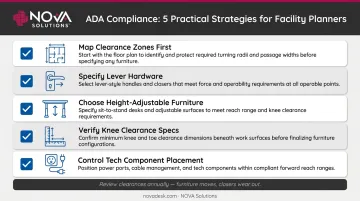
Compliance requires ongoing attention. Furniture gets moved, closers wear out, and hardware loosens over time. Walk each space at least annually to verify that door maneuvering clearances remain unobstructed. Confirm accessible workstations are still positioned correctly and functioning as specified.
Frequently Asked Questions
What are the ADA requirements for door clearance?
The 2010 ADA Standards require a minimum 32-inch clear opening width (36 inches for doorways deeper than 24 inches), 80-inch vertical clearance, and maneuvering clearances on both sides: 60 inches deep with 18 inches beyond the latch side for a front pull-side approach. Thresholds must be ½ inch maximum, hardware must require no more than 5 lbf to operate, and closers must take at least 5 seconds to travel from 90 to 12 degrees.
What is the ADA clearance around furniture?
Accessible work surfaces (Section 902) require a 30 × 48 inch clear floor space for forward approach, knee clearance of at least 27 inches high × 30 inches wide × 8 inches deep, and a surface height between 28 and 34 inches. All clearances must be unobstructed and connected to an accessible route.
Can ADA door clearances overlap with other clearances?
Yes — maneuvering clearances at doors can overlap other required clearances, including clear floor spaces and turning spaces. However, doors generally cannot swing into the clear floor space required at accessible fixtures. Swinging into a turning space is permitted under Section 304.4.
What is the minimum ADA door width for wheelchairs?
The minimum clear opening width is 32 inches for standard doorways (measured with the door open at 90 degrees). Doorways deeper than 24 inches require a 36-inch minimum. This applies to manual, sliding, folding, and automatic doors on accessible routes.
What are ADA requirements for desk and work surface heights?
Section 902 requires accessible surfaces in public-use areas to be 28–34 inches high. Knee clearance underneath must be at least 27 inches high and 30 inches wide.
Does ADA apply to existing buildings or only new construction?
Both. New construction must fully comply with the 2010 ADA Standards. Existing buildings must remove barriers when "readily achievable." When alterations affect primary function areas, the path of travel to those areas must be made accessible — up to 20% of the total alteration cost.