Introduction
Picture a government briefing center where 40 training stations each manage their own cables invisibly, monitors retract into desk surfaces at the touch of a button, and every seat — including those occupied by wheelchair users — has identical access to power, connectivity, and display technology. Now ask: what actually separates that environment from one where someone duct-taped a power strip to a conference table and called it "tech-enabled"?
The gap is intentional design. Smart furniture is defined by how thoroughly technology is engineered into the furniture itself — not simply by whether a device sits nearby.
This review examines what technology-integrated furniture actually consists of, what design principles make it work, and why institutional buyers in education, government, and corporate training need to understand the difference before their next procurement decision.
Key Takeaways
- Smart furniture embeds technology into its structure — wire management, power, height adjustment, monitor integration — rather than retrofitting standard pieces afterward.
- Key institutional applications include computer labs, AV training rooms, government briefing centers, and corporate learning hubs.
- ADA compliance and technology integration are complementary goals, not competing ones, when designed correctly from the start.
- GSA contract availability, fully assembled shipping, and verified ADA certification are the most reliable indicators of institutional-grade quality.
- Integrated durability lowers total long-term cost — no aftermarket add-ons required.
What Is Smart Furniture? Defining Technology-Integrated Design
Smart furniture is any piece designed from the ground up with embedded or complementary technology that extends its core function. That means more than a desk with a USB port bolted on as an afterthought.
True integration includes height-adjustment mechanisms engineered into the frame, power distribution routed internally, monitor systems that retract cleanly into the surface, and cable management that eliminates exposed wires entirely.
The distinction matters because surface-level "tech-friendliness" doesn't hold up under institutional use. Standard furniture placed near technology creates cluttered surfaces, tripping hazards, accessibility gaps, and a slow accumulation of aftermarket fixes that undermine both aesthetics and function.
The Shift Toward Purposeful Integration
Over the past two decades, professional furniture has moved from purely ergonomic or aesthetic priorities toward active, multifunctional design. This shift is most visible in settings where productivity and compliance aren't optional: training facilities, government agencies, university computer labs, and corporate AV environments.
The smart furniture market reflects this demand directly, with significant projected growth driven by institutional adoption. The key categories driving that growth:
- Height-adjustable and sit-stand systems for ergonomic flexibility
- Integrated wire and cable management for clean, compliant environments
- Embedded power and connectivity — outlets, USB charging, and data ports
- Retractable monitor and display systems for space efficiency
- Sensor-driven and app-controlled features gaining traction in newer deployments
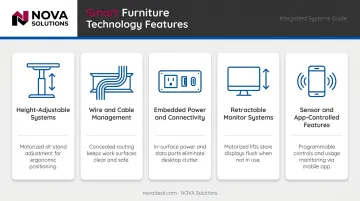
Each category solves a specific failure mode of standard furniture in technology-dense environments.
The Technology Inside: Core Features of Smart Furniture
Height Adjustment and Motorized Mechanisms
Electric sit-stand systems are the most widely understood smart furniture feature, and the research supporting them is substantial. Studies published via NCBI show meaningful reductions in sedentary time and improvements in health outcomes with sit-stand workstation interventions. The American Society of Interior Designers has linked standing desk use to increased productivity in workplace settings.
For institutional furniture, height adjustability serves a second critical purpose: ADA compliance. A desk that adjusts to wheelchair-accessible heights doesn't require a separate "accessible version" — it serves every user from the same unit.
NOVA Solutions' height-adjustable AV lecterns and sit-stand podiums adjust electrically from 30" to 42" (12" of travel) with a 550 lb lift capacity, controlled via touch switch. That range covers seated wheelchair users through standing presenters: one piece of furniture, every user.
Integrated Power and Connectivity
Training and conference environments routinely host users with multiple devices. Research from Forrester found that 66% of employees use two or more devices at work — a figure that has only grown with mobile-first work patterns.
Furniture that embeds power distribution directly eliminates the visible power strips, floor cables, and adapter clusters that standard setups generate. NOVA Solutions offers pop-up power centers, round flush power/USB charging centers, and power/data combinations as integrated options across training desks and conference tables — keeping surfaces clear and keeping every seat productive.
Integrated Wire and Cable Management
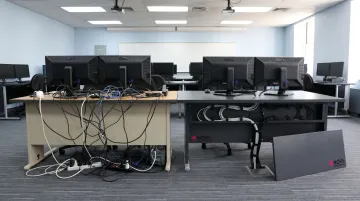
Wire management earns its own category. In technology-heavy environments, it's the feature that gets overlooked during planning and becomes impossible to ignore after installation — because the failure shows up on every surface, every floor, and in every IT service call.
In a 30-seat computer lab, unmanaged cables create:
- Trip and fall hazards along traffic routes
- ADA pathway obstructions
- Visual clutter that undermines professional environments
- Damage risk to equipment from pulled cables and tangled connections
- IT maintenance complexity during equipment changes
NOVA Solutions' iMod™ wire management system addresses this structurally. Cables route through a dedicated compartment on the backside of the furniture unit, with an integrated multi-plug power strip per user and a removable modesty panel (laminate or perforated metal) that provides IT access without exposing wiring during normal use.
The result: a surface that stays clean, a floor that stays clear, and equipment that stays protected. iMod™ ships as a standard feature across NOVA's computer training desks and tables, not an optional add-on. Retrofit kits extend the system to existing furniture from other manufacturers, making it a practical infrastructure investment for facilities that aren't replacing everything at once.
Retractable Monitor and Display Technologies
Two NOVA technologies address the specific challenge of monitors in training environments:
Trolley™ Monitor Lift: A motorized, push-button system that raises monitors from a recessed compartment within the desk surface. When training requires full instructor-to-student visibility, monitors retract completely. Key specs:
- Supports up to 24" widescreen monitors (Trolley™ EXL)
- 3-year warranty with extended coverage available
- Intelligent Motion Technology™ stops movement if obstructed, preventing accidental damage
Downview™ Visual Display: First introduced by NOVA in 1988, this system recesses the monitor beneath a tinted tempered glass viewport in the worksurface. Users view the screen with a natural downward gaze, reducing neck strain while keeping the sightline between instructor and student completely unobstructed. It's available in three viewport sizes supporting up to 24" monitors, backed by a 5-year limited warranty.
Mission College Santa Clara, Borough of Manhattan Community College, and the Department of Veterans Affairs all selected the Trolley™ system specifically to eliminate monitors as a distraction during instruction.
Design Principles That Make Smart Furniture Work
Technology features only deliver value when the design principles holding them together are sound. Five principles determine whether smart furniture actually performs — or just looks like it should.
Form-Function Integration from the Start
Technology retrofitted onto standard furniture compromises both. A clip-on charging pad disrupts surface lines. An external cable tray creates a gap between furniture and function. Factory-integrated solutions — like iMod™ built into the desk structure, or a Trolley™ system engineered into the surface from the design stage — maintain structural integrity and clean aesthetics simultaneously.
NOVA Solutions ships products fully assembled with technology components factory-installed and tested before delivery. That assembly approach is a quality guarantee, not just a logistics convenience.
Modularity and Adaptability
Institutional buyers need furniture that serves multiple configurations. A training room that functions as a lecture hall on Monday, a collaborative workshop on Wednesday, and an individual testing environment on Friday requires furniture built for reconfiguration — not replacement.
NOVA's collaboration tables are available in Keystone, D-Top, round, and boat-shaped configurations. Training tables support single and double-user layouts across multiple width and depth dimensions. The modular design allows spaces to adapt to changing group dynamics and instructional needs without swapping out furniture.
Materials Built for Technology-Dense Environments
Smart furniture places demands on materials that standard furniture doesn't face:
- Surfaces must withstand repeated height adjustment cycles
- Embedded hardware needs protection from spills and impact
- Structural components must support electronics weight without flexing
NOVA uses high-pressure laminate worksurfaces, 2mm PVC edge banding for wear resistance, and robust column legs rated to 550 lbs for height-adjustable units. The iMod™ compartment protects electrical components from the user environment while remaining accessible for IT maintenance.
Aesthetic Restraint
The best technology disappears into the furniture. Cable routes are invisible. Charging surfaces are flush. Adjustment mechanisms are silent. In professional environments, visual calm supports focus — and a clean, uncluttered room signals organizational competence.
NOVA's laminate finishes span ten standard colors (from Wild Cherry to Graphite Nebula) with matching base and metal hardware options, ensuring that technology integration doesn't mean sacrificing visual consistency with the surrounding environment.
ADA Compliance as Engineering, Not Afterthought
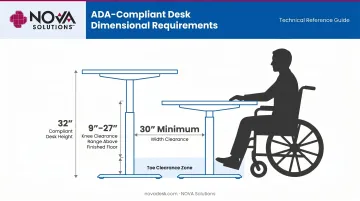
ADA requirements — reach ranges, clearance dimensions, operable part accessibility — must be engineered in from the design stage. They can't be effectively bolted on later.
NOVA's ADA-compliant products meet specific dimensional requirements: 32" compliant desk height, knee clearance between 9" and 27" above finished floor with 30" minimum width, and toe clearance specifications that accommodate wheelchair users at every workstation. Technology features — iMod™, Trolley™, Downview™ — are preserved in ADA configurations. Accessible furniture doesn't mean stripped-down furniture.
Smart Furniture in Professional and Institutional Environments
Corporate Training Rooms and Conference Facilities
Corporate training environments demand high-density seating, frequent reconfiguration, and consistent AV access at every position. Purpose-designed training furniture handles these demands where adapted residential or standard office pieces fail.
When outdated or poorly integrated room technology creates friction, the cost is measurable. Research cited by industry sources suggests employees lose roughly 3 hours of productivity per week to meeting technology issues — a figure that points directly at environments where furniture and technology integration haven't been treated as a single design problem.
Government and Educational Procurement
Institutions in these sectors often operate under procurement frameworks requiring verified compliance with federal standards. Furniture available through established contract vehicles reduces procurement risk, eliminates custom compliance work, and accelerates deployment timelines.
NOVA Solutions holds GSA Contract GS-28F-005GA (February 2017 through February 2027) at 61.71% off list price, Net 30 terms. Coverage includes AV lecterns, training desks and tables, conference tables, collaboration furniture, study carrels, eSports desks, and retrofit kits under SINs 33721 and OLM.
Additional contract vehicles include:
| Contract | Number | Discount | Expiration |
|---|---|---|---|
| PEPPM National | #548362-163 | 60% off | December 2028 |
| TIPS | #230301 | 60% off | May 2028 |
| California CMAS | #4-18-71-0130C | — | — |
State contracts are also active in Alabama, Arkansas, Louisiana, and New York (#PC70250).
The "Ships Fully Assembled" Advantage
Large-scale institutional deployments — 40-seat computer labs, multi-room agency training centers — cannot absorb extended on-site assembly. Furniture that arrives ready to use reduces installation labor and minimizes disruption to ongoing operations. Technology components are factory-tested before delivery, so setup is straightforward from day one.
NOVA's computer training desks, training tables, AV lecterns, sit-stand podiums, and study carrels all ship fully assembled. Collaboration tables ship assembled in sections due to size. For large multi-room rollouts, knowing which pieces arrive floor-ready versus in sections directly affects your installation timeline.
Benefits of Smart Furniture Across Settings
Productivity and Focus
When technology infrastructure is built into furniture, users don't waste time managing cables, hunting for power, or reconfiguring their setups between sessions. That friction-free environment compounds across every class, meeting, or training cycle.
In training environments specifically, the Trolley™ Monitor Lift's ability to remove screen distractions on demand supports instructor-led sessions — a benefit noted across NOVA installations at Kennesaw State University and the Department of Veterans Affairs.
Accessibility and Inclusivity
Smart furniture designed to ADA standards ensures all users can participate fully without requesting special accommodation. Separate "accessible" setups signal exclusion and create coordination overhead — height-adjustable, ADA-engineered furniture eliminates that distinction at the source.
CDC data notes that 1 in 4 US adults has some form of disability. In institutional environments serving the general public — government offices, universities, community colleges — that figure translates directly to daily use requirements.
Long-Term ROI
Smart furniture typically requires higher upfront investment than standard alternatives. The total cost picture looks different over a 5–10 year institutional cycle:
- Integrated technology eliminates aftermarket add-on costs
- Durable materials reduce replacement frequency
- Made-in-USA manufacturing supports consistent quality control
- Fully assembled delivery reduces installation labor costs
- Warranty coverage (3-year Trolley™, 5-year Downview™) extends supported lifespan
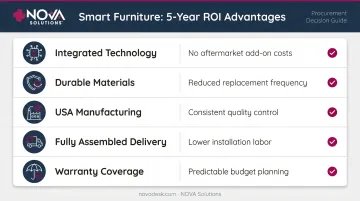
For institutions managing multi-year procurement cycles, that warranty coverage means fewer emergency replacements and more predictable budget planning across departments.
Emerging Trends and the Future of Smart Furniture Design
AI-Responsive and Sensor-Driven Features
The leading edge of the market involves furniture that detects occupancy, stores user preferences (height, monitor angle), and feeds data to facility management platforms. Occupancy sensor integration with room scheduling systems is already present in high-end corporate and healthcare deployments. Educational and government adoption will follow as IoT infrastructure becomes standard in institutional construction and renovation.
Sustainability as a Parallel Imperative
Durability is itself a sustainability attribute: furniture that lasts 10+ years under daily institutional use simply doesn't enter the waste stream. BIFMA's sustainability framework and the ANSI/BIFMA e3 standard are increasingly referenced in institutional procurement criteria, reflecting growing demand for responsibly sourced materials with reduced lifecycle impact.
Longevity-focused design and sustainability goals align more often than they conflict. For institutional-grade furniture, they're the same engineering priority expressed in two different languages.
Smart Buildings, Smart Furniture
As buildings become more connected, furniture is following. Integration with room scheduling, occupancy tracking, and energy management is already shifting from premium feature to expected specification in institutional procurement.
What separates future-ready furniture from the rest comes down to how it was designed in the first place:
- Built-in technology integration — wire management, monitor systems, and sensor-ready infrastructure included at the manufacturing stage
- Compatibility with facility platforms — room scheduling and occupancy data that flows into existing building management systems
- Upgrade paths without replacement — modular components that accommodate new technology without requiring full furniture cycles
Furniture engineered around technology from the start won't need another generation of retrofitting. That distinction will matter more as institutional IoT becomes the norm rather than the exception.
Frequently Asked Questions
What is futuristic furniture?
Futuristic furniture refers to designs that anticipate and embed emerging technologies — AI-driven adjustment, integrated connectivity, sensor-based responsiveness — into everyday functional pieces. The goal is fully adaptive environments where furniture responds to users and communicates with building systems without manual input.
What is the lifespan of a smart couch or consumer smart furniture?
Consumer smart furniture typically follows a 5–8 year electronics replacement cycle tied to the embedded tech. Commercial-grade institutional furniture can exceed 10 years with proper maintenance, owing to higher durability standards and heavier daily use requirements.
What is the biggest furniture trend in 2026?
Accessibility-by-design, ADA-compliant height adjustability, and seamless technology integration — wire management, embedded power, connectivity — are among the most prominent directions in institutional and commercial settings.
How does ADA compliance factor into smart furniture design?
ADA compliance sets specific requirements for reach ranges, clearance dimensions, and operable part accessibility that must be engineered into furniture from the design stage. Height adjustability ranges, control placement, and connectivity feature locations all need to meet ADA standards to ensure usability for individuals regardless of mobility or dexterity.
What should institutions look for when purchasing technology-integrated furniture?
Evaluate wire management quality, height-adjustability range, verified ADA compliance, GSA or cooperative contract availability, and whether products ship fully assembled. Manufacturers who provide documented specifications rather than vague promotional language are the most reliable indicator of institutional-grade quality.