
Introduction
Most ADA clearance violations in training rooms and conference facilities aren't intentional — they're planning errors that don't surface until a wheelchair user tries to navigate a fully furnished room.
ADA clearances around furniture are the minimum open floor space dimensions required at, under, and around furniture pieces so wheelchair users and individuals with mobility aids can approach, position themselves, and use surfaces independently. Getting those dimensions right matters for two reasons: legal compliance and actual usability. A space can pass a checklist review and still fail a real user.
ADA clearance requirements are frequently cited in procurement specs, then routinely misapplied. High-density environments — training rooms, computer labs, conference facilities — are where mistakes happen most often.
This guide covers exact dimensions from the 2010 ADA Standards, how they apply to specific furniture types, and where the most common planning errors occur.
Key Takeaways
- The minimum clear floor space at any accessible element is 30 inches wide by 48 inches deep (Section 305.3)
- Knee clearance under tables and desks must be at least 27 inches high, 30 inches wide, with toe clearance extending 17 inches minimum beneath the surface
- Aisles between furniture must be 36 inches wide minimum; turning spaces require a 60-inch diameter circle or T-shaped equivalent
- ADA clearance requirements apply to how furniture is arranged — buying "ADA-labeled" furniture does not automatically make a space compliant
- Furniture with ADA clearances built in (such as NOVA Solutions' training desks) removes guesswork from layout compliance at the procurement stage
What Are ADA Clearances Around Furniture?
ADA clearances refer to the specific dimensions of open, unobstructed floor and under-surface space that must exist at and around furniture so wheelchair users can approach, position themselves, and use a surface without assistance. The governing framework is the 2010 ADA Standards for Accessible Design — specifically Section 305 for clear floor space and Section 306 for knee and toe clearance.
Two Types of Clearance
These two requirements work together at desks, dining tables, and work surfaces:
- Clear floor space — the open area in front of or beside a piece of furniture for wheelchair approach and positioning
- Knee and toe clearance — the open space beneath a surface that allows a wheelchair user to pull forward and work at the surface
Clearance Is About Placement, Not Just Product Specs
A desk can meet every ADA dimension on paper and still create a compliance violation if placement blocks the required clearances. Compliance lives in how furniture occupies a room — not in what the product spec sheet says.
The 2010 ADA Standards Chapter 9 (Built-In Elements) covers dining and work surfaces under Section 902. DOJ guidance further clarifies that Title III barrier removal obligations — which include rearranging tables and chairs — extend to movable furniture, not just fixed building elements.
Key ADA Clearance Dimensions for Furniture
These measurements come directly from the 2010 ADA Standards and apply wherever wheelchair users need to access furniture elements: training rooms, conference rooms, offices, and cafeterias alike.
Clear Floor Space at Furniture Elements
Section 305.3 requires clear floor space of 30 inches wide by 48 inches minimum deep. This space must:
- Be free of obstructions
- Not slope more than 1:48
- Connect to an accessible route
- Be positioned for a forward approach at desks and work surfaces
The alcove rule: Where clear floor space is confined on all or part of three sides, the required width increases. For a forward approach where depth exceeds 24 inches, width must be 36 inches minimum. For a parallel approach where depth exceeds 15 inches, width must be 60 inches minimum (Section 305.7). This catches a lot of planners off guard in training rooms where desks sit against walls.
Knee and Toe Clearance Under Surfaces
Section 306 defines both clearance types. Here's the quick reference:
| Clearance Type | Dimension | Requirement |
|---|---|---|
| Knee clearance height | 9" to 27" above floor | Required range |
| Knee clearance width | 30" minimum | Full width |
| Toe clearance depth | 17" minimum | At 9" above floor |
| Toe clearance maximum depth | 25" | At 9" above floor |
| Knee clearance depth at 9" | 11" minimum | Tapers up to 25" max |
| Surface height | 28"–34" | Section 902.3 |
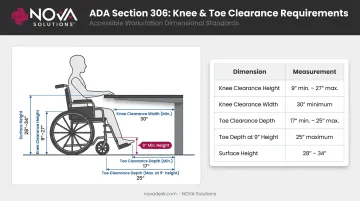
Between 9 and 27 inches above the floor, knee clearance depth may taper at a rate of 1 inch per 6 inches of height. Toe clearance space extending more than 6 inches beyond available knee clearance at 9 inches high does not count toward the requirement.
Surface height between 28 and 34 inches (Section 902.3) accommodates both wheelchair users and standard chair users — which is why height-adjustable desks work well in mixed environments. NOVA Solutions' computer training desks and tables ship at 30" or 32" (the latter specifically designated as ADA Height Compliant), with optional height-adjustable legs available on training tables.
Accessible Routes and Turning Space
- Aisles: Section 403.5.1 requires 36 inches minimum clear width on accessible routes
- 180-degree turns: Where a route turns around an obstruction narrower than 48 inches, Section 403.5.2 requires 42 inches approaching, 48 inches at the turn, and 42 inches leaving — or simply 60 inches at the turn, dropping the approach/exit minimums entirely
- Turning space: Section 304.3 permits a 60-inch diameter circular space or a T-shaped space within a 60-inch square with 36-inch-wide arms and stem
Turning spaces may overlap with clear floor spaces at nearby elements — meaning one open area can serve multiple compliance functions. Useful in compact training rooms, but it doesn't allow you to eliminate required clearances entirely.
Applying ADA Clearances by Furniture Type and Space
Training Rooms and Classroom Desks
Each student workstation serving a wheelchair-accessible position needs:
- 30" × 48" clear floor space positioned for forward approach
- 27" minimum knee clearance height, 17" toe clearance depth minimum
- 36" accessible aisle behind the workstation
Open-base or C-leg desk designs provide the best knee clearance geometry. Pedestal or fixed-panel bases that run down to the floor create problems — eating into the under-desk space that wheelchair users need. NOVA Solutions' ADA-compliant training desks are engineered with these clearances as part of the base design, which reduces the measurement burden for facility managers configuring rooms from scratch.
How many accessible positions? Section 226.1 requires at least 5 percent of work surfaces provided for public use to comply with Section 902, dispersed throughout the space (Section 226.2). For a 20-seat training room, that's a minimum of one accessible position — and placement matters. Clustering accessible positions in one corner doesn't meet the dispersal requirement.

Conference and Meeting Room Tables
Conference tables must provide standard knee clearance dimensions plus at least one wheelchair-accessible position (more for larger tables, based on the 5 percent threshold). U-shaped configurations and fixed-base tables create the most problems: end positions frequently lack knee clearance, and access aisles inside the U can drop below 36 inches when chairs are pushed in.
NOVA Solutions' conference tables are available in ADA-compliant configurations and meet the 28–34 inch surface height range. For high-density meeting rooms, a practical tip: measure clearances with chairs in their occupied positions, not pushed in, for an accurate picture of actual usability.
Reception and Service Counters
Where a forward approach is provided at a service counter:
- Knee clearance must be provided at the accessible portion
- Counter height for the accessible section: 28–34 inches
- Clear floor space: 30" × 48" minimum
Side-approach counters don't require knee clearance but still need the full 30" × 48" clear floor space.
Outdoor and Cafeteria Settings
Same dimensional rules apply, with two additional factors:
- Outdoor surfaces must be firm and stable
- Slope across the clear floor space cannot exceed 1:48 in any direction
Common Mistakes and Misconceptions About ADA Furniture Clearances
Mistake 1: "ADA-Labeled" Furniture Makes a Space Compliant
A desk with correct knee clearance dimensions still creates a violation if an adjacent chair, cable run, or neighboring desk blocks the required 30" × 48" clear floor space in front of it. The furniture's spec sheet doesn't determine compliance — the arrangement does.
Mistake 2: Movable Furniture Is Exempt
Many facility managers assume ADA clearance requirements only govern fixed, built-in elements. Technically, the 2010 Standards target fixed components — but DOJ Title III regulations (Section 36.304) explicitly list rearranging tables, chairs, vending machines, and other furniture as an example of barrier removal where readily achievable.
In training and conference rooms that get rearranged regularly, movable furniture that blocks accessible routes or eliminates clearance zones becomes an ADA barrier in practice. Title II and Title III both require accessible features to be maintained in operable working condition — not just present at installation.
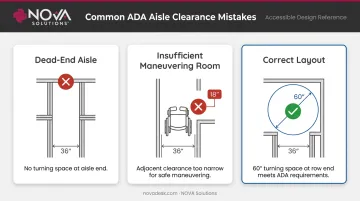
Mistake 3: A 36-Inch Aisle Is Sufficient Everywhere
Assuming a 36-inch gap between furniture rows is enough to achieve compliance misses several scenarios:
- A 36-inch aisle that dead-ends at a wall without turning space creates an inaccessible dead end regardless of width
- Areas immediately adjacent to wheelchair seating positions need additional maneuvering room beyond the baseline aisle width
- Turning points require 60-inch clearances that a standard 36-inch aisle doesn't provide
The DOJ's accessible meetings guidance specifically notes that aisle width should be measured with chairs pulled out and occupied — not in their stored or pushed-in positions.
Frequently Asked Questions
Does ADA apply to furniture?
ADA regulations apply directly to fixed and built-in furniture elements like counters, built-in desks, and fixed tables. For movable furniture, placement must still support ADA-compliant clearances and accessible routes — a space with compliant structure but blocked pathways remains inaccessible under Title II and Title III maintenance-of-access requirements.
What is the minimum clearance for ADA?
The minimum clear floor space at any accessible element is 30 inches wide by 48 inches deep. Aisles must be at least 36 inches wide, and turning space requires a 60-inch diameter circle or T-shaped equivalent. Knee clearance under surfaces is a separate requirement: 27 inches high minimum, 30 inches wide, with toe clearance extending at least 17 inches deep.
What is the required knee clearance under an ADA-compliant desk or table?
Knee clearance must be at least 27 inches high and 30 inches wide, with toe clearance extending a minimum of 17 inches deep beneath the surface (up to 25 inches). Surface height must fall between 28 and 34 inches.
How wide do aisles need to be around furniture in a training room or classroom?
Primary accessible routes must be 36 inches wide minimum. Where wheelchair users need to turn or reverse at the end of a row, a 60-inch turning space must be available.
Can movable furniture create an ADA violation?
Yes. While ADA standards technically govern fixed elements, consistently placing movable furniture in ways that block accessible routes or eliminate required clearance zones constitutes an ADA barrier — especially in institutional settings subject to ADA inspections or complaints. DOJ regulations identify furniture rearrangement as a barrier removal obligation.
How much turning space is required around wheelchair-accessible furniture?
A 60-inch diameter circular turning space or a T-shaped turning space (60 inches wide and 60 inches deep with 36-inch arms and stem) is required wherever a wheelchair user must reverse direction. This turning space may overlap with clear floor space at nearby furniture elements, allowing it to serve multiple compliance functions in tighter layouts.