That gap — between a legitimate employee need and a clear employer response — is where most ADA liability begins. The law doesn't require perfection, but it does require engagement. And many employers, particularly those without dedicated HR infrastructure, simply don't know where to start.
This guide covers the core of what Title I of the ADA requires: who is covered, what reasonable accommodation actually means, how to handle a request properly, and what physical workspace accessibility looks like in practice.
TL;DR: Key ADA Responsibilities at a Glance
- The ADA applies to private employers, state/local governments, and employment agencies with 15 or more employees (some states set a lower threshold)
- Covered employers must provide reasonable accommodations to qualified employees with disabilities — unless doing so creates undue hardship
- Accommodations include schedule flexibility, modified duties, accessible workstations, and assistive equipment
- Employers must engage in a good-faith interactive dialogue when a request is made — ignoring it is a violation
- Non-compliance risks EEOC charges, back pay liability, and legal fees
- Most exposure comes from poor documentation, not bad intentions
Who the ADA Covers — and What "Disability" Really Means
Covered Employers
Title I of the ADA applies to:
- Private employers with 15 or more employees
- State and local government employers
- Employment agencies and labor organizations
- Joint labor-management committees
The 15-employee threshold is the federal floor. Several states set stricter standards — California covers employers with 5 or more employees, and New York's Human Rights Law covers all employers in the state. Employers should verify their state's rules before assuming only federal standards apply.
The Three-Part Definition of Disability
Under the ADA, a disability is:
- A physical or mental impairment that substantially limits one or more major life activities
- A record of such an impairment
- Being regarded as having such an impairment
Following the ADA Amendments Act of 2008 (ADAAA), "substantially limits" is interpreted broadly and is not a demanding standard.
Episodic conditions and impairments in remission still qualify if they would substantially limit a major life activity when active. Mitigating measures — medication, for example — are generally not considered when assessing whether a disability exists.
Who Qualifies as a "Qualified Individual"
To qualify under the ADA, an employee must meet two criteria:
- Satisfies the skill, experience, and education requirements of the job
- Can perform the job's essential functions with or without reasonable accommodation
What Counts as a Reasonable Accommodation
What "Reasonable Accommodation" Actually Means
A reasonable accommodation is any modification to a job, work environment, or how work is performed that enables a qualified individual with a disability to apply for a job, perform essential functions, or access equal employment benefits.
Common Accommodation Categories
| Category | Examples |
|---|---|
| Schedule & leave | Flexible start times, unpaid leave, modified break schedules |
| Job restructuring | Redistributing marginal tasks, modifying non-essential duties |
| Policy modifications | Adjusting conduct or dress code rules |
| Equipment & technology | Assistive software, amplified phones, ergonomic workstations |
| Physical workspace | Accessible layouts, lowered surfaces, reserved parking |
The Undue Hardship Limit
Employers are not required to provide an accommodation that would cause significant difficulty or expense relative to the organization's size, financial resources, and operational structure. This threshold is high.
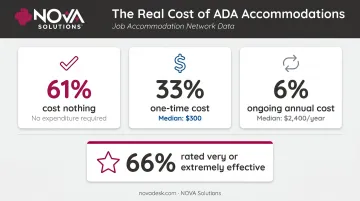
According to the Job Accommodation Network (JAN), 61% of accommodations cost nothing, 33% carry a one-time median cost of $300, and only 6% involve ongoing costs (median: $2,400 annually). 66% of employers also rated their accommodations as very or extremely effective — a reminder that "hardship" is a narrow bar, not a routine escape hatch.
What Accommodation Does NOT Require
- Eliminating essential job functions
- Creating a new position
- Providing personal-use items (hearing aids, eyeglasses, wheelchairs) that an employee needs both on and off the job
One important distinction: accommodating a disability is not the same as excusing conduct. Employers can hold all employees — including those with disabilities — to the same legitimate workplace behavior standards.
The Reasonable Accommodation Request Process
How a Request Is Triggered
Employees do not need to invoke the ADA by name or use the phrase "reasonable accommodation." Any time an employee connects a job-related difficulty to a health condition, a request may have been made. Examples include:
- "I'm having trouble meeting my 8 a.m. start time because of ongoing medical treatments."
- "My doctor says I can't lift more than 10 pounds — can my duties be adjusted?"
- "The lighting in this workspace is triggering my migraines."
Each of these should prompt a response, not silence.
The Interactive Process
Once a request is made, the employer and employee must engage in an informal, good-faith dialogue to identify the barrier and explore effective accommodations. Both parties contribute: the employee understands their limitations; the employer understands the operational context.
Skipping this dialogue — even without formally denying a request — can itself constitute an ADA violation and expose the employer to an EEOC charge.
Requesting Medical Documentation
If the disability or need for accommodation is not obvious, employers may request documentation from a healthcare provider — but only to confirm the disability and establish the need for accommodation. All medical information must be:
- Kept strictly confidential
- Stored separately from personnel files
- Shared only with those who have a legitimate need to know
Choosing Among Effective Options
The employer has final discretion to select among effective accommodations. The employee's preference should receive primary consideration, but the employer may choose an equally effective alternative — including one that costs less. What's not acceptable: denying a request outright without exploring alternatives first.
Keeping the Process Current
Accommodations need ongoing attention, not just initial approval. Circumstances change — job duties shift, disabilities evolve, work environments get restructured — and any of these can require revisiting what's in place. Build in periodic check-ins to confirm the accommodation still works.
Document every step throughout the process:
- Initial request and how it was received
- Notes from the interactive process discussion
- The accommodation selected and the reasoning behind it
- Any follow-up reviews or adjustments made
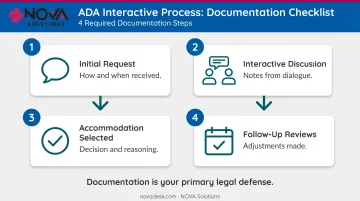
That documentation is your primary defense if a dispute arises.
Physical Workspace Accessibility: Where Environment Meets Compliance
The Employer's Physical Accessibility Obligation
Under Title I, employers must make work environments accessible as a reasonable accommodation — covering workstations, break rooms, restrooms, training rooms, and any facility an employee uses for work-related activities. The U.S. Access Board provides specific dimensional standards:
- Clear floor space: 30" × 48" minimum
- Knee clearance height: 27" minimum
- Reach ranges: 15" to 48" unobstructed
- Work surface height: 28" to 34" above finished floor
Accessible Workstation Design in Practice
An accessible workstation isn't just about height. It requires:
- Adjustable or appropriately fixed surface heights for wheelchair users
- Adequate knee and toe clearance beneath work surfaces
- Clear floor space for mobility devices to approach and maneuver
- Equipment controls within accessible reach ranges
- Wire management that eliminates floor-level hazards
Cables on the floor are a frequently underestimated hazard — one that creates real safety risks for wheelchair users, employees with visual impairments, and anyone using a mobility aid. NOVA Solutions' iMod™ wire management system routes and conceals cables within a compartment on the backside of each unit, keeping the floor clear and connections accessible without physical strain.
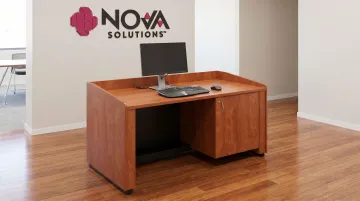
The removable modesty panel provides quick access to power strips and equipment without requiring users to reach under the desk.
Training and Conference Room Accessibility
Training rooms are a frequently overlooked compliance risk. When employers host training events, orientations, or meetings, the furniture layout and equipment setup must accommodate all participants, including those using wheelchairs or other mobility devices.
The obligation extends to third-party venues as well. If you contract with an external facility for a company training event and it's inaccessible, the employer bears that liability.
Purpose-built accessible furniture solves this proactively. NOVA Solutions manufactures ADA-compliant computer training desks and tables at 32" heights, meeting knee clearance minimums of 11" depth at 9" above the floor and 30" minimum width, in single and double-user configurations. Their product line covers the full range of training room needs:
- Sit/stand AV lecterns adjust electrically from 30" to 42", accommodating both seated wheelchair users and standing presenters
- Trolley™ monitor lifts raise and lower screens with push-button activation, removing the need for physical manipulation by users with limited dexterity
Because NOVA's products ship fully assembled, employers can implement accommodations immediately upon delivery — the standard lead time is 50 days after receipt of order — rather than waiting for on-site assembly.
Universal Design as a Proactive Strategy
Adjustable-height surfaces, clear floor plans, and integrated wire management improve usability across a broad range of users — not only those with documented disabilities. Employers who audit their environments before a request is made reduce reactive, one-off accommodations and lower their overall compliance exposure.
Common ADA Myths That Get Employers in Trouble
Myth: Accommodations Are Expensive
JAN data shows 61% of accommodations cost nothing, and one-time costs average $300. Eligible small businesses can also offset expenses through IRS tax incentives:
- Disabled Access Credit (Form 8826): Up to $5,000 for businesses with $1M or less in gross receipts or 30 or fewer full-time employees
- Barrier Removal Tax Deduction: Up to $15,000 per year for qualified accessibility expenses
Myth: Good-Faith Efforts Still Lead to Lawsuits
The EEOC's mediation program resolves many charges before litigation. The EEOC received 88,531 new discrimination charges in FY 2024 — up over 9% from FY 2023 — but most ADA employment disputes settle through negotiation or mediation, not court. Litigation becomes far more likely when requests are ignored or mishandled.
Myth: Employers Can't Discipline Employees With Disabilities
EEOC guidance is clear: employers may apply the same performance and conduct standards to all employees. Discipline or termination is permissible when:
- The action is unrelated to the disability
- The employee cannot perform essential functions even with accommodation
- The employee poses a documented direct threat to workplace safety
Penalties for Non-Compliance and How to Protect Your Organization
EEOC Enforcement Basics
Employees and applicants have 180 days to file a charge with the EEOC (or 300 days if a parallel state or local law applies). Remedies can include hiring, reinstatement, back pay, attorneys' fees, and reasonable accommodation itself. Compensatory and punitive damages are capped by employer size:
| Employer Size | Damages Cap |
|---|---|
| 15–100 employees | $50,000 |
| 101–200 employees | $100,000 |
| 201–500 employees | $200,000 |
| 500+ employees | $300,000 |
Practical Steps to Reduce Risk
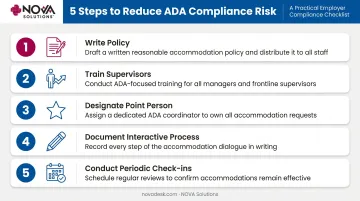
- Write a reasonable accommodation policy and distribute it to all employees
- Train supervisors to recognize accommodation requests and escalate appropriately, since managers are often the first point of contact
- Designate a point person to manage accommodation requests and maintain documentation
- Document the interactive process thoroughly — every conversation, every option considered, every decision made
- Conduct periodic check-ins with employees whose accommodations are in place
Free Compliance Resources
- Job Accommodation Network (JAN): Free, confidential consulting on accommodation options at askjan.org
- EEOC Technical Assistance: Publications and guidance at eeoc.gov
- ADA National Network: 10 regional centers offering training and guidance at adata.org
Frequently Asked Questions
What are the most common ADA violations in the workplace?
The most frequently cited issues include failing to engage in the interactive accommodation process, refusing reasonable accommodations without documenting undue hardship, asking prohibited medical questions before a job offer, and retaliating against employees who request accommodations.
Does the ADA cover conditions like lupus and Meniere's disease?
Yes, both conditions can qualify as ADA disabilities if they substantially limit one or more major life activities. The ADAAA of 2008 specifically extended coverage to episodic and variable conditions, meaning the analysis applies even when symptoms fluctuate or are managed with medication.
How many employees does a company need before the ADA applies?
Title I covers employers with 15 or more employees. However, many state anti-discrimination laws set a lower threshold — California covers employers with 5 or more, and New York covers all employers statewide. Always check applicable state law.
What qualifies as "undue hardship" under the ADA?
Undue hardship means the accommodation would require significant difficulty or expense relative to the employer's size, financial resources, and operational structure — inconvenience or modest cost doesn't qualify. Each case is evaluated individually, and the employer must document specific reasons the hardship claim applies.
Can an employer ask about an employee's disability or require a medical exam?
Pre-offer, disability-related questions and medical exams are prohibited. Post-offer, exams are permitted if applied uniformly to all candidates in the same job category. Once employed, any medical inquiry must be job-related and justified by business necessity.
What happens if an employer ignores an accommodation request?
Ignoring a request can constitute an ADA violation even if no formal accommodation was denied — the failure to engage in the interactive process is itself actionable. This can result in an EEOC charge, investigation, and liability for back pay and legal fees.