Introduction
Picture this: a newly renovated lab opens after months of planning and significant budget investment. The benches look sharp. The storage units are exactly what was specced. But within two weeks, researchers are complaining — the workstations are cramped, cables snake across every surface, wheelchair users can't reach critical equipment, and there's nowhere for the team to gather and think through a problem together.
This outcome is more common than most facilities managers want to admit. And it almost always traces back to the same root cause: furniture was selected in isolation, without involving the people who actually work in the space.
A collaborative approach to lab furniture design means bringing the right stakeholders into every decision from the start. End users, facilities teams, architects, procurement leads, and a knowledgeable furniture partner all need to be involved before a single product is specified.
This article covers who needs to be involved, the design principles that must be resolved collaboratively, how to plan for flexibility and technology, and a practical framework for the process.
TLDR
- Involve end users, facilities managers, architects, procurement leads, and your furniture partner from day one
- ADA compliance and ergonomics are baseline requirements, not optional upgrades
- Modular furniture reduces long-term costs by enabling reconfiguration rather than full replacement
- Technology integration — power, data, cable management — must be planned during design, not retrofitted
- A three-phase process (discovery → design → specification) prevents costly post-installation fixes
Who Belongs at the Lab Furniture Design Table?
The most common mistake in laboratory furniture projects is limiting design input to procurement or facilities management alone. When that happens, you get furniture that fits the budget and the floor plan but fails the people using it daily.
Good outcomes require multiple voices — each bringing a different layer of knowledge the others don't have.
Identifying the Key Stakeholders
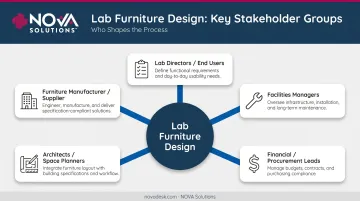
Every lab furniture project should include:
- Lab directors and end users — daily workflows, equipment requirements, and the practical frustrations of the current space are things only they can speak to
- Facilities managers — they know utility placement, compliance requirements, and physical space constraints
- Financial and procurement leads — responsible for aligning selections with budgets and identifying contract vehicles (like GSA or cooperative purchasing programs) that reduce cost and administrative burden
- Architects or space planners — managing the broader build or renovation, they need furniture specifications integrated into their drawings from the start
- The furniture manufacturer or supplier — a true design partner, not just a vendor, who asks the right questions before recommending anything
A furniture partner worth working with asks about current pain points, anticipated growth, ADA requirements, and technology needs before presenting any product options. That consultation work is what separates a genuine design partner from a catalog order.
NOVA Solutions, for example, provides CAD and REVIT files for architects and planners and works with clients to develop tailored configurations before orders are finalized. Catching layout problems on paper costs far less than correcting them after delivery.
The furniture supplier should be part of the conversation early. If they're only receiving a purchase order at the end, the collaborative process has already broken down.
Core Design Principles Every Lab Furniture Collaboration Should Address
Whether the project is an education lab, government facility, or corporate R&D space, certain design principles must be resolved before any furniture is selected. They're not preferences — they're the decisions that determine whether the finished space actually works.
Ergonomics and ADA Compliance
Adjustable-height workstations and ergonomic positioning aren't optional upgrades for high-end labs. They're baseline requirements.
The BLS reported 2.5 million private-industry nonfatal injuries and illnesses in 2023–2024, with nearly 946,290 DART cases driven by overexertion, repetitive motion, and bodily conditions — the exact hazards that poor workstation design creates. OSHA's computer workstation guidance recommends monitor tops at or just below eye level, relaxed shoulders, wrists in line with forearms, and feet flat on the floor or footrest. These principles apply directly to lab bench design.
ADA compliance adds specific dimensional requirements that must be addressed during design:
- Work surface height: 28–34 inches above finished floor (ADA 902.3)
- Knee clearance: 30 inches minimum wide, with precise depth requirements at varying heights (ADA 306)
- Accessible route width: 36 inches minimum (ADA 403.5.1)
- Operable parts: no tight grasping or wrist twisting required, maximum 5 lbs of force (ADA 309.4)
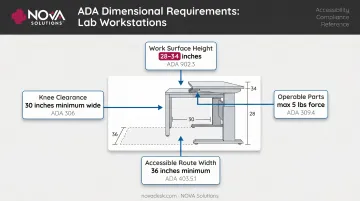
NOVA Solutions' ADA-compliant workstations are built to these specifications, with 32-inch height configurations and knee clearance dimensions precisely matched to ADA standards. ADA compliance doesn't require sacrificing technology integration — their ADA configurations maintain full iMod™ wire management, Trolley™ monitor lift, and Downview™ display functionality.
Material Selection and Chemical Resistance
Surface material must be chosen based on actual workflow data, not assumptions. The most common lab work surface materials each serve distinct conditions:
| Material | Best For |
|---|---|
| Epoxy resin | Heavy chemical exposure, acid/solvent resistance |
| Stainless steel | Sterile environments, heat resistance, easy sanitization |
| Phenolic resin | Moderate chemical use, durability in general lab settings |
| High-pressure laminate | General-purpose training and low-chemical environments |
NOVA Solutions uses high-pressure laminate with 2mm PVC edge banding for its training and technology workstations — appropriate for computer labs, training facilities, and administrative research environments where chemical resistance isn't the primary concern but durability under daily use is. For wet lab environments, the collaborative design process should include a direct conversation about chemical exposure levels before any surface is specified.
Safety as a Design Layer, Not an Add-On
Safety features must be planned into the furniture layout from the beginning. Retrofitting is expensive and often incomplete.
Key safety design considerations:
- Emergency equipment clearance — eyewash stations, fire exits, and emergency shutoffs must remain unobstructed by furniture placement
- Spill containment — surface edges and containment features prevent chemical spread
- Ventilation placement — fume hood positioning relative to bench layout affects airflow patterns
- Aisle width — meets both ADA route requirements and safety egress standards simultaneously
Furniture placement decisions directly determine whether safety equipment stays accessible — which is why storage planning belongs in the same early conversation, not as an afterthought.
Efficient Storage Planning
Under-planned storage is a common reason otherwise well-designed labs fail in practice. When researchers run out of organized storage, supplies end up on bench surfaces — reducing usable workspace and creating safety hazards.
Effective storage planning includes:
- Integrated drawer units and under-bench cabinets for general supplies
- Vertical shelving to maximize value from high-cost lab square footage
- Dedicated, compliant storage for hazardous materials separate from general supply areas
- CPU compartments and peripheral storage at technology workstations
NOVA Solutions integrates CPU shelves, keyboard and mouse drawers, and iMod™ wire management compartments into their training workstations as standard or optional features — addressing both physical supply storage and technology cable organization within the same unit.
Designing for Flexibility, Collaboration, and Future-Proofing
Modern labs need to support multiple research workflows, cross-disciplinary teams, and equipment that changes over time. Fixed, static furniture layouts weren't designed for that reality.
Modular Furniture as the Foundation of Flexible Labs
Modular furniture means individual components that can be independently reconfigured, added to, or replaced without disrupting the entire lab layout. This differs fundamentally from fixed casework, which requires construction-level intervention to change.
Technology refresh pressure is a useful benchmark here. Sacred Heart University notes that classroom technology typically undergoes a refresh cycle of approximately five years depending on device type — meaning the furniture around that technology needs to accommodate change on a similar cadence. Furniture that can't adapt to new monitor sizes, updated equipment, or shifting bench configurations forces full replacement rather than targeted upgrades.
NOVA Solutions' collaboration tables and multi-purpose tables are built around this principle. Their retrofit kits and accessories — including Trolley™ monitor lifts and integrated wire management components — allow existing furniture to be upgraded with new technology rather than replaced entirely.
Creating Space for Researcher Collaboration
Isolated workstations made sense when research happened in silos. Most labs today don't work that way.
EDUCAUSE's 2022 QuickPoll found that 100% of respondents had at least one type of learning space undergoing transformation — with the shift toward collaborative, flexible configurations driving most of that change.
Physically enabling collaboration requires intentional furniture choices:
- Open-concept bench arrangements that allow researchers to see and communicate across workstations
- Shared work surfaces for collaborative review, data analysis, or equipment sharing
- Designated breakout zones with writable surfaces, flexible seating, and presentation capability
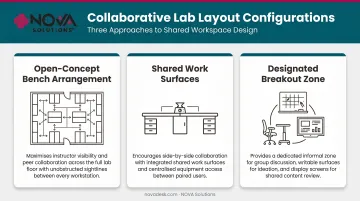
NOVA's collaboration tables — available in keystone, D-top, round, and boat-shaped configurations — support exactly this. The keystone design, for instance, angles each seat slightly toward a focal point, improving sightlines to instructors or display screens while maintaining group interaction.
Layout Planning for Workflow and Movement
Furniture layout directly affects how efficiently researchers move through their day. Key layout considerations:
- Position benches near the instruments they support to minimize unnecessary movement
- Resolve gas, water, and power outlet placement relative to bench positioning before finalizing the layout
- Maintain clear circulation routes that satisfy both daily workflow and safety egress requirements
- Plan aisle widths for ADA minimums (36 inches) plus additional clearance for equipment carts
Getting this right on paper before installation is far less expensive than correcting it afterward.
Integrating Technology Into Your Laboratory Furniture Design
Technology needs evolve faster than the furniture built around them. Addressing power, data, and equipment compatibility during the design phase is far less disruptive than retrofitting after installation. Addressing power, data, and equipment compatibility during the design phase is far less disruptive than retrofitting after installation. That planning starts with two fundamentals: cable management and workstation design.
Power, Data, and Cable Management
Poor cable management isn't just an aesthetic problem. OSHA's standard 1926.416(b)(2) explicitly requires that working spaces and walkways be kept clear of cords to prevent hazards — meaning tangled cables on lab floors are a compliance issue, not just a nuisance.
Cable management planning should address:
- Power outlet placement relative to each workstation
- Data port locations for instruments and computers
- Overhead service carriers or under-bench access channels for routing
- Integrated wire management that keeps surfaces clear and cables protected
NOVA Solutions' iMod™ wire management system is built into the furniture itself — housing cables within a dedicated compartment on the backside of each unit, with a multi-plug power strip per user, a removable modesty panel for IT access, and finishes in laminate or perforated metal.
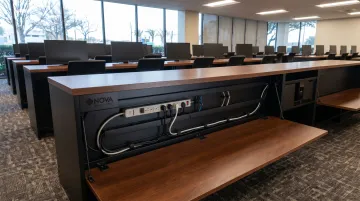
Specifying this during the design phase eliminates the surface clutter, tripping hazards, and cable damage that come with after-the-fact workarounds.
Workstations Built for Technology-Intensive Workflows
Standard benches don't support technology-intensive computer training or instrumentation work. Purpose-built technology workstations include:
- Surface mount arms, articulating arms, or motorized lift options for monitor positioning
- Trolley™ monitor lifts that raise and lower monitors via push-button control, with Intelligent Motion Technology™ to prevent mechanical damage
- Downview™ displays recessed below tempered glass for natural downward viewing — frees surface space and improves sightlines in training rooms
- Keyboard drawers with adjustable locking positions and built-in wrist rests
These aren't premium add-ons for high-budget projects. In computer training labs, corporate training facilities, and technology-equipped classrooms, skipping these features means instructors and users constantly work around the furniture instead of with it — and that's a problem that can't be fixed after installation.
ADA-Accessible Technology Workstations
ADA compliance and technology integration are not competing priorities. They should be addressed together during the design collaboration.
For wheelchair-accessible technology workstations, the design requirements include:
- 32-inch surface height to meet ADA work surface standards while preserving usable workspace
- 30-inch minimum knee clearance width, with precise depth specifications at 9 and 27 inches above floor
- Operable controls within reach range — ADA Section 308 specifies 15–48 inches for unobstructed forward reach
- Power and data connections positioned within reach range, no tight grasping required
NOVA's ADA-compliant configurations maintain full technology integration — iMod™ wire management, Trolley™ monitor lifts, Downview™ displays, and keyboard drawer systems — without sacrificing accessibility clearances. Getting these specs right requires coordinating dimensional tolerances, reach ranges, and technology mounting positions simultaneously — something that only works when the furniture manufacturer is involved before the layout is finalized.
How the Collaborative Design Process Works in Practice
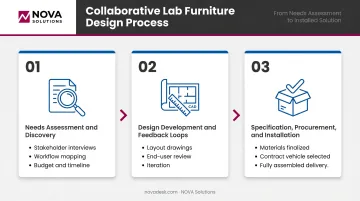
There's a structured, repeatable process behind successful lab furniture projects. Understanding it helps both clients and suppliers have more productive conversations from the first meeting.
Phase 1: Needs Assessment and Discovery
A thorough needs assessment documents:
- Current workflows and where they break down
- Equipment that must be accommodated (with dimensions and utility requirements)
- User demographics, including accessibility needs
- Budget parameters and timeline constraints
- Growth projections that may affect future configurations
The furniture partner should be actively driving or participating in this phase — not waiting to receive a purchase order after all decisions have been made. NOVA Solutions requires that all orders be accompanied by a layout drawing, which reflects how seriously they take the planning phase. The pre-order conversation about space, workflow, and requirements is what makes that drawing accurate.
Phase 2: Design Development and Feedback Loops
Design development translates discovery findings into furniture configurations, layouts, and specifications. Iteration is what separates a good layout from a costly mistake.
Reviewing drawings or renderings with end users before ordering prevents expensive post-installation corrections. NOVA provides CAD and REVIT files that architects and space planners can integrate directly into their layouts, and authorized representatives provide quote drawings for client review before orders are finalized.
Don't skip this step. A correction on paper costs nothing. A correction after delivery costs real money, time, and operational disruption.
Phase 3: Specification, Procurement, and Installation
Finalizing specifications means locking in materials, dimensions, finishes, and accessory configurations. For government and educational buyers, this is also where they select their procurement path.
NOVA Solutions holds GSA Contract GS-28F-005GA (through February 2027), offering a 61.71% discount off list price for federal buyers. Available contract vehicles include:
- PEPPM National Contract — 60% off list price, valid through 2028
- California CMAS Contract — for California state agency buyers
- State contracts — active in Alabama, Arkansas, Louisiana, and New York
These vehicles eliminate competitive bidding requirements and reduce administrative burden.
On the installation side, NOVA ships products fully assembled — meaning facilities receive furniture ready for immediate placement and connection rather than requiring on-site assembly. In active training facilities and government buildings where downtime has real operational costs, this matters.
Frequently Asked Questions
How do you design a laboratory layout?
Start with a needs assessment that maps current workflows, equipment requirements, and user demographics. Involve all stakeholders early, resolve utility placement and safety clearances before finalizing furniture positions, then select furniture that supports both current needs and anticipated future changes. Iterate with end users before ordering.
Why is purpose-built laboratory furniture important?
Standard office furniture isn't designed for lab conditions. Purpose-built lab furniture provides chemical resistance, ergonomic suitability for research tasks, safety compliance, and the durability to withstand high-use environments. Repurposed office furniture fails on at least one of these dimensions.
What are the three main types of laboratory benches?
- Peninsula benches mount to a wall and extend work surface along one or more sides
- Island benches sit freestanding in the center of the lab, accessible from all sides
- Mobile or modular benches can be repositioned to accommodate changing workflows or equipment configurations
What is laboratory furniture and fittings?
Laboratory furniture includes workbenches, storage cabinets, seating, mobile carts, and shelving. Fittings are the integrated utilities — sinks, gas outlets, electrical outlets, and data ports — that together create the functional built environment supporting safe, efficient lab work.
How does ADA compliance factor into laboratory furniture design?
ADA requirements for lab environments include accessible work surface heights (28–34 inches), knee clearance of at least 30 inches wide, storage and controls within reach range, and aisle widths of 36 inches minimum. Address these during the design collaboration phase — post-order modifications cost more and rarely achieve the same result.