This guide breaks down the 2010 ADA Standards in plain language: who must comply, the compliance timeline, what each of the 10 chapters covers, and the technical specifications most relevant to workspaces and training environments.
One important note up front: though published in 2010, these standards remain the current enforceable federal standard under the Americans with Disabilities Act.
TLDR: Key Takeaways
- Published September 15, 2010; mandatory for new construction and alterations starting March 15, 2012
- Covers state/local government facilities (Title II) and public accommodations/commercial facilities (Title III)
- Sets both scoping requirements (how many accessible elements) and technical requirements (exact dimensions)
- Not a building code; enforcement comes through federal complaints and private lawsuits, not building permits
- Religious organizations and private clubs are generally exempt from ADA requirements
- Federal buildings follow the Architectural Barriers Act, not the ADA
What Are the 2010 ADA Standards for Accessible Design?
The 2010 ADA Standards are minimum accessibility requirements published by the U.S. Department of Justice in the Federal Register on September 15, 2010. They were adopted under Titles II and III of the Americans with Disabilities Act of 1990 and are not guidelines or suggestions — they are enforceable federal law.
Structure: Two Parts Working Together
The standards combine two regulatory sources:
- DOJ regulations — Title II at 28 CFR 35.151 and Title III at 28 CFR Part 36, Subpart D
- 2004 ADA Accessibility Guidelines (ADAAG) — at 36 CFR Part 1191, Appendices B and D
Where the two conflict, the CFR regulations prevail.
Scoping vs. Technical Requirements
These two concepts do different jobs:
- Scoping tells you how many accessible elements are required. Example: a parking lot with 1–25 spaces must provide at least 1 accessible space.
- Technical tells you exactly how those elements must be built. Example: car spaces must be 96 inches wide, van spaces 132 inches wide, with 60-inch access aisles.
What These Standards Are Not
Those technical requirements above define what to build — but there's no plan review, permitting, or certification process to verify it. Organizations must self-certify and manage their own compliance. Enforcement comes through complaints to federal agencies or lawsuits from private individuals or the DOJ.
Section 103 also permits equivalent facilitation — alternative designs or technologies are permitted if they provide substantially equivalent or greater accessibility. The entity bears the burden of proving equivalency if challenged.
Who Must Comply: Title II vs. Title III
Title II covers all state and local government facilities — including:
- Public schools and universities
- Libraries and courthouses
- Parks and recreational facilities
- Transit stations and correctional facilities
There is no size exemption; all government entities must comply.
Private entities face a parallel set of obligations under Title III.
Title III — Places of Public Accommodation and Commercial Facilities
Title III applies to private businesses and nonprofits open to the public:
- Restaurants, hotels, and retail stores
- Hospitals and medical offices
- Movie theaters and gyms
- Private schools and daycare centers
Commercial facilities not open to the public — such as warehouses — must still comply with new construction and alteration requirements.
Note on transportation: The Department of Transportation issues its own ADA regulations for bus systems, rail systems, and airports. These are separate from DOJ standards and have their own vehicle and transit facility accessibility guidelines.
Who Is Exempt
Two categories hold general exemptions under 42 U.S.C. §12187:
- Religious organizations — churches, mosques, synagogues, and entities they control are exempt from Title III
- Private clubs — certain exclusive membership organizations may also qualify for exemption
Exempt organizations may still face state and local accessibility code requirements. Separately, federal government buildings are not covered by the ADA at all — they fall under the Architectural Barriers Act, which has its own standards from the U.S. Access Board.
Compliance Timeline: From 1991 to the 2010 Standards
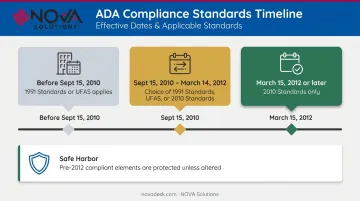
Which ADA standard applies to your facility depends on when physical construction or alteration began. This date determines your compliance obligations — and whether newer requirements can be avoided through safe harbor protections.
| Construction Start Date | Applicable Standard |
|---|---|
| Before September 15, 2010 | 1991 Standards or UFAS |
| September 15, 2010 – March 14, 2012 | 1991 Standards, UFAS, or 2010 Standards |
| March 15, 2012 or later | 2010 Standards only |
The Safe Harbor Provision
Facilities or elements already built in compliance with the 1991 Standards before March 15, 2012, are not required to retrofit solely because the 2010 Standards changed an incremental requirement. Safe harbor holds — unless an alteration to a primary function area triggers path-of-travel requirements. That exception is where the next rule comes in.
The Path-of-Travel Rule
When a primary function area is altered (a bank lobby, an office work area, a conference room), the building owner or organization must also make the path of travel to that area accessible. If those path-of-travel costs exceed 20% of the primary alteration cost, full compliance is considered disproportionate — but the entity must still prioritize accessible elements in this order:
- Accessible entrance
- Accessible route to the altered area
- Accessible restrooms (at least one per sex, or one single-user)
- Accessible telephones
- Accessible drinking fountains
What the 10 Chapters of the 2010 Standards Cover
The standards are organized into 10 chapters covering every element of the built environment. Chapter 2 determines where and how many accessible elements a facility must provide. Chapters 3–10 deliver the measurable technical requirements behind each of those decisions.
Chapters 1–2: Administration, Definitions, and Scoping
Chapter 1 establishes the document's purpose, equivalent facilitation rules, dimension conventions, and referenced industry standards (ANSI/BHMA, ASME, NFPA, ICC/IBC). Its definitions section governs interpretation throughout the document — terms like "alteration," "accessible," "primary function," and "technically infeasible" shape how every later requirement applies.
Chapter 2 is the master scoping chapter. It specifies where and how many accessible elements a facility must provide, including:
- Accessible routes
- Accessible entrances (minimum 60% of public entrances)
- Parking spaces and van-accessible spaces
- Drinking fountains, toilet rooms, and signage
- Assembly area wheelchair spaces (scaled by seat count)
- Transient lodging rooms and recreational elements
Exceptions for alterations, historic properties, and employee-only work areas are embedded throughout Chapter 2.
Chapters 3–5: Building Blocks, Routes, and Site Elements
Chapter 3 sets the physical building blocks of accessibility:
- Floor surfaces: stable, firm, slip-resistant
- Level changes greater than ½ inch: must be ramped
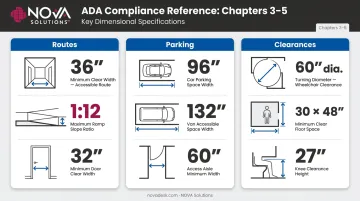
- Turning space: 60-inch diameter minimum (circular) or T-shaped equivalent
- Clear floor space: 30 × 48 inches minimum
- Knee clearance: 27 inches high × 30 inches wide × 11 inches deep minimum
- Reach ranges: 15–48 inches above finished floor
Chapter 4 sets the requirements for accessible routes:
- Running slope: maximum 1:20; cross slope: maximum 1:48
- Minimum clear width: 36 inches
- Ramp slope: maximum 1:12; maximum rise per run: 30 inches; handrails required when rise exceeds 6 inches
- Door clear width: 32 inches minimum
- Elevators: must comply with ASME A17.1
Chapter 5 addresses site and building elements:
- Car parking spaces: 96 inches wide minimum
- Van spaces: 132 inches wide minimum with 60-inch access aisles
- 1 van space required per every 6 accessible spaces
- Stair risers: 4–7 inches high; treads: 11 inches deep minimum
- Handrails: gripping surface 34–38 inches above nosings; 1¼–2 inch circular cross-section
Chapters 6–7: Plumbing and Communication Elements
Chapter 6 specifies fixtures in toilet and bathing facilities:
- Water closets centered 16–18 inches from side wall; seat height 17–19 inches
- Side grab bar: 42 inches minimum; rear grab bar: 36 inches minimum; both at 33–36 inches above the floor
- Lavatories: front rim no higher than 34 inches with knee and toe clearance beneath
- Transfer showers: 36 × 36 inches; roll-in showers: 30 × 60 inches minimum
Chapter 7 covers signage and alarms:
- Raised characters: 5/8–2 inches high, sans serif, uppercase, with Grade 2 Braille
- Tactile character baselines: 48–60 inches above the floor
- Assembly areas with audible communication must have assistive listening systems
- Fire alarms: both audible and visible components required
Chapters 8–10: Special Spaces, Built-In Elements, and Recreation
Chapter 8 covers assembly areas, transient lodging, medical care facilities, and residential dwelling units. Assembly areas require wheelchair spaces scaled to seat count — 1 space for 4–25 seats, increasing by formula for larger capacities — with dispersed placement that provides equivalent lines of sight.
Chapter 9 addresses built-in elements such as dining and work surfaces, including the surface height and knee clearance requirements that apply directly to computer training tables and conference furniture.
Chapter 10 specifies requirements for recreation facilities:
- Pools with more than 300 linear feet of wall: at least two accessible means of entry
- Play areas, golf facilities, exercise machines, and shooting ranges each carry specific technical requirements
Key Technical Requirements for Workspaces and Training Environments
Section 902 of Chapter 9 governs dining and work surfaces in covered facilities — a specification directly relevant to training rooms, computer labs, conference rooms, libraries, and government offices.
The 5% Scoping Rule
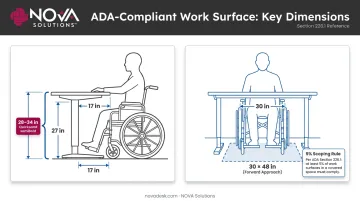
Under Section 226.1, at least 5% of work surfaces provided for non-employee use must comply with Section 902. Compliant surfaces must meet:
- Top height: 28–34 inches
- Clear floor space positioned for a forward approach
- Knee clearance: 27 inches high, 30 inches wide, 17 inches deep minimum beneath the surface
Work surfaces used only by employees aren't required to meet Section 902, but employers may still need to provide reasonable accommodations under Title I of the ADA.
Employee Work Area Circulation
Section 206.2.8 requires common-use circulation paths within employee work areas to comply with Chapter 4's 36-inch clear width requirement. One exception applies: areas under 1,000 square feet defined by permanent partitions, counters, casework, or furnishings are excluded.
Furniture Selection in ADA-Compliant Environments
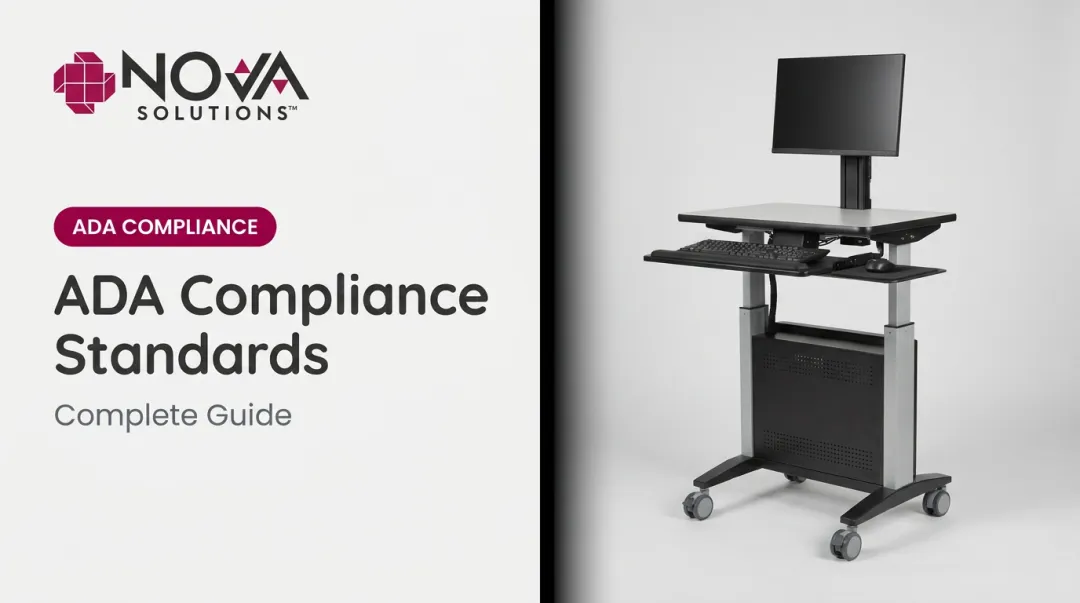
When outfitting training rooms, computer labs, or government facilities, furniture selection directly affects compliance. NOVA Solutions manufactures ADA-compliant technology furniture — including computer training desks and sit/stand lecterns — built to Section 902 height and clearance specifications.
Key product specifications include:
- Sit/stand lecterns: Adjust electrically from 30 to 42 inches, covering the full ADA-required range for seated users
- Computer training desks: Available in 32-inch ADA height configurations with 30-inch-wide knee clearance and 17-inch minimum depth toe clearance
- iMod™ wire management: Routes cables behind the modesty panel rather than into the knee clearance zone, keeping ADA dimensions intact
NOVA holds a GSA contract (GS-28F-005GA) covering these product lines through February 2027, simplifying procurement for government agencies and institutions. Products ship fully assembled, which reduces deployment time for facilities working against compliance deadlines.
Frequently Asked Questions
What are the 2010 ADA Standards for Accessible Design?
The 2010 ADA Standards are minimum accessibility requirements published by the U.S. Department of Justice on September 15, 2010. They cover state/local government facilities (Title II) and places of public accommodation and commercial facilities (Title III), specifying both how many accessible elements are required and their exact dimensional specifications.
What is the latest version of the ADA Standards, and when did it take effect?
The 2010 ADA Standards remain the current version. They became mandatory for all new construction and alterations with a construction start date on or after March 15, 2012. Before that date, facilities could use the 1991 Standards or UFAS as alternatives.
What are the ADA Accessibility Guidelines (ADAAG)?
The ADAAG are the technical companion to the DOJ's ADA regulations, developed by the U.S. Access Board. Together, the ADA regulations and ADAAG form the 2010 ADA Standards — the enforceable requirements covered entities must follow.
What is the difference between ANSI A117.1 and the 2010 ADA Standards?
ANSI A117.1 is a voluntary consensus standard often adopted into state and local building codes, while the 2010 ADA Standards are federal civil rights requirements. Meeting ANSI A117.1 under a local building code does not automatically satisfy federal ADA obligations.
Which chapter covers plumbing elements?
Chapter 6 (Plumbing Elements and Facilities) covers all plumbing-related accessibility requirements, including drinking fountains, water closets, toilet compartments, urinals, lavatories, bathtubs, shower compartments, grab bars, and bathing seats.
What disabilities are not covered by the ADA?
The ADA covers physical, sensory, cognitive, and mental impairments that substantially limit a major life activity. 42 U.S.C. §12211 lists specific exclusions — including current illegal drug use and certain behavioral conditions — though the ADA Amendments Act of 2008 broadened overall coverage considerably.
What is the difference between "ADA" and "accessible"?
"ADA" refers to the Americans with Disabilities Act — the federal civil rights law. "Accessible," as defined in Section 106.5 of the 2010 Standards, means a site, building, facility, or portion thereof that complies with those standards. Informally the term is used loosely, but it carries a precise legal meaning in compliance contexts.