ADA podium compliance involves specific dimensional standards, clearance geometry, control placement requirements, and approach space rules. Getting any one of these wrong can expose organizations to complaints, enforcement actions, and costly retrofits — and more importantly, it excludes people from full participation.
This guide covers exactly what the ADA requires for podiums, how those requirements translate into practical design decisions, and the most common mistakes facilities make when they assume a lower counter height is enough.
Key Takeaways
- ADA-compliant podiums need a work surface between 28 and 34 inches high, per Section 902.3
- Knee clearance must be at least 27 inches high, 30 inches wide, with proper depth per Section 306
- A clear floor space of 30 × 48 inches is required for forward wheelchair approach (Section 305)
- Operable controls must fall within 15–48 inches from the floor (institutions often target a preferred 24–40 inch range)
- Height-adjustable podiums accommodate both seated and standing users, making them the most practical compliance solution
Why ADA Compliance for Podiums Matters More Than You Think
Who Must Comply
The legal scope here is wide. Three distinct frameworks cover most institutional settings:
- ADA Title II applies to state and local government facilities — courtrooms, government meeting rooms, city council chambers, and public university classrooms
- ADA Title III covers places of public accommodation and commercial facilities, including private schools, conference centers, lecture halls, and corporate training spaces open to the public
- Section 504 of the Rehabilitation Act extends accessibility requirements to any educational institution receiving federal financial assistance
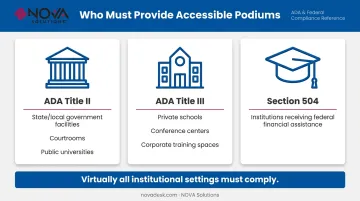
Together, these frameworks mean that virtually every school, government building, conference venue, and many corporate facilities must provide accessible podiums in spaces where podiums are used.
The Real-World Scale
According to the CDC, more than 1 in 4 U.S. adults have some type of disability, with 12.2% reporting a mobility disability. In educational settings, NCES data shows that 21% of undergraduates and 11% of postbaccalaureate students reported a disability in 2019–20. For facility managers and procurement teams, those numbers translate directly into daily operational reality.
When accessibility fails at the podium level, the consequences extend well beyond the speaker's experience.
What Non-Compliance Actually Costs
Beyond legal exposure, inaccessible podiums carry real operational and reputational costs:
- ADA complaints filed with the DOJ or OCR, triggering formal investigations
- Costly after-the-fact retrofits that are more expensive than compliant design from the start
- Reputational damage when accessibility failures become visible to the public
- Disabled faculty, staff, and officials being unable to present from the same equipment as their peers — an equity failure with real institutional consequences
Core ADA Requirements for Podiums
The ADA doesn't have a dedicated "podiums" section. Compliance is built from several sections of the 2010 ADA Standards that collectively govern accessible work surfaces:
| ADA Section | What It Governs |
|---|---|
| Section 902 | Work surface height (28–34 inches) |
| Section 305 | Clear floor space (30 × 48 inches) |
| Section 306 | Knee and toe clearance dimensions |
| Section 308 | Reach ranges for operable parts (15–48 inches) |
| Section 309 | Operable parts — one-hand use, max 5 lb force |
Dimensional and Clearance Requirements
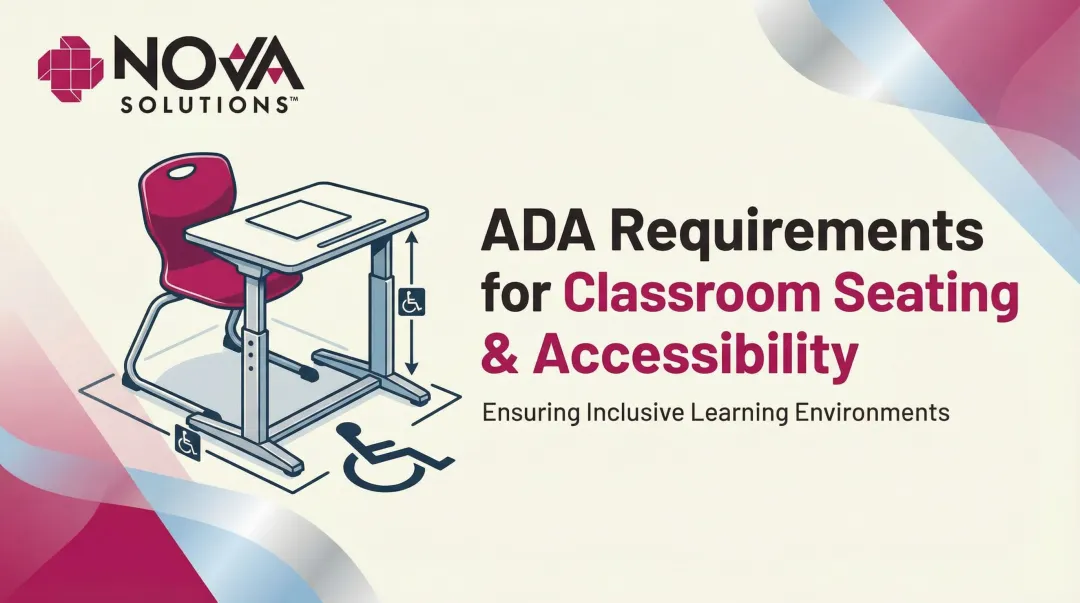
Work surface height is the most cited requirement: the top of an accessible podium must be between 28 and 34 inches above the finished floor (Section 902.3). A fixed-height podium at or below 34 inches satisfies the baseline, but an adjustable-height unit that spans this range serves both seated and standing users.
Knee and toe clearance is where many podiums fail. Section 306 specifies:
- Knee clearance width: 30 inches minimum
- Knee clearance height: space between 9 and 27 inches above the floor
- Knee clearance depth: 11 inches minimum at 9 inches high, 8 inches minimum at 27 inches high
- Toe clearance: space from floor to 9 inches high, extending 17 inches minimum under the element, 30 inches wide minimum
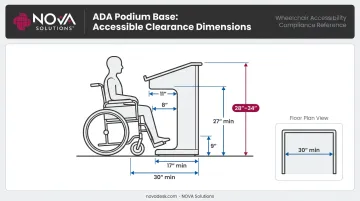
A common misconception is that "17 inches deep" describes knee clearance. It doesn't — 17 inches is the minimum toe clearance depth. Knee clearance uses the tiered depth profile above.
Reach Range and Control Placement
Every operable part on a podium must be reachable from a wheelchair. That includes:
- USB ports and HDMI inputs
- Microphone controls and lighting switches
- Display and AV controls
Per Section 308.2, the reach range requirements are:
- Unobstructed forward reach: 15 to 48 inches above the floor
- Obstructed high forward reach: 44 inches maximum when reach depth exceeds 20 inches
Temple University's Learning Spaces Accessibility Guidelines translate this into a practical preferred range of 24 to 40 inches for podium controls, ports, and peripherals. That institutional benchmark, while not a federal mandate, reflects where controls are actually reachable and usable from a seated position.
Controls positioned at the top or rear of a tall lectern cabinet frequently end up above 48 inches, placing them outside the compliant range entirely.
Approach and Maneuvering Space
Two clearance requirements govern the space around the podium:
- Section 305 requires a minimum 30 × 48-inch unobstructed floor space at the front of the podium for a forward wheelchair approach
- Temple University's guidelines recommend a minimum 60 inches between the back of the podium and any wall or fixed structure to allow adequate wheelchair maneuvering
Both matter. A podium with correct dimensions but no approach space still fails.
Key Features of an ADA-Compliant Podium
Height-Adjustable Mechanism
A sit/stand podium is the most practical compliance solution because it eliminates the need for separate accessible equipment. One unit serves wheelchair users, shorter presenters, and standing speakers without any last-minute setup changes.
NOVA Solutions' sit/stand lecterns use an electrically actuated mechanism with a touch-button control. Key specs across the lineup:
- Height range: 30 to 42 inches (Prestige model: 32 to 44 inches)
- Vertical travel: 12 inches
- Lift capacity: up to 550 lbs
- Ships fully assembled — no on-site installation required
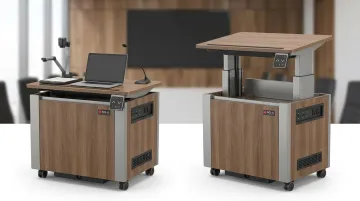
One note for facilities planning: while NOVA's sit/stand range begins at 30 inches (which falls within the ADA-required 28–34 inch accessible range), organizations requiring a surface at the 28-inch lower threshold should confirm specific configurations with NOVA's team.
Knee and Toe Clearance by Design
The podium's base structure must provide open knee space — no fixed cabinets, drawers, or panels in the clearance zone. Many standard lecterns fail here because their closed bases block the required clearance entirely.
NOVA's ADA-compliant lecterns are confirmed to meet the Section 306 knee and toe clearance specifications, with a 30-inch minimum width across the clearance zone and proper depth profiles.
Integrated Technology Within Reach
AV controls, HDMI ports, USB connections, and display interfaces must all fall within the accessible reach range.
NOVA's iMod™ wire management system routes cables through a rear compartment, keeping wiring off the floor and out of the clearance zone — without pushing controls to inaccessible heights. The removable modesty panel, available in laminate or perforated metal, gives IT staff quick access while keeping the presenter-facing surface clean.
Structural Stability
When a user leans on the surface or applies force to the controls, the podium needs to hold steady. NOVA's sit/stand units are built with a 550-lb lift capacity and high-pressure laminate work surfaces with 2mm PVC edge banding — construction that handles the load of full AV setups while remaining stable under use.
Best Practices for ADA-Compliant Podium Setup and Use
Placement and Route Access
The full path from the accessible entrance to the podium must comply with accessible route requirements (Section 402). For stages and raised platforms, ADA Section 206.2.6 requires an accessible route to performance areas, satisfied by a ramp, elevator, or platform lift per Section 206.7.1 — not just a ramp.
If the route exists but the approach is blocked, the podium is effectively inaccessible.
Once at the podium, the 30 × 48-inch clear floor space must be completely unobstructed and must not overlap a travel path or adjacent furniture.
Train Facility Staff
Even well-designed accessible podiums fail when staff aren't prepared. Common operational failures include:
- Stacking chairs or equipment in the podium approach zone before events
- Not knowing how to operate the height adjustment mechanism
- Failing to clear loose cables from the wheelchair approach path
Designate someone responsible for confirming accessible setup before each event.
Plan for Mixed-Use Sessions
Lecture halls, government chambers, and corporate training rooms regularly host both standing and seated presenters in the same session. Height-adjustable units eliminate the need for last-minute equipment swaps. Designate at least one fully accessible podium station and keep it configured for immediate use, ready without retrieval from storage.
Document and Review Periodically
Purchasing an accessible podium is the starting point, not the finish line. Keep compliance current by taking these steps:
- Maintain an inventory of accessible podium locations and their dimensions
- Re-verify dimensions after any room renovation or reconfiguration
- Reassess when new AV technology is added, since new equipment can shift control locations outside the compliant reach range
Common ADA Compliance Mistakes to Avoid
Most ADA compliance failures at the podium aren't deliberate — they're gaps that emerge during retrofits, AV upgrades, or day-to-day room setup. These three mistakes show up most often:
- Stopping at surface height, ignoring knee clearance. Dropping a podium surface to 34 inches doesn't make it compliant if cabinets or structural elements block the required knee and toe clearance zone. Many retrofits address height alone and miss this entirely.
- Placing AV controls out of reach range. Standard tall lecterns frequently push controls above 48 inches or to the back panel — both outside accessible reach limits. This is especially common when AV systems are added to existing furniture after purchase.
- Letting equipment crowd the approach space. Even a dimensionally correct podium fails if chairs, cables, or equipment occupy the required 30 × 48-inch floor space or block the 60-inch approach corridor. This is an ongoing operational issue, not just a design one. Staff should keep that zone clear before and during every event.
Conclusion
ADA podium compliance is a system problem, not a single measurement. The surface height, knee and toe clearance geometry, control placement, approach space, and route to the podium all have to work together. And the requirements apply to new construction and alterations alike.
The most effective strategy is building compliance in from the start rather than retrofitting it later. Height-adjustable podiums designed with ADA compliance as a core feature, not an afterthought, serve every user without requiring separate setups or accommodations.
NOVA Solutions' sit/stand lecterns and podiums are manufactured to these standards, ship fully assembled, and are available through GSA Contract GS-28F-005GA for government and institutional procurement.
Treat accessible podium design as an ongoing operational standard. Review it when rooms change, when AV systems are updated, and when new users need to present.
Frequently Asked Questions
What are the ADA requirements for podiums?
ADA-compliant podiums must have a work surface between 28 and 34 inches high (Section 902.3), proper knee and toe clearance per Section 306, a clear floor space of 30 × 48 inches for wheelchair approach (Section 305), and all operable controls positioned within 15 to 48 inches from the floor (Section 308).
Does ADA require podiums to be height-adjustable?
The ADA does not explicitly mandate height-adjustable podiums. A fixed-height podium at 28–34 inches satisfies the dimensional requirement. That said, height-adjustable units are strongly recommended because they serve both seated and standing users without requiring separate accessible equipment or last-minute configuration changes.
What is the knee clearance requirement under an ADA podium?
Section 306 requires knee clearance of at least 30 inches wide, 11 inches deep at 9 inches high, and 8 inches deep at 27 inches high. Toe clearance must extend at least 17 inches under the element and reach 9 inches high.
Are standing-height podiums ADA compliant?
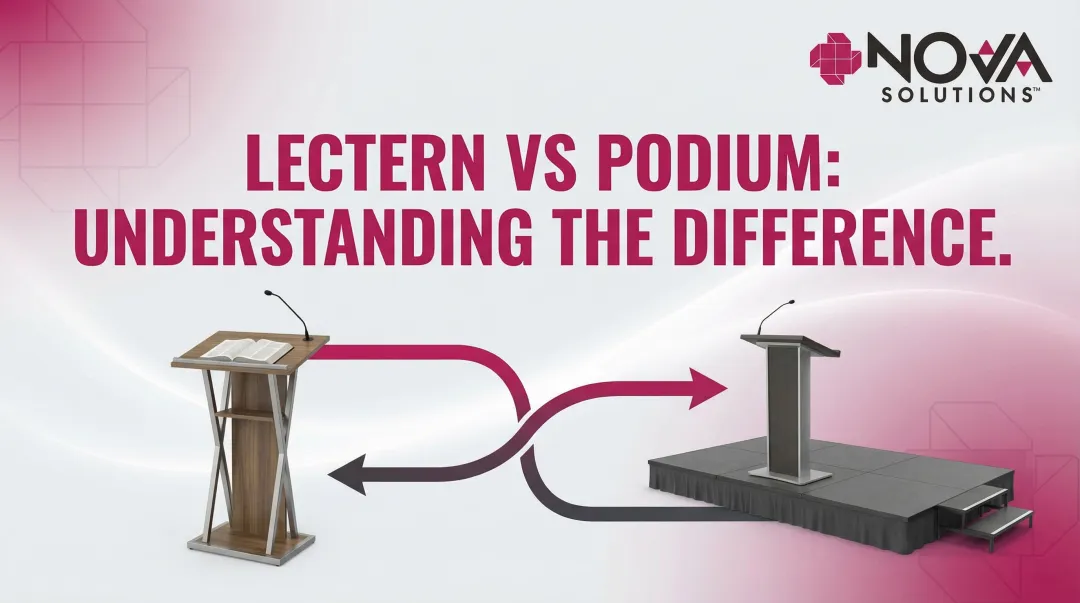
A standard tall lectern is not independently ADA-compliant for wheelchair users. It can satisfy requirements if a collapsible shelf or adjacent accessible surface at no more than 34 inches is provided alongside it, along with the required clear floor space and accessible controls.
Do ADA podium requirements apply to private businesses?
Yes. ADA Title III applies to places of public accommodation — including conference centers, private schools, and many corporate training facilities. Title II covers government facilities, and both mandate the same accessible dimensional standards for podiums.
What is the required approach space in front of an accessible podium?
ADA Section 305 requires a clear floor space of at least 30 × 48 inches for a forward wheelchair approach. Temple University's institutional guidelines recommend a minimum of 60 inches between the back of the podium and any wall or fixed structure to allow adequate wheelchair maneuvering room.